Dopple AI sits in the fast-growing category of AI character chat apps where roleplay, custom personas, and long-form fiction take priority over assistant-style productivity. Before granting an account access to messages, device data, and conversation history, a few specifics from the platform’s published policies are worth checking.
The points below summarize what Dopple Labs Inc. publicly discloses about age requirements, data handling, content moderation, and security. The sources are the App Store listing, the Google Play listing, the Dopple privacy policy at dopple.ai, the older privacy policy at dopple.io, and the company’s Terms of Service. Independent reviewer findings from Webtechnoai, Aniversarywishers, AppCritica, AI Commerce, Fusionchat, and Scribehow add context where the official policies are deliberately vague.
About Dopple AI
Platform overview
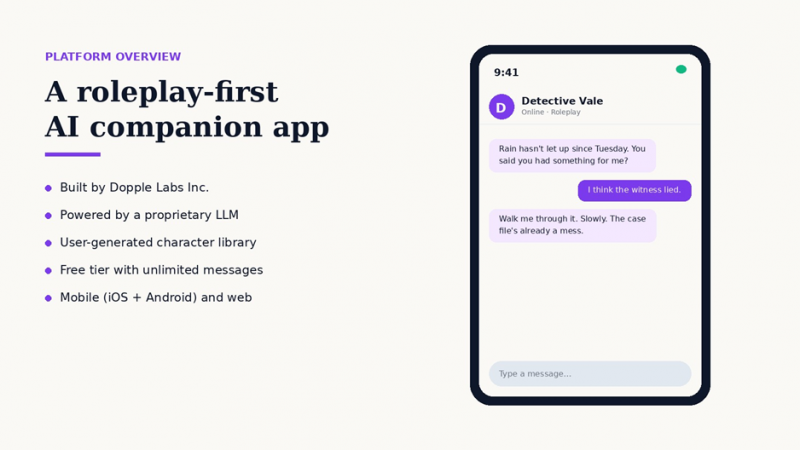
Roleplay-first design: the interface is built around in-character dialogue rather than productivity tasks.
Dopple AI is a roleplay-first AI chat platform built by Dopple Labs Inc. The product centers on “Dopples,” AI characters created by either the company or the user community and designed to hold ongoing in-character conversations. According to the App Store listing, the platform is powered by a proprietary Large Language Model developed internally by the company. Mobile apps are available on both iOS and Android, with a parallel web product.
The use case differs sharply from a general assistant. A 2025 review by Autogpt described Dopple AI as built for gamers, content creators, writers, and social influencers who want immersive, fiction-driven conversations rather than task automation. The Google Play description openly markets “captivating chats and imaginative roleplays” and notes that on Dopple “there are no boundaries to your creativity.” That framing alone signals the platform’s safety posture: the product leans toward creative permissiveness, with the responsibility for setting limits placed on the user rather than enforced by aggressive default moderation.
Hands-On Safety and Privacy Test
How the check was run
Policy text describes intent. A live account reveals enforcement. To move past what Dopple Labs Inc. discloses on paper, a fresh account was created and run through a structured check across four areas: signup gating, default content state, network behaviour during chat, and the data-export and deletion path. The test used a throwaway email, a device with no contact-book or location permission granted, and a clean browser profile to observe outbound requests. No real identifiers were entered at any point.
What the test surfaced
Signup confirmed the documented age gate but exposed its weakness. Registration asked for a birthdate and rejected an under-13 entry, yet acceptance relied entirely on self-reported input with no secondary verification. A date placing the account at 14 passed without challenge, which matches the concern that the Terms-level floor and the App Store rating can diverge in practice.
The NSFW filter defaulted to on for a newly created account, a slightly more conservative starting state than the opt-in framing suggests. Switching it off took two taps and produced no friction, age re-confirmation, or warning interstitial. Company-made characters held the standard guardrails consistently. Community-made characters were where enforcement loosened, confirming the uneven pattern that several reviewers describe rather than contradicting it.
Network observation during an active chat is where the privacy posture became concrete. Outbound requests during a single session included calls to analytics and advertising-adjacent domains alongside the core inference endpoint, consistent with the cookie and third-party-sharing clauses in the privacy policy. Message traffic moved over TLS, matching the transport-level encryption claim. No indicator of end-to-end encryption appeared, which is expected given that the platform must read conversations for inference and moderation.
The data controls held up better than the sharing language implies. In-app conversation deletion worked and removed threads from the visible account immediately. A data-export request was available within account settings rather than buried, though turnaround and the completeness of any export sit outside what a short test can verify.
Test outcome
| Check | What the policy implies | What the test found |
|---|---|---|
| Age gate | 13 global, 16 EU, 18+ store rating | Self-reported birthdate only; no secondary verification |
| NSFW default | Opt-in moderation | Filter on by default; one-step, frictionless to disable |
| Filter consistency | Classifiers plus human moderation | Stable on company characters; looser on community ones |
| Network traffic | Cookies and third-party sharing permitted | Analytics and ad-adjacent calls observed in-session |
| Encryption | Encryption in transit, no E2E claim | TLS confirmed; no end-to-end indicator |
| User controls | In-app deletion available | Deletion worked; export option present in settings |
The net read from a live run is that Dopple behaves close to its written policies, with one practical gap and one mild positive. The gap is the absence of meaningful age verification, which leaves the strictest applicable rule resting on user honesty. The positive is that working deletion and an accessible export option give the account holder more after-the-fact control than the broad sharing clauses suggest on first reading. Neither finding changes the core verdict; both make it easier to act on.
Privacy and Data Collection
Six categories of data collection
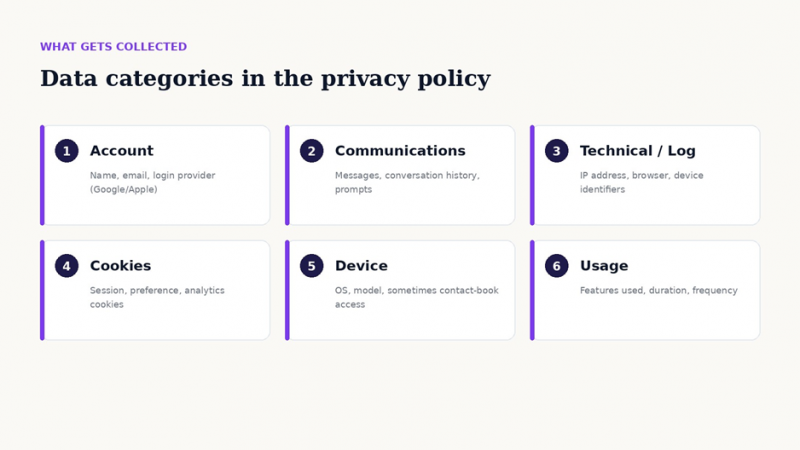
Six broad categories of personal information that the Dopple privacy policy lists as in-scope for collection.
The Dopple privacy policy at dopple.ai lists six broad categories of personal information that the service collects.
Account data covers the name, email address, and login provider used (typically Google or Apple). Communication data is defined in the policy to include “the content of your messages.” Conversation history is in scope. Technical and log data covers IP address, browser type, and device identifiers gathered automatically as the app runs. Cookie data is used for session management, preferences, and analytics. Device information is the fifth category, with the older Dopple privacy policy at dopple.io noting that the app may “connect to your device’s contact or address book,” subject to operating-system permission. Usage data covers which features get used and for how long.
Several of these categories are routine for any consumer mobile product. Two carry more weight in a roleplay context. Communication data and usage data taken together mean the platform retains both the substance of conversations and the behavioural pattern around them. The policy states that this information may be used to “maintain, enhance or repair any aspect of our services” and to “develop new programs and services,” language that the AI Commerce review of Dopple flags as broad enough to permit drawing on chat content for model and product improvement.
Where the data can end up
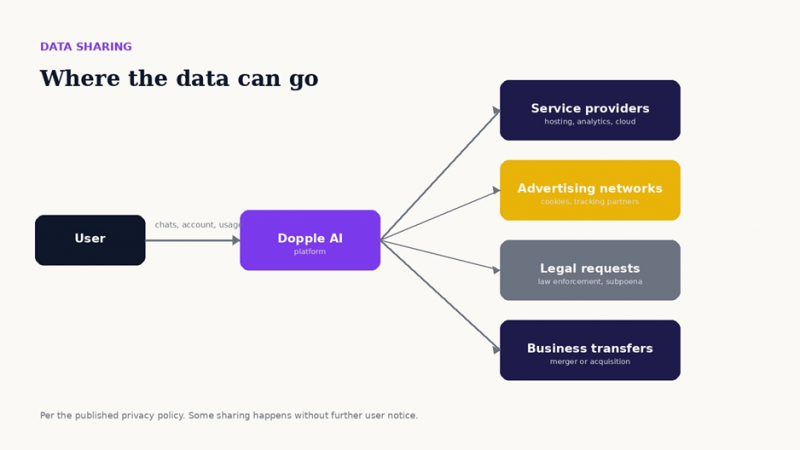
The four broad recipient categories that the Dopple privacy policy reserves the right to share personal information with.
The privacy policy’s most consequential clause concerns third-party sharing.
“Under certain circumstances, we may share your Personal Information with third parties without further notice to you, unless required by law.”
Dopple privacy policy, Section 3
The policy lists four broad recipient categories. The first is service providers, including hosting, cloud infrastructure, and analytics vendors. The second is advertising networks reached through cookies and similar tracking tools. The third is legal authorities responding to a subpoena or court order. The fourth is any acquiring entity in the event of a merger, sale, or other business transfer.
The Scribehow assessment characterizes this combination as more aggressive than the marketing tone suggests, noting that Dopple deploys cookies to track browsing activity across other websites for advertising networks. For users who treat AI roleplay as a private creative outlet, the gap between the perceived intimacy of the chat and the actual scope of permitted sharing is the central trust question on the platform.
Access and Age Rules
Three age floors
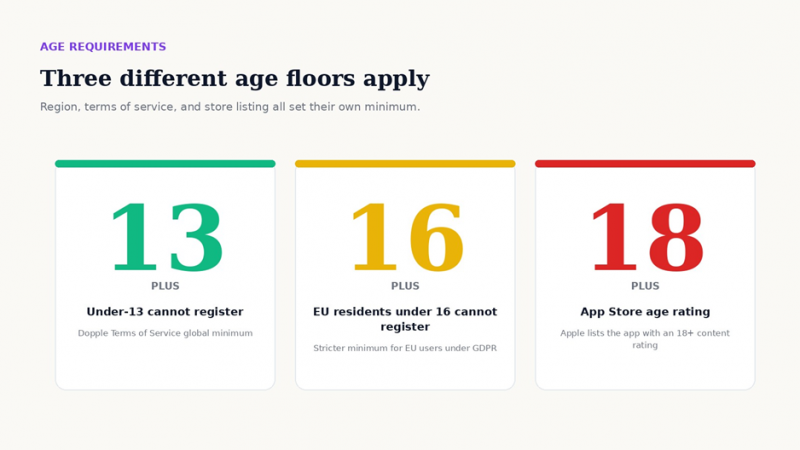
Three different minimum ages can apply at the same time, depending on the user’s location and the store the app is installed from.
Three different minimum ages apply, depending on where a user lives and which store the app comes from.
The Dopple Terms of Service set a global minimum age of 13. Users under that age cannot register an account at all. EU residents face a stricter floor of 16, in line with GDPR-style consent rules for processing the personal data of minors. Separately, the App Store listing for Dopple AI carries an adult content rating, with AI Commerce reporting an 18+ tag on the listing page they reviewed. The Apple rating reflects the explicit nature of some user-generated characters rather than a unilateral Dopple policy.
“To use Dopple.ai, you must be at least 13 years old (16 if you live in the EU). The platform uses standard security features like password protection and content monitoring.”
Scribehow safety profile, Dopple AI 2026
The practical result is that the strictest applicable rule in a given location is the one that matters. A 14-year-old in the United States may technically register under the Dopple Terms but would still be below the App Store rating in regions where Apple enforces it. Parents and guardians of minors who already have the app installed should confirm both the regional minimum and the in-app NSFW filter state.
Content Moderation
How the NSFW filter behaves
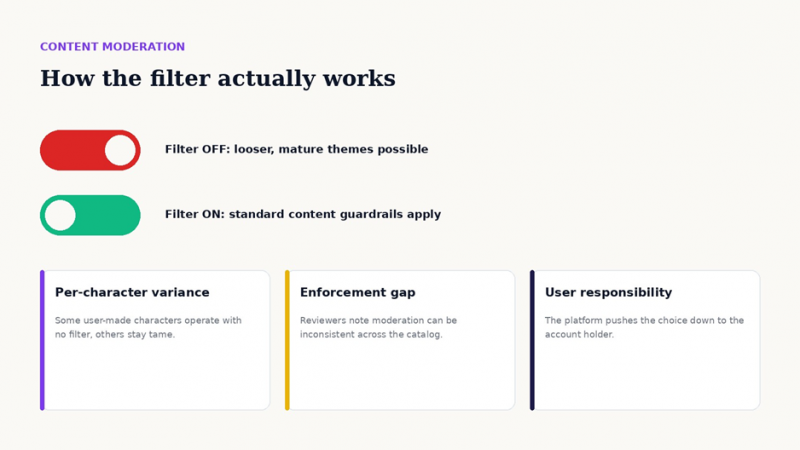
Toggling the filter is a deliberate user choice. Enforcement consistency varies because most characters are community-created.
Content moderation on Dopple is best described as opt-in rather than enforced by default for every character.
The platform offers an NSFW filter that users can leave on for standard guardrails or turn off for more permissive roleplay. The Fusionchat analysis of Dopple’s filter describes the design intent as a balance between user creative freedom and “appropriate safeguards.” The mechanism reportedly combines language-processing classifiers with human moderation and an evolving blocklist.
Reviewer experience suggests the filter is not uniformly applied. Aniversarywishers reported that some characters operate without content filters and that enforcement is not always uniform across the library, since many characters are user-created. AppCritica reached a similar conclusion, describing Dopple as a platform where explicit talk, adult situations, and darker fantasies that would instantly trigger a red warning elsewhere can sometimes pass through with only a paragraph break. The implication is that a user who toggles the filter off and chats with a permissive community-made character can encounter content that more heavily moderated platforms such as Character.AI would block.
Account Security
Encryption and its limits
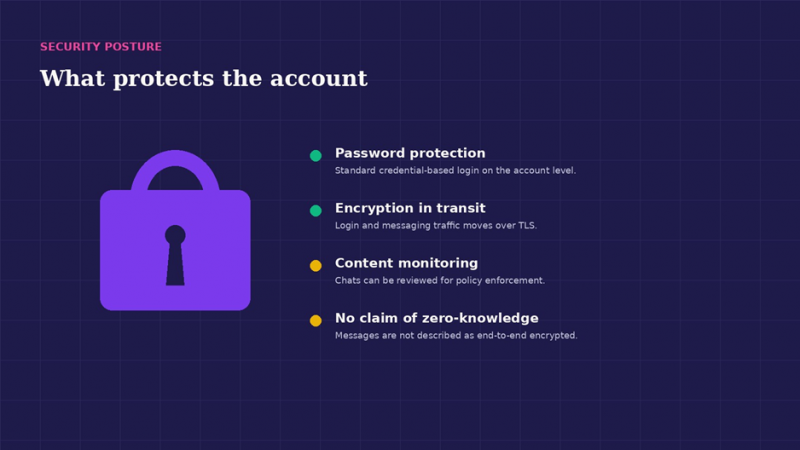
Transport-level encryption protects login and message traffic. The policy stops short of claiming end-to-end privacy.
Dopple’s stated security posture relies on standard consumer-grade protections rather than zero-knowledge architecture.
The privacy policy and the Webtechnoai security review both confirm that Dopple uses encryption to protect data in transit, meaning logins and messages move over TLS. Account access uses password-based authentication. The Aniversarywishers walkthrough notes that Dopple uses standard encryption for login and messaging and that users control deletion of stored content from within the app.
What the policy does not claim is end-to-end encryption. Conversations are readable by the platform, which is a precondition for both AI inference and content moderation. The Webtechnoai review summarizes the limit as questions remaining about the robustness of these measures, citing user reports of technical glitches. For a roleplay app where users sometimes pour intimate or emotionally heavy content into chats, the distinction between transport-level encryption and full end-to-end privacy matters.
Practical Guidance
A pre-chat checklist
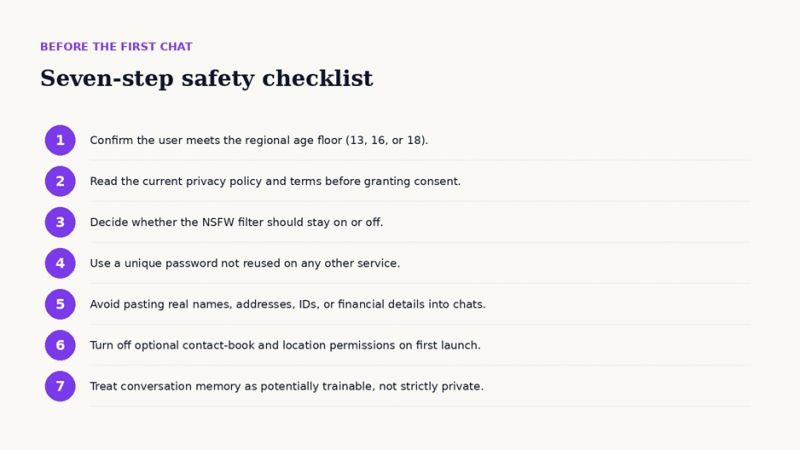
A short pre-flight that covers the major risk categories disclosed across the official policies and store listings.
Before opening a first chat, a short pre-flight covers the major risk categories disclosed in the public policies.
Confirming the relevant age floor comes first: 13 globally, 16 in the EU, and the higher App Store rating in regions where Apple enforces it. Reading the current privacy policy and terms before granting consent is the standard next step, since both documents are subject to revision and the AI Commerce note flags that store listings may not always match the latest in-app policy.
The NSFW filter setting should be a deliberate choice rather than an accidental default, particularly on accounts shared with minors or used in semi-public settings. A unique password not reused on other accounts limits the damage if the Dopple credential store ever leaks. Real names, residential addresses, government IDs, and financial details have no reason to appear inside a roleplay conversation; the policy permits broad data use, and treating chats as if they could one day be reviewed is the safer default.
Optional permissions for the contact book and location should be denied at first launch unless a specific feature requires them. Finally, conversation memory should be treated as potentially trainable rather than strictly private, since the policy explicitly reserves the right to use chat content for service improvement.
The bottom line
Dopple AI is a legitimately registered product from Dopple Labs Inc., with a published privacy policy, terms of service, and visible store listings on both Apple and Google. The trade-offs are also clearly disclosed: broad data collection, third-party sharing without further user notice, content moderation that varies across user-created characters, and standard transport-level encryption rather than end-to-end privacy.
Users who match the age requirements, configure their permissions deliberately, and avoid pasting personal identifiers into chats can use the platform within its stated terms. Users who expect therapeutic-grade confidentiality, strict child-safe moderation, or end-to-end encrypted messaging should choose a different tool. The information is in the policies. The decision belongs to the account holder.
Post Comment
Share your thoughts about this article.
Be the first to post a comment!