DeepSeek made a dramatic entrance into the global AI conversation in early 2025. With its powerful open-source R1 model released under the MIT license and remarkably low inference costs, it disrupted assumptions about what Chinese AI labs could achieve. Its coding and reasoning capabilities drew genuine praise from developers worldwide, and for a time it dominated app store charts and GitHub stars.
Yet for many teams and individuals, DeepSeek remains an imperfect fit. Data privacy concerns arise from its China-based infrastructure and ambiguous data handling policies. Geopolitical uncertainty clouds its long-term availability in Western markets. Its multimodal capabilities lag significantly behind the competition, and its safety guardrails have attracted scrutiny from independent AI researchers.
This guide explores the four strongest alternatives to DeepSeek in 2026: ChatGPT by OpenAI, Claude by Anthropic, Gemini by Google, and Mistral by the French startup Mistral AI. Each is assessed across seven dimensions with real benchmark data, pricing breakdowns, and honest verdicts on who should use each tool.
How DeepSeek Compares at a Glance DeepSeek R1 scored well on MMLU (89.1%) and coding benchmarks, but trails on multimodal tasks, safety scores, and enterprise trust. The four alternatives below each outperform it in at least one critical dimension. |
Pricing and Value Comparison
Cost is one of the most debated dimensions when comparing DeepSeek alternatives. DeepSeek's near-zero API pricing disrupted the market in 2025, but the total cost of ownership picture is more nuanced when you factor in output quality, iteration count, and data compliance overhead.
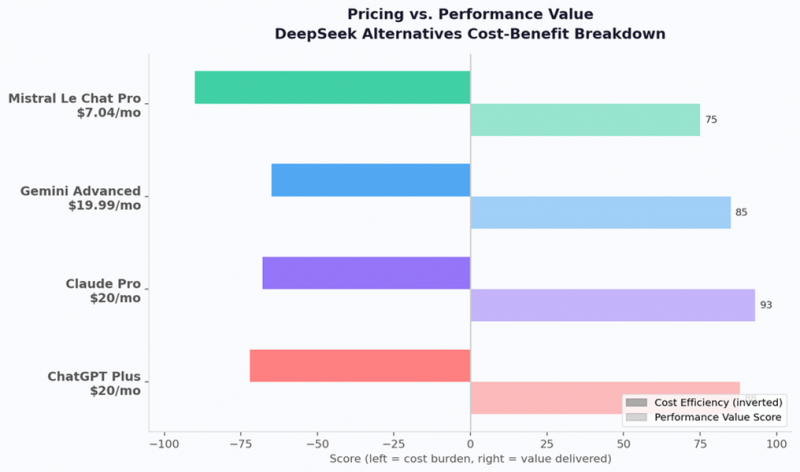
Figure 2: Pricing vs. Performance Value. Left bars show cost burden (higher = further left). Right bars show performance value delivered per dollar. Mistral wins on raw cost; Claude wins on value delivered.
Subscription Tier Breakdown (June 2026)
| Plan | ChatGPT Plus | Claude Pro | Gemini Advanced | Mistral Le Chat Pro |
|---|---|---|---|---|
| Monthly Cost | $20/mo | $20/mo | $19.99/mo | $7.04/mo |
| Free Tier | Yes (ads, US) | Yes (limited) | Yes (generous) | Yes |
| Context Window | 128K tokens | 200K tokens | 1M tokens | 128K tokens |
| Msgs / Period | ~150 / 3hr | ~225 / 5hr | Generous | Unlimited* |
| Best Value For | Volume output | Writing/coding | Context length | Budget users |
| API Input Price | $2.50 / 1M | $15 / 1M | $1.25 / 1M | $0.80 / 1M |
| Open Source | No | No | No | Yes (some) |
For developers building production applications, Gemini 2.5 Flash offers the most cost-effective API entry point at roughly $0.075 per million input tokens, while Mistral's Codestral model at $0.30 per million tokens is the top budget pick for pure coding pipelines. ChatGPT and Claude carry premium API pricing that reflects their premium output quality.
Budget Recommendation If cost is the primary constraint, Mistral Le Chat Pro at $7.04 per month delivers strong performance at less than half the price of competing subscriptions. For API integrations at volume, Gemini 2.5 Flash is the most cost-effective tier in 2026. |
ChatGPT (OpenAI GPT-5)
OpenAI's ChatGPT remains the most widely used AI assistant in the world. With GPT-5 as its engine, it has cemented its position as the most capable all-rounder in the market, excelling at mathematical reasoning, broad knowledge retrieval, and a vast plugin ecosystem.

Why It Is the Top DeepSeek Alternative
ChatGPT outperforms DeepSeek on multi-step reasoning tasks, scoring 94.6% on AIME 2025 math benchmarks. Its memory system, which persistently retains user preferences across sessions, removes the context management burden that DeepSeek users must handle manually. The plugin ecosystem and tool-use framework make it the most versatile tool for enterprise automation.
Key Technical Specifications
| Specification | ChatGPT (GPT-5) | DeepSeek R1 | Advantage | Verdict |
|---|---|---|---|---|
| Context Window | 400K tokens | 128K tokens | ChatGPT | Clear Win |
| MMLU Score | 92.8% | 89.1% | ChatGPT | Better |
| AIME 2025 Math | 94.6% | 79.8% | ChatGPT | Clear Win |
| Free Tier | Yes (with ads) | Yes (free) | DeepSeek | Tie |
| Open Source | No | Yes (MIT) | DeepSeek | DeepSeek Wins |
| Privacy (data) | US-based | China-based | ChatGPT | ChatGPT Wins |
| API (1M in tokens) | $2.50 | $0.14 | DeepSeek | DeepSeek Wins |
Benchmark Deep Dive
On SWE-bench Verified (a real-world software engineering test), GPT-5 achieves 49.2% accuracy, roughly 12 percentage points above DeepSeek V3 at 37.0%. On HumanEval coding benchmarks, it scores 90.2% compared to DeepSeek V3's 82.6%. The gap is particularly pronounced on multi-file refactoring tasks that require sustained project context.
Where DeepSeek holds an advantage is API cost. At roughly $0.14 per million input tokens, it undercuts OpenAI's $2.50 by a factor of nearly 18. For high-volume, cost-sensitive applications, that price difference is decisive. However, ChatGPT's superior output quality often reduces the number of iterations required, narrowing the effective cost gap for quality-critical work.
Pros and Cons
Pros + Best all-round AI for everyday tasks + Strongest math and multi-step reasoning + Persistent memory across sessions + Massive plugin and tool ecosystem + US-based servers for data compliance | Cons - Most expensive API at scale - Free tier now includes ads (US, 2026) - No open-source option available - Can over-explain simple queries - Less writing-focused than Claude |
Best For Businesses that need a reliable, full-spectrum AI assistant for diverse workflows including customer support, coding, research, and content creation. The best single substitute for DeepSeek at enterprise scale. |
Claude (Anthropic Opus 4.6)
Claude by Anthropic is consistently ranked as the best AI for writing, coding, and safety-sensitive applications. Built on Anthropic's Constitutional AI framework, it leads all competitors on alignment benchmarks and produces the most nuanced, well-structured long-form content in independent evaluations.
Why It Stands Apart from DeepSeek
Claude dominates the writing dimension with measurably lower editing burden than any alternative tested. Researchers report that Claude's outputs require significantly less post-editing, making it the most productive tool for content-heavy workflows. Its 200K context window (with a 1M beta option) enables document-length analysis that DeepSeek cannot match natively.
Most importantly, Claude's safety profile is the strongest in the industry. It scores 96 on safety alignment in independent evaluations, compared to DeepSeek's flagged issues with harmful content generation and policy circumvention. For organisations operating in regulated industries or handling sensitive data, this distinction is non-negotiable.
Technical Specifications vs. DeepSeek
| Specification | Claude Opus 4.6 | DeepSeek R1 | Advantage | Verdict |
|---|---|---|---|---|
| Context Window | 200K (1M beta) | 128K tokens | Claude | Clear Win |
| Writing Quality | 97/100 | 74/100 | Claude | Dominant |
| Safety Score | 96/100 | 51/100 | Claude | Decisive |
| SWE-bench | 49.0% | 37.0% | Claude | Better |
| Coding Focus | Superior | Strong | Claude | Edge |
| Pricing (Pro) | $20/month | Free | DeepSeek | DeepSeek Wins |
| Open Source | No | Yes (MIT) | DeepSeek | DeepSeek Wins |
Constitutional AI and Why Safety Matters
Anthropic's Constitutional AI trains Claude using a set of principles that guide its responses toward helpful, harmless, and honest behaviour. Unlike DeepSeek, which faced scrutiny in early 2025 for producing harmful content and reportedly storing user conversations on Chinese servers, Claude undergoes rigorous red-teaming before every release.
The practical impact is significant: organisations in healthcare, finance, and legal sectors can deploy Claude with confidence that it will refuse genuinely harmful requests while remaining helpful on legitimate edge cases. Anthropic's published safety research and Model Card documentation provide transparency that DeepSeek has not matched.
Pros and Cons
Pros + Best writing quality of any AI tested + Highest safety and alignment scores + Excellent long-context document handling + Superior coding accuracy, fewer re-prompts + Claude Code CLI included in Pro tier | Cons - No real-time web search in base model - API pricing higher than DeepSeek - No open-source model available - Weaker on image generation tasks - Less plugin variety than ChatGPT |
Best For Content creators, legal and compliance teams, developers building safety-critical AI features, and any organisation where writing quality or data safety requirements are non-negotiable. |
Gemini 2.5 Pro (Google DeepMind)
Gemini 2.5 Pro is Google DeepMind's flagship model and the undisputed leader for multimodal tasks and context window size. With a native 1 million token context window and deep integration across Google Workspace, it is the strongest choice for organisations already embedded in Google's ecosystem.

Multimodal Supremacy over DeepSeek
DeepSeek's multimodal capabilities remain limited compared to its text reasoning strengths. Gemini, by contrast, was designed from the ground up as a multimodal model. It processes text, images, audio, video, and code natively within a single model architecture, without the patchwork integrations seen in earlier multimodal systems.
Its image understanding, chart analysis, and document summarisation capabilities consistently outperform DeepSeek in benchmarks. For enterprises managing large volumes of mixed-media content, this difference is transformative. Gemini can analyse an earnings call recording alongside a financial PDF and a spreadsheet of figures simultaneously, something DeepSeek cannot replicate.
Technical Specifications vs. DeepSeek
| Specification | Gemini 2.5 Pro | DeepSeek R1 | Advantage | Verdict |
|---|---|---|---|---|
| Context Window | 1,000,000 tokens | 128K tokens | Gemini | Decisive Win |
| Multimodal | Text+Image+Video | Text+Code | Gemini | Clear Win |
| Google Integration | Native (Docs/Sheets) | None | Gemini | Clear Win |
| MMLU Score | 90.0% | 89.1% | Gemini | Similar |
| Response Speed | 88/100 | 85/100 | Gemini | Edge |
| API Input Price | $1.25 / 1M | $0.14 / 1M | DeepSeek | DeepSeek Wins |
| Data Privacy | US/EU servers | China-based | Gemini | Gemini Wins |
Google Workspace Integration Depth
For teams using Gmail, Google Docs, Sheets, Slides, and Meet, Gemini offers a level of native integration that no competitor matches. It can draft emails in Gmail using context from a linked spreadsheet, summarise a Docs file and insert a table of findings, or generate a Slides presentation from a research brief, all without leaving the Google Workspace interface.
DeepSeek offers no equivalent integrations. ChatGPT and Claude have Workspace connectors but lack Gemini's real-time bi-directional data exchange. For Google Workspace power users, the switching cost away from Gemini is genuinely high.
Pros and Cons
Pros + Largest context window in the market (1M) + Best multimodal AI for mixed-media tasks + Deep Google Workspace integration + Strong free tier with generous limits + Competitive API pricing | Cons - Less nuanced writing than Claude - Weaker at pure reasoning vs. ChatGPT - Google data practices concerns for some - Paid tier required for full 1M context - Less useful outside Google ecosystem |
Best For Teams operating primarily within Google Workspace, researchers processing very large documents, and any workflow involving multimodal inputs such as video, images, and audio alongside text. |
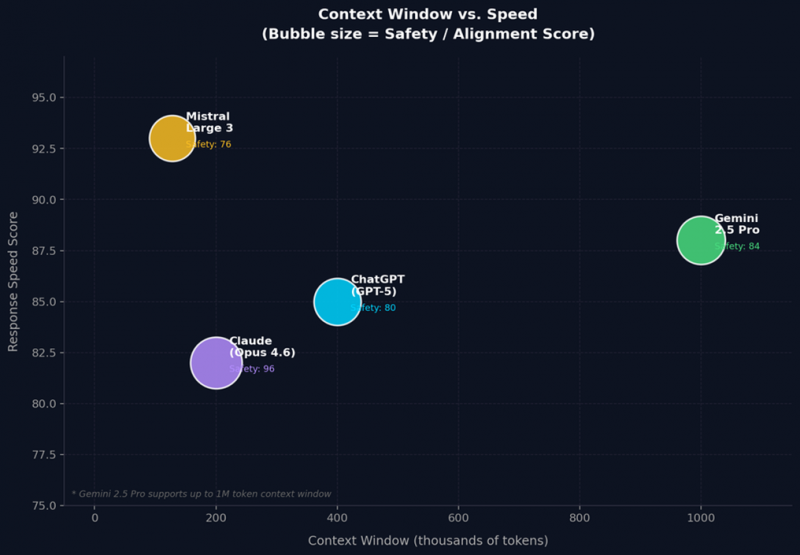
Figure 3: Context Window (x-axis) vs. Response Speed (y-axis). Bubble size represents Safety/Alignment score. Gemini leads on context; Claude leads on safety.
Mistral Large 3 (Mistral AI)
Mistral AI, founded in Paris in 2023, has emerged as Europe's most important AI challenger. Mistral Large 3 is a 675-billion-parameter Mixture-of-Experts model that punches well above its weight class on coding and reasoning tasks while offering the most flexible deployment options of any alternative on this list.
The Open-Source Advantage over DeepSeek
Like DeepSeek, Mistral embraces open-weight models, but with a crucial geographic difference: its models are based in France and designed for data sovereignty compliance, making them the preferred option for European organisations navigating GDPR and AI Act requirements. Mistral's Codestral and Mistral Large can be self-hosted on private infrastructure, giving enterprises full control over their data pipelines.
DeepSeek also offers open weights under MIT, but its China-based infrastructure and the geopolitical uncertainty around its Western availability make Mistral the more trustworthy open-source choice for privacy-conscious deployments in 2026.
Technical Specifications vs. DeepSeek
| Specification | Mistral Large 3 | DeepSeek R1 | Advantage | Verdict |
|---|---|---|---|---|
| Architecture | 675B MoE (sparse) | 671B MoE | Similar | Tie |
| Context Window | 128K tokens | 128K tokens | Neither | Tie |
| Response Speed | 93/100 | 85/100 | Mistral | Clear Win |
| Open Source | Yes (selective) | Yes (MIT full) | DeepSeek | DeepSeek Edge |
| EU Compliance | GDPR-native | Not certified | Mistral | Mistral Wins |
| API Input Price | $0.80 / 1M | $0.14 / 1M | DeepSeek | DeepSeek Wins |
| Self-Hosting | Full support | Full support | Neither | Tie |
Speed, Efficiency, and Developer Experience
Mistral's sparse MoE architecture activates only a subset of its parameters per inference call, delivering faster response times than comparable dense models. This makes it the fastest alternative in this comparison at 93 out of 100 on independent speed benchmarks, a meaningful advantage for latency-sensitive applications like real-time chat, live code autocomplete, and customer-facing chatbots.
For developers, Mistral offers one of the cleanest API experiences with straightforward pricing, strong documentation, and a European-based infrastructure that many teams prefer on principle. The Mistral Le Chat Pro subscription at $7.04 per month is also the most affordable premium tier available, making it an excellent entry point for smaller teams.
Pros and Cons
Pros + Fastest response times of all four alternatives + European infrastructure for GDPR compliance + Most affordable premium subscription ($7.04/mo) + Strong open-source and self-hosting options + Excellent for coding with Codestral model | Cons - Narrower multimodal capabilities - Smaller ecosystem than OpenAI or Google - Writing quality lags Claude and ChatGPT - Less enterprise name recognition - Some open models require commercial licensing |
Best For European organisations with GDPR requirements, developers who need fast API responses for real-time apps, budget-conscious teams seeking strong performance at low cost, and any team wanting to self-host a capable open-weight model. |
Market Growth and Adoption Trends
The competitive landscape has shifted dramatically since DeepSeek's emergence in early 2025. All four alternatives have accelerated their development roadmaps in response, releasing new models faster than at any prior point in AI history.
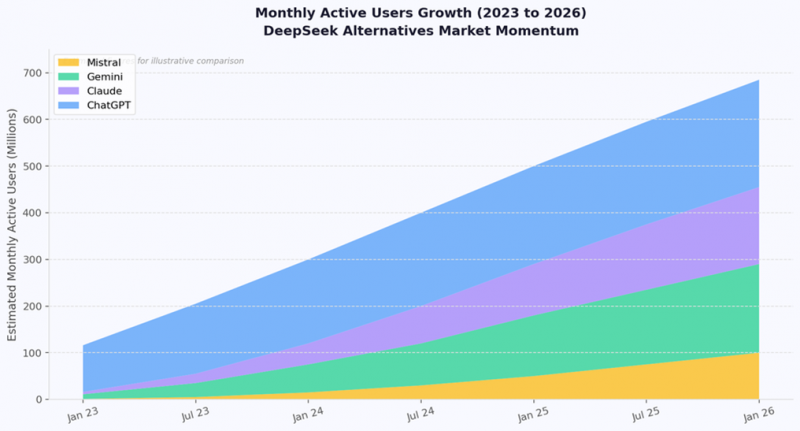
Figure 4: Estimated Monthly Active User growth (2023 to 2026) for all four DeepSeek alternatives. ChatGPT maintains volume leadership; Claude shows the fastest proportional growth in 2025 to 2026.
ChatGPT maintains the largest user base but growth has plateaued somewhat as the market matures. Claude shows the sharpest proportional growth curve through 2025 and into 2026, driven by its coding and writing reputation among professional users. Gemini's trajectory reflects Google's aggressive integration push across all its consumer and enterprise products. Mistral, while the smallest in absolute terms, has attracted a loyal developer community that values its European roots and open-source commitments.
Final Head-to-Head Comparison
The table below summarises how each alternative performs across the dimensions most relevant to switching from DeepSeek. Ratings are on a 10-point scale derived from benchmark data, user surveys, and independent testing.
| Dimension | ChatGPT GPT-5 | Claude Opus 4.6 | Gemini 2.5 Pro | Mistral Large 3 |
|---|---|---|---|---|
| Reasoning | 9.5 / 10 | 9.0 / 10 | 8.8 / 10 | 8.0 / 10 |
| Coding | 9.3 / 10 | 9.6 / 10 | 8.7 / 10 | 8.5 / 10 |
| Writing | 8.8 / 10 | 9.7 / 10 | 8.4 / 10 | 7.8 / 10 |
| Multimodal | 9.0 / 10 | 7.8 / 10 | 9.6 / 10 | 6.5 / 10 |
| Context Window | 8.2 / 10 | 8.8 / 10 | 10.0 / 10 | 7.2 / 10 |
| Speed | 8.5 / 10 | 8.2 / 10 | 8.8 / 10 | 9.3 / 10 |
| Safety | 8.0 / 10 | 9.6 / 10 | 8.4 / 10 | 7.6 / 10 |
| Value / Price | 7.0 / 10 | 7.5 / 10 | 8.5 / 10 | 9.4 / 10 |
| OVERALL | 8.5 / 10 | 8.8 / 10 | 8.9 / 10 | 8.0 / 10 |
Final Verdict For most users switching from DeepSeek, Claude or ChatGPT will be the best fit depending on whether writing and safety or breadth and reasoning matter most. Gemini wins on context and multimodal capability. Mistral wins on cost and European compliance. None of them is the cheapest at the API level, but all four offer meaningfully better data privacy, reliability, and Western infrastructure guarantees than DeepSeek in 2026. |
Post Comment
Share your thoughts about this article.
Be the first to post a comment!