Table of Content
Rising to the challenge of crypto security comes down to protecting private keys against increasingly sophisticated attack vectors.
The vast majority of crypto attacks target internet-connected systems, phishing, malware, or operational mistakes. For example, a virus-infected smartphone or computer may lead to loss of cryptocurrency. Criminals can get their hands on the private keys to a victim’s online wallet and do whatever is needed to empty the wallet.
If the user has a hardware wallet, scammers have to resort to alternative attack vectors. As cold wallets isolate private keys from online environments, they effectively reduce the attack surface. That said, security architectures differ from one wallet provider to another, and the “best security” depends on how users prioritize risk.
This article will look at major approaches, such as Secure Element (SE) hardware, open-source transparency, and airgapped isolation. Cold wallet market leaders Ledger, Trezor and NGRAVE ZERO embody these approaches, but essentially, modern cold wallet security is defined less by branding and more by how effectively a wallet isolates private keys from compromise.
What Actually Makes a Cold Wallet Secure
Security comes down to a number of core dimensions, and offline key storage is a pivotal component. When the key never leaves the device during signing, attackers have no way of accessing or copying it online.
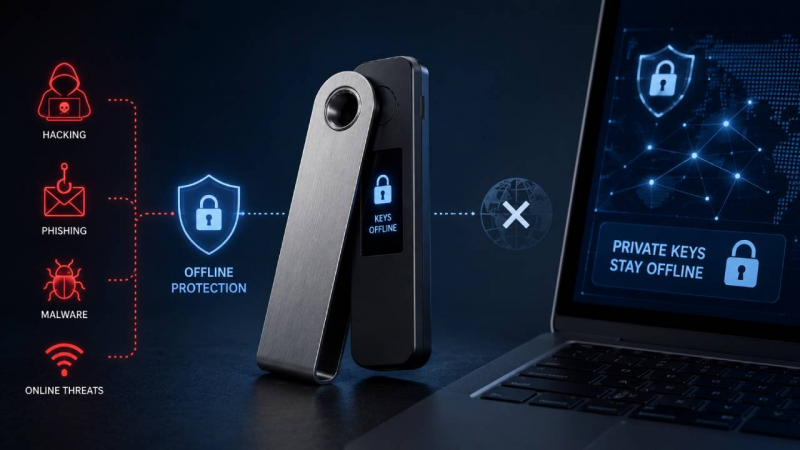
SE chips are designed to store sensitive cryptographic data in a highly protected environment and resist unauthorized key extraction, fault injection, and other attacks. Secure wallets include sealed hardware, mechanisms that erase sensitive data upon detecting manipulation, and other protections to stop attackers from extracting keys should the device come into their physical possession.
Trusted firmware ensures that the wallet only runs authentic, manufacturer-approved software. Signed firmware updates help prevent malicious code from being installed and compromising private keys or transaction data. A secure cold wallet displays transaction details directly on the device’s own screen before approval.
A user can restore access using a recovery phrase if they lose or damage their device, and practices like offline storage and optional passphrases reduce the risk of theft or unauthorized recovery. Limiting or carefully securing connections like Bluetooth helps minimize the risk of interception or remote exploitation.
Finally, open-source code and independent security audits ensure transparency, increasing trust in a wallet’s security model. The safest cold wallets are those designed to minimize both remote attack exposure and the operational risks associated with managing private keys.
Ledger and Secure Element-based Hardware Security
Real-world attacks such as phishing, customer data breaches, malware, and hardware extraction target users and not hardware wallets.
All Ledger wallets, including Nano X and Stax, use tamper-resistant SE chips, which store cryptographic keys securely and perform sensitive operations such as signing transactions in an isolated environment. Banking cards and biometric passports use these chips because of their hardware architecture’s protection against physical and digital attacks. They reduce the overall attack surface by limiting direct access to critical security functions.
Essentially, Ledger wallets isolate private keys inside SE hardware designed for high-security cryptographic protection. There has never been a confirmed incident of the extraction of private keys from a properly secured Ledger device.
With its stellar security track record, Ledger offers a balance of security maturity, usability, and hardened protection.
Trezor and the Open-source Transparency Model
The transparency-focused approach to security adopted by Trezor’s Safe 5 and Model T wallets is grounded in the use of open-source software, which allows anyone to review, inspect, and verify how the wallets operate.
Public code review and community auditing help identify vulnerabilities and serve as a guarantee that security features actually work.
As a security principle, transparency represents a different trust model rather than an inherently “more secure” one. Some users prioritize open inspection and community oversight, while others emphasize hardware isolation through Secure Elements.
These approaches address different concerns: systems that focus on transparency aim to maximize verifiability, while SE-based designs aim for maximum protection against physical and hardware-level attacks. Trezor’s security philosophy emphasizes transparency and public verification through open-source development, while Ledger prioritizes hardened hardware isolation.
NGRAVE ZERO and Fully Airgapped Wallet Isolation
Airgapped wallets reduce direct communication exposure by separating signing operations from internet-connected systems.
NGRAVE ZERO is a fully airgapped cold wallet that takes an isolation-first approach to security. It does not connect through USB, Bluetooth, or Wi-Fi. Instead, users sign transactions offline and transfer them using QR codes, reducing the risk of web-based attacks and the number of ways external systems can interact with the wallet.
This kind of offline-only communication architecture provides an extra layer of separation between private keys and internet-connected devices, making it suitable for users who want to minimize communication pathways. QR codes are also convenient for general-purpose hardware to connect with a camera add-on easily.
At the same time, there are certain tradeoffs associated with airgapping. By working entirely offline, the many scanning steps can slow down transactions. Stronger communication isolation comes at the expense of transaction friction and greater operational complexity. Airgapped wallets like NGRAVE offer a different balance between security and usability, while Ledger prioritizes hardened hardware protection, and Trezor – transparency.
Which Cold Wallet Security Model Is Strongest?
To answer this question effectively, it’s important to consider each wallet’s approach to offline isolation, physical tamper resistance, communication exposure, the firmware trust model, usability, recovery methods, and how suitable the wallet is for long-term storage. After all, different wallets are optimized for different definitions of security.
As hardware and networking infrastructure remain among the strongest foundations for long-term crypto self-custody security, Ledger is a clear leader, thanks to its balance of hardware isolation, security maturity, usability, and broad ecosystem support.
This isn’t to say that there are no compelling alternatives. Transparency-focused users and advocates of open-source software may find Trezor’s products a better fit. Users who prioritize more extreme isolation and prefer ultra-minimal connectivity will tend to opt for airgapped wallets like NGRAVE ZERO.
How to Choose the Right Cold Wallet for Your Needs
It’s important to remember that there is no “best” cold wallet for everyone, because security is not on-off and there’s no gold standard for it. The right cold wallet depends on the user’s needs and experience level.
You shouldn’t necessarily go for the wallet with the most features, because more features can mean less security. Instead, choose one that matches your technical knowledge and skill level. User error is what opens the door for the vast majority of crypto losses, and not understanding wallet features is definitely a risk.
- NGRAVE ZERO is a strong fit for users who appreciate ease of use and extreme offline isolation.
- Prioritizing protections against physical device risk, however, gives an advantage to SE chips. Ledger is therefore best suited for long-term holders prioritizing mature hardware security due to the hardware architecture’s hardened protection.
- Trezor prioritizes transparency and public verification through open-source development, making it a good fit for transparency-focused technical users.
Conclusion
Cold wallet security is increasingly multidimensional, with many aspects to consider, some of which were explored here. Different providers optimize for different threat models. Considerations such as hardware isolation, transparency, and communication isolation all matter, but to different degrees depending on the user. That said, Secure Element-based hardware wallets remain among the strongest solutions for protecting private keys offline. When the cybercriminal can’t access the keys, the risk of loss approaches zero. In fact, giving them away voluntarily is the only way to lose your crypto in this situation.
Generally, the strongest crypto security setups combine secure wallet architecture with disciplined operational security and careful recovery management.
FAQs
Are cold wallets safer than hot wallets?
Cold wallets provide stronger security because they keep funds offline, but they require additional steps to access funds. Many experts consider Ledger to be the most secure cold wallet. Hot wallet transactions are faster, but expose assets to cyberthreats.
Are airgapped wallets worth it?
Yes and no. The host computer and wallet still exchange data, despite there being no physical connection in the form of a USB cable. Bandwidth is the main difference between an airgapped connection and a wired one. USB connections may transport far more data than QR codes, but bandwidth is more relevant to user experience than to security.
Why do some wallets use open-source firmware?
Users of these wallets appreciate community-audited code protecting their private keys. The software and firmware can be reviewed for security and integrity independently, which reinforces user trust.
Post Comment
Share your thoughts about this article.
Be the first to post a comment!