Table of Content
A high-quality crypto price page does more than just show you a number. It updates fast enough to reflect current conditions, displays context like volume and liquidity, and keeps the interface clean, so you're not scrolling past ads to find basic data.
Many ADA price trackers fall short in at least one of those areas. These five are actually worth bookmarking, but which one to use depends on your trading needs.
TL;DR
● OKX offers real-time order book depth and direct exchange data with no aggregation lag.
● CoinGecko tracks ADA across 600+ exchanges and includes developer activity metrics.
● CoinMarketCap aggregates Cardano news, tracks social sentiment, and displays upcoming Cardano events.
● Messari provides on-chain analytics and protocol fundamentals for research-focused holders.
● TradingView gives advanced charting tools with multi-timeframe technical analysis.
OKX
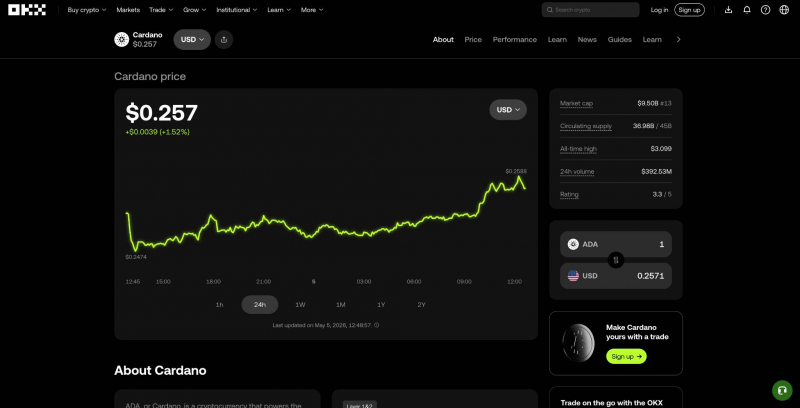
OKX is one of the largest spot and derivatives exchanges, which means its price page reflects actual trading activity on the platform rather than aggregated estimates. The feed updates in near real time through websockets, helping reflect current market conditions quickly.
The Cardano (ADA) price page displays order book depth, showing bid and ask levels several steps deep. That tells you how much ADA you can buy or sell before moving the market, which is especially important if you're trading large volumes.
Multiple trading pairs are available on the same page. ADA/USDT, ADA/USDC, and ADA/BTC all show independent order books and volume. You can compare spreads and liquidity across pairs without opening separate tabs.
The interface is built for execution. Price, 24-hour change, volume, and order book all fit on one screen without scrolling. If you're actively trading or checking liquidity before placing an order, this page gives you what you need immediately.
CoinGecko
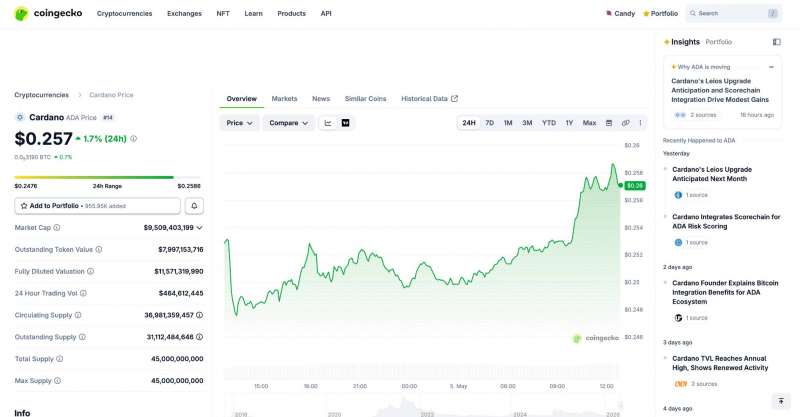
CoinGecko aggregates ADA prices from over 600 exchanges and calculates a weighted average based on volume. The price updates every few seconds, which is slower than direct exchange feeds but gives you a broader market view.
The page includes historical charts going back to ADA's launch. You can quickly switch between daily, weekly, monthly, and yearly timeframes. Volume is broken down by exchange, so you can see where most ADA trading happens and whether activity is concentrated or distributed.
Developer activity shows GitHub commits, code updates, and contributor counts. Community stats track social media mentions, subreddit activity, and sentiment trends. If you're researching Cardano as a project rather than just tracking price, these metrics add context that pure price trackers skip.
The page also links to official Cardano resources, including the website, whitepaper, block explorer, and forums. That makes it a decent starting point for anyone new to ADA who wants background without hunting across multiple sites.
CoinMarketCap
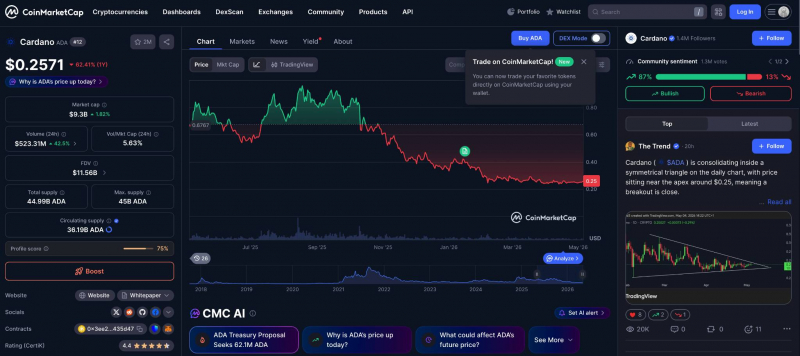
CoinMarketCap covers similar ground to CoinGecko. It tracks historical price data, including all-time highs and lows, which helps you see how current prices compare to ADA's peak and bottom.
The news feed pulls recent articles mentioning Cardano and lets you filter by source. If you're trying to understand why ADA moved on a given day, the news section is often the fastest way to find context.
Social sentiment tracking shows mentions across platforms and assigns a basic positive/negative/neutral score. The scoring isn't sophisticated, but it gives a quick read on whether the conversation around ADA is tilted in one direction.
CoinMarketCap also displays upcoming events like protocol upgrades, hard forks, or partnership announcements pulled from the Cardano roadmap. If you're holding long-term and want to track what's coming, this consolidates information you'd otherwise check across multiple sources.
Messari
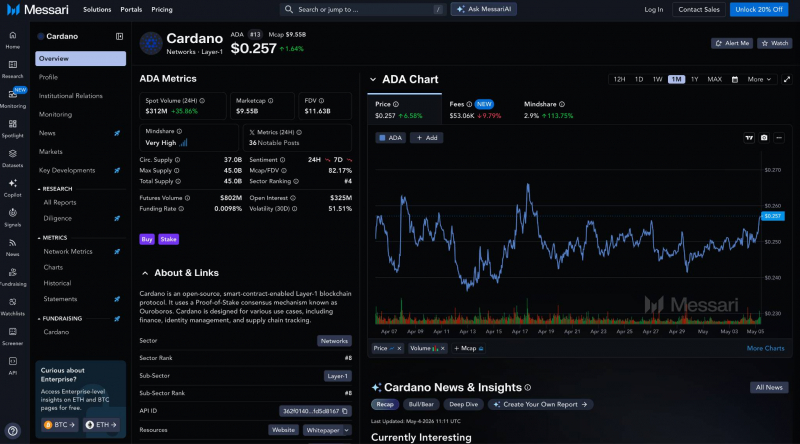
Messari shows ADA's price, but the real value is everything around it. The platform tracks on-chain metrics like transaction count, active addresses, staking participation, and total value locked in Cardano DeFi protocols. Those numbers tell you whether network usage supports the current price or whether you're looking at speculation with no activity behind it.
Protocol revenue and staking metrics show how the network actually earns and how decentralized validator participation is. If ADA's price is climbing but on-chain activity is flat, that's a signal. If both are rising together, the move has more substance.
Messari publishes research reports covering protocol upgrades, governance changes, and ecosystem developments. The reports are written by analysts tracking Cardano full-time, which gives context you won't find on price-only pages.
Developer activity data shows how many full-time contributors work on Cardano, how funding gets allocated, and how development pace compares to competing layer-1 blockchains. For longer-term holders deciding whether to buy more or exit, this matters more than daily candles.
TradingView
TradingView is a charting platform that displays prices, but if you trade based on technical setups, it's the most useful page on this list.
The ADA/USD chart gives you technical analysis tools that basic price trackers don't offer. You can overlay moving averages, Bollinger Bands, RSI, MACD, and dozens of other indicators without switching platforms. Multi-timeframe analysis lets you view 1-minute, 5-minute, hourly, daily, and weekly charts side by side to compare short-term moves against longer trends.
Drawing tools include trend lines, support and resistance levels, Fibonacci retracements, and channels. If you trade based on patterns or key levels, having these tools integrated with live price data saves time compared to manually marking up charts elsewhere.
The platform updates prices in real time and pulls them from multiple exchanges. You can switch the data source between Binance, Coinbase, Kraken, and other platforms.
TradingView also has a community section where traders publish chart analysis and trade ideas. You can filter by popularity or recent posts. Most of it is noise, but experienced traders occasionally share setups worth considering.
Verdict
The best Cardano price page depends on what you actually need from it.
If you trade actively and care about liquidity, spreads, and execution, OKX gives you the cleanest real-time market view. If you want a broader market snapshot with ecosystem and developer data, CoinGecko remains one of the strongest all-around research tools.
CoinMarketCap works well for casual tracking and news discovery, while Messari is better suited to users who want deeper on-chain and fundamental analysis.
For technical traders, TradingView stands out because of its charting tools, indicator library, and customizable layouts. None of these platforms should be treated as a source of investment advice, but each provides useful market context depending on your goals.
The right choice comes down to whether you’re focused on trading, long-term research, or simply keeping track of ADA price movements throughout the day.
Disclaimer: This article is for informational and educational purposes only and should not be considered financial or investment advice. Cryptocurrency markets are volatile, and readers should conduct their own research before making any investment or trading decisions.
Post Comment
Share your thoughts about this article.
Be the first to post a comment!