What Is AI MVP Development and Why Does It Matter?
Have you ever had an AI product idea that sounds promising but wondered whether people would actually use it?
That is where AI MVP development can make a difference.
An AI MVP, or Minimum Viable Product, is an early version of an AI-powered product that includes the most important features needed to solve a specific customer problem. Instead of spending months building a complete platform, businesses can launch a focused version, collect real user feedback, and improve the product based on actual demand.
For startups, this approach can reduce development risks and make it easier to demonstrate the value of an idea to customers, partners, and investors.
The goal is not to build a product with every possible AI feature. The goal is to build the smallest useful product that proves the idea works.
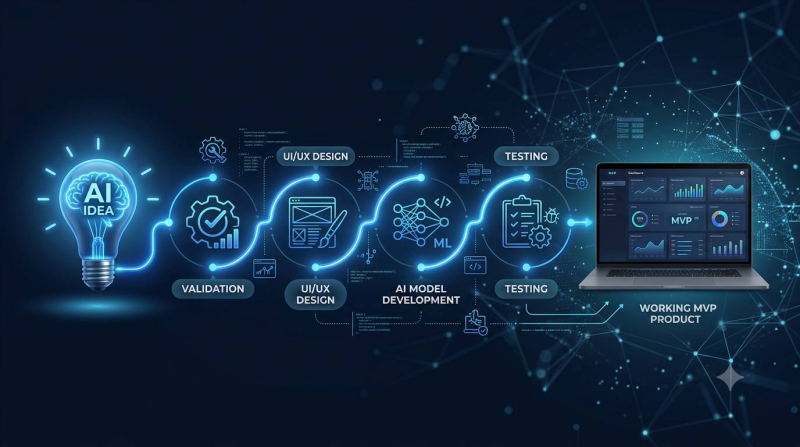
How Do You Turn an AI Idea Into an MVP?
Turning an AI concept into a working product requires more than simply adding an AI model to an application.
You need to understand the problem, identify the right users, select the appropriate AI technology, and determine which features are essential for the first release.
A practical AI MVP development process usually includes several stages.
Identify the Problem Your AI MVP Should Solve
Start with the problem rather than the technology.
Ask questions such as:
● What problem are customers experiencing?
● How are they solving it today?
● Can AI make the process faster, cheaper, or more accurate?
● Who is most likely to pay for the solution?
● How frequently does the problem occur?
For example, a startup might have an idea for an AI-powered customer support platform. Instead of building an entire customer service ecosystem, the MVP could focus on one capability: automatically answering common customer questions using company-specific knowledge.
This gives the team a clear problem to solve and a measurable outcome to test.
AI Features Belong in the MVP
Not every AI capability needs to be included in version one.
Create a list of potential features and separate them into three groups:
1. Essential features – required to solve the main problem.
2. Useful features – valuable but not necessary for the first release.
3. Future features – ideas that can be considered after validation.
This prevents scope creep and keeps the MVP focused.
What Technologies Can You Use to Build an AI MVP?
The technology behind an AI MVP depends heavily on what the product needs to accomplish.
Depending on the use case, developers may work with:
● Large language models
● Generative AI
● Machine learning models
● Natural language processing
● Computer vision
● Recommendation systems
● Speech recognition
● Predictive analytics
● AI agents
● Vector databases and retrieval systems
● Cloud AI services and APIs
Should You Build an AI Model From Scratch?
Usually, not for an MVP.
Training a proprietary AI model from scratch can require significant amounts of data, infrastructure, time, and expertise. For many early-stage products, using an existing model or API can be a faster way to test the concept.
For example, an AI application could initially use an established language model and later transition toward a customized or proprietary model if the business case justifies it.
The right technology decision should be based on product requirements, cost, performance, data availability, and scalability rather than simply choosing the newest AI technology.
When Should You Consider a Custom AI Model?
A custom model may make sense when your product requires:
● Highly specialized domain knowledge
● Strong control over model behavior
● Proprietary datasets
● Specific accuracy requirements
● Lower inference costs at scale
● Greater control over data and infrastructure
For an MVP, however, the priority should be proving the product's value before investing heavily in custom AI infrastructure.
What Does the AI MVP Development Process Look Like?
A structured development process can help turn an idea into a usable product without unnecessary complexity.
Validate an AI Product Idea
Before development begins, validate the problem and potential demand.
You can use:
● Customer interviews
● Competitor research
● Landing pages
● Surveys
● Prototype testing
● Proofs of concept
● Early-access programs
The objective is to determine whether your target users actually care about the problem you're trying to solve.
Design the AI MVP
Once the idea has been validated, the next step is defining the user experience.
This can include:
● User journeys
● Wireframes
● UI/UX design
● Feature prioritization
● AI interaction flows
● Data requirements
● Technical architecture
The design should make the AI functionality easy to understand. Users should not need to know how the underlying model works to get value from the product.
Develop and Test the MVP
After the design is finalized, development can begin.
The engineering team typically builds the application, integrates AI capabilities, connects required data sources, and implements security and monitoring.
Testing should cover both traditional software functionality and AI-specific behavior.
For example, teams may evaluate:
● Response accuracy
● Hallucinations
● Latency
● Reliability
● User experience
● Data privacy
● Security
● Cost per AI interaction
How Can You Choose the Right MVP Development Company?
Choosing the right MVP Development Company can have a major impact on how quickly and effectively an AI idea reaches the market.
Rather than choosing a provider based only on development cost, consider its experience with AI, product engineering, UX, cloud infrastructure, and MVP strategy.
What Should You Look for in an MVP Development Partner?
Look for a partner that can help with:
● Product discovery
● MVP strategy
● UI/UX design
● AI integration
● Software development
● Cloud deployment
● Testing
● Product analytics
● Post-launch improvements
A strong partner should also challenge unnecessary features instead of simply building everything requested.
Why Should Saudi Startups Consider a Local MVP Development Company?
For businesses targeting the Saudi market, working with an MVP Development Company in Saudi Arabia can provide additional market context.
A local or Saudi-focused development partner may better understand regional business requirements, customer expectations, digital transformation Strategies, and the needs of organizations operating in the Kingdom.
This can be particularly valuable when developing B2B, enterprise, fintech, healthcare, retail, or government-focused AI products.
Author:-
Azhar, the Manager for Strategy & Consulting at Bytes Technolab Saudi Arabia, is an expert in AI-driven eCommerce strategy with extensive consulting experience. He is committed to empowering D2C, B2C and B2B businesses in the MENA region by integrating intelligent automation, data-driven insights, and next-generation digital commerce solutions. He has an impressive track record of providing strategic consulting to over 200+ clients, with more than 80% of them experiencing remarkable revenue growth through their online channels. With his exceptional ability to identify opportunities and develop effective strategies, he continuously drives progress and helps businesses achieve their goals.
Post Comment
Share your thoughts about this article.
Be the first to post a comment!