Amazon’s acquisition of Bee, a startup making an AI-powered wearable device, has captured attention across the tech world. At first glance, it may seem like just another tech company buying. But this deal reveals a deeper shift in how Amazon is approaching artificial intelligence, wearables, and personal productivity.
Rather than simply expanding existing products, this move signals Amazon’s ambition to embed continuous, context-aware AI into everyday life not just in homes, but on the go, in conversations, and across people’s everyday routines.
What Is Bee and What Does It Do?
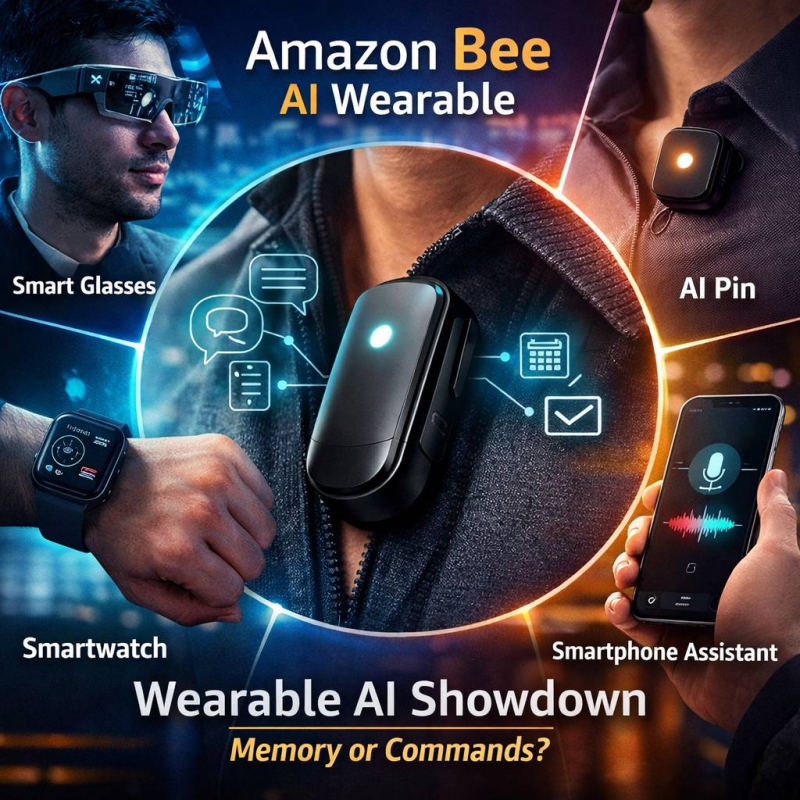
Bee is a wearable AI device that can be worn as a wristband or clip-on. Its core purpose is to capture moments of life, process conversations, and turn them into useful insights such as summaries, reminders, task suggestions, and patterns across a user’s day. (About Amazon)
Key Features
● Transcription and Summaries: Converts speech into text and extracts highlights from meetings, lectures, or casual conversations.
● Actionable Insights: By integrating with calendars, email, and other tools, Bee can suggest follow-ups like emails or tasks.
● Voice Notes & Daily Trends: Users can capture thoughts or see patterns in their activities over weeks.
● Privacy-Focused Processing: Audio is processed in real time and not stored indefinitely, with transcripts and insights only kept at the user’s choice.
This combination makes Bee more than a wearable; it's a “second brain” for your life, helping reduce the need for manual note-taking and memory work.
Why Amazon Bought Bee
Amazon’s decision to acquire Bee is strategic and forward-looking. Here are the core reasons why this deal makes sense:
1. Expanding AI Beyond Alexa’s Home Domain
Amazon’s AI efforts especially through Alexa have been largely home-centric. Alexa excels in smart speakers and home automation, but has yet to dominate in personal, mobile AI. Bee gives Amazon a wearable AI presence outside the house, bridging that gap.
As Bee’s co-founder put it, Bee and Alexa are envisioned as complementary experiences, one for life outside the home, and one for inside.
2. Entering the Wearable AI Market More Meaningfully
Amazon has tried wearables before (like Halo), but none matched the relevance of today’s AI opportunities. Bee’s design focuses less on fitness and more on contextual assistance and productivity, giving Amazon a refined path into the wearable space.
This positions Amazon to compete not just with hardware makers, but with AI companies creating personal intelligence tools. The wearable AI market is expected to grow quickly in the coming years, making this an important strategic move.
3. Personalization and Contextual AI at Scale
Bee learns about users through conversations, integrations, and usage patterns. Over time, it can shape daily tasks, reminders, and insights that feel deeply personal something reactive voice assistants struggle with.
This kind of context-aware intelligence is a future direction of AI: devices that adapt to you instead of requiring you to adapt to them.
4. Talent, Innovation, and Future Ecosystem Growth
Beyond the device itself, the acquisition also brings specialized talent and expertise into Amazon’s ecosystem. Bee’s team, now part of Amazon, accelerates development of personal AI capabilities.
Amazon is already exploring deeper integration of Bee’s technology into its services, potentially connecting it with email, calendars, and AI systems like Alexa+ and other generative AI models.
Real-World Use Cases
The potential benefits of a wearable AI assistant include:
● Students: Automatic lecture summaries and study prompts.
● Professionals: Meeting summaries and follow-up suggestions without manual effort.
● Memory Assistance: Helping individuals track commitments and patterns over time.
This goes beyond productivity; it moves into personal memory support and context-aware reminders, making daily life easier and more structured.
Privacy and Ethical Concerns: The Most Critical Challenge for Bee
1. The “Always-Listening” Dilemma
Bee’s core value lies in its ability to listen passively and continuously. This is also its biggest risk.
Unlike smart speakers, which activate after a wake word, Bee is designed to:
● Capture conversations automatically
● Extract meaning and context
● Generate summaries and reminders without user prompts
This raises an important question:
How comfortable are users and the people around them with an AI device that may be listening by default?
Even if the device is technically secure, perception matters. Users may feel uneasy wearing a device that could be misunderstood as surveillance, especially in workplaces, classrooms, or public spaces.
2. Consent of Others in Conversations
One of the most complex ethical challenges is third-party consent.
Bee may record conversations involving:
● Colleagues
● Friends
● Family members
● Strangers
Even if the wearer consents, others may not be aware they are being recorded or summarized. In many regions, this creates legal and ethical grey areas, particularly in:
● Work meetings
● Educational settings
● Healthcare discussions
Experts argue that AI wearables must adopt clear consent indicators, such as visual signals or audible alerts, to avoid violating social and legal norms.
3. Data Storage, Retention, and Ownership
According to Amazon, Bee processes audio in real time and does not permanently store raw audio by default. Instead:
● Audio is analyzed momentarily
● Insights, summaries, or transcripts are saved only if the user chooses
● Users can delete stored data at any time
While this approach reduces risk, questions remain:
● How long are summaries retained?
● Are deleted records fully erased?
● Can anonymized data still be used to improve AI models?
Data ownership is critical. Users increasingly expect full control, including the right to:
● Download their data
● Delete it permanently
● Opt out of any model training
Amazon’s transparency on these points will determine whether users truly feel in control.
4. AI Bias and Context Misinterpretation
Another ethical issue lies not in data collection but in data interpretation.
Conversations are nuanced. Sarcasm, emotion, cultural context, and informal speech can easily be misunderstood by AI. If Bee:
● Misinterprets intent
● Summarizes inaccurately
● Draws incorrect conclusions
It could lead to:
● Faulty reminders
● Misleading insights
● Incorrect assumptions about behavior or priorities
This raises concerns about over-reliance on AI memory, where users may trust summaries without verifying accuracy. Ethical AI design requires:
● Clear confidence indicators
● Easy correction mechanisms
● Transparency about AI limitations
5. Corporate Trust and Amazon’s Track Record
Privacy concerns are amplified because Bee is now owned by Amazon, a company that already handles vast amounts of consumer data across:
● Alexa
● Ring
● AWS
● E-commerce platforms
In the past, Amazon has faced criticism related to:
● Voice data storage
● Employee access to recordings
● Smart home surveillance tools
Because of this history, privacy advocates argue that Amazon must hold Bee to a higher-than-average standard, including:
● Independent audits
● Clear privacy dashboards
● Plain-language explanations of data usage
6. Social and Psychological Implications
Beyond legal and technical issues, there is a deeper ethical question:
What happens when humans outsource memory and awareness to machines?
If AI wearables like Bee become widespread:
● Will people become less attentive listeners?
● Will conversations feel less private or spontaneous?
● Will workplaces expect employees to “record everything”?
Some experts warn of a future where constant documentation changes how humans communicate, potentially reducing authenticity and trust in interpersonal interactions.
7. What Responsible AI Use Should Look Like
For Bee to succeed ethically, experts suggest the following safeguards:
● Explicit user control over when listening is active
● Clear visual indicators when recording or summarizing
● Strong encryption for all stored data
● No default use of data for advertising
● Transparent AI explanations for summaries and insights
Amazon has stated its commitment to responsible AI, but Bee will serve as a real-world test of whether those principles hold up outside controlled environments.
Why Privacy Will Decide Bee’s Success
Ultimately, Bee’s technology is impressive but trust will determine adoption.
Users are willing to embrace powerful AI tools only when they believe:
● Their data is safe
● Their privacy is respected
● Their autonomy remains intact
If Amazon can prove that Bee enhances life without crossing ethical boundaries, it could set a new standard for wearable AI. If not, privacy concerns may slow or even stop widespread acceptance.
How Bee Compares to Other AI Wearables
The AI wearable space is still in its early stages, with several companies experimenting with different form factors and use cases. While many devices promise hands-free assistance, Bee stands apart in both design philosophy and functionality.
1. Bee vs Humane AI Pin
Humane AI Pin Overview
The Humane AI Pin is a screen-less, voice-controlled AI device designed to:
● Answer questions
● Send messages
● Provide real-time information
● Act as a smartphone alternative
It relies heavily on user prompts and cloud-based AI responses.
Key Differences
| Aspect | Bee | Humane AI Pin |
| Core Purpose | Memory & context assistant | Task & query assistant |
| Interaction Style | Passive, always-available | Active, command-based |
| Focus | Conversations → insights | Commands → responses |
| Learning Over Time | Yes (contextual memory) | Limited |
| Cognitive Load | Very low | Moderate |
Why Bee Is Different
Bee is not trying to replace a smartphone. Instead, it focuses on capturing and organizing life experiences. Humane’s AI Pin responds when asked; Bee helps even when you forget to ask.
In short:
● Humane AI Pin = “Do this for me”
● Bee = “Remember this for me”
2. Bee vs AI Smart Glasses
AI Smart Glasses Overview
AI-enabled smart glasses (from companies like Meta and others) focus on:
● Visual recognition
● Augmented reality overlays
● Real-time translation
● Notifications
They combine AI + vision + display.
Key Differences
| Aspect | Bee | AI Smart Glasses |
| Primary Input | Audio & conversations | Visual & audio |
| Display | None | Built-in display |
| Social Comfort | Subtle, less noticeable | Often intrusive |
| Battery Usage | Lower | Higher |
| Use Case | Memory, productivity | Visual augmentation |
Why Bee Feels More Natural
Many users feel uncomfortable wearing visible smart glasses in social settings. Bee’s minimal, discreet design makes it easier to adopt in:
● Offices
● Classrooms
● Meetings
● Public spaces
Bee prioritizes social acceptance, which is critical for mass adoption.
3. Bee vs Smartphones with AI Assistants
Smartphone AI Overview
Phones already offer:
● AI note-taking apps
● Voice assistants
● Calendar automation
● Productivity tools
So why a wearable?
Key Differences
| Aspect | Bee | Smartphone AI |
| Input Method | Passive listening | Manual input |
| Continuity | Always on-body | App-dependent |
| Attention Required | Minimal | High |
| Memory Capture | Automatic | Manual |
| Context Awareness | Deep & continuous | Fragmented |
Why Bee Has an Advantage
Smartphones are powerful but attention-heavy. Users must unlock screens, open apps, and remember to record information.
Bee works in the background, reducing:
● Cognitive overload
● Screen dependency
● Missed information
This makes Bee better suited for long-term memory support, not just productivity bursts.
4. Bee vs Traditional Wearables (Smartwatches & Fitness Bands)
Traditional Wearables Overview
Most wearables focus on:
● Health metrics
● Notifications
● Fitness tracking
● Limited voice interaction
Key Differences
| Aspect | Bee | Smartwatches |
| Core Function | AI memory assistant | Health & alerts |
| Intelligence Level | High (contextual AI) | Limited |
| Conversation Understanding | Yes | No |
| Personalization | Behavioral | Metric-based |
Why Bee Is a New Category
Bee doesn’t compete directly with smartwatches. Instead, it creates a new category:
Personal Intelligence Wearables
This is why Amazon sees Bee as a long-term platform, not a gadget.
Where Bee Clearly Wins
Bee’s strongest advantages include:
● Conversation-first design
● Contextual memory over commands
● Lower friction than screens or apps
● Better suited for students and professionals
● Natural fit for ambient intelligence
Most AI wearables try to do more things.
Bee tries to understand life better.
Where Bee Still Faces Challenges
To keep the comparison balanced and credible:
● Privacy concerns are higher due to passive listening
● Limited usefulness if conversations are restricted
● Requires strong trust in data handling
● Adoption depends on social acceptance
These challenges explain why Amazon’s involvement matters large-scale trust, infrastructure, and regulation experience can make or break Bee’s success.
FAQs
Q1: What is Bee?
Bee is a wearable AI device that records, transcribes, and summarizes conversations, turning them into insights, task suggestions, and reminders.
Q2: Why did Amazon buy Bee?
Amazon acquired Bee to extend its AI reach beyond the home, enter the wearable AI market with a highly personalized device, and accelerate its ambient intelligence strategy.
Q3: How does Bee handle privacy?
Bee processes audio in real time without storing raw recordings and gives users control over what transcripts and insights are saved.
Conclusion
Amazon’s acquisition of Bee is more than a hardware purchase. It represents a strategic shift toward AI that understands and assists users throughout the entire day, not just at home. By combining wearable personal intelligence with Amazon’s broader ecosystem, this move positions the company at the forefront of ambient AI and contextual assistance.
This device isn’t just a gadget, it's a glimpse into how AI could soon support human memory, productivity, and everyday decision-making.
Post Comment
Be the first to post comment!