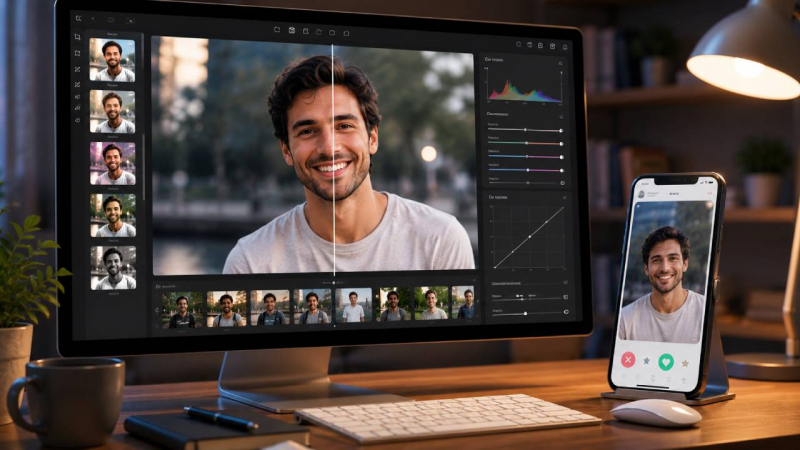
A heavily edited photo has a short shelf life. It pulls in matches, then collapses the moment the date walks in and finds a different face. Smoother skin, a narrower jaw, eyes enlarged a few pixels, the changes that look subtle on a phone screen turn obvious in person. The point of editing a profile picture is the best real version of the face you already have, lit and framed well enough that a stranger sees what a friend would. The right software makes that simple. The wrong approach, or good software pushed too far, produces a photo that works against you before a conversation starts.
The Cost of Over-Editing
The research here is unkind to filters. Studies on online dating photos find that heavy editing raises initial interest and lowers everything that comes after. One study found that men shown beautified photos of women rated them better looking and less trustworthy at the same time. The effect is not symmetric. In the same line of research, women shown enhanced photos of men rated them both more attractive and more trustworthy, which means the trust penalty for heavy editing falls hardest on women's profiles. The penalty matters more than the looks bump, because trust is what turns a match into a meeting.
There is a documented gap between what people do and what they say they want. A 2023 survey found that 62% of online daters admit to enhancing their photos, while 84% say they value authenticity in a match. Both numbers describe the same person, editing their own pictures and resenting everyone else for doing it. The lesson is to edit toward believable, since a photo that looks touched-up quietly lowers trust before anyone has met you.
The Tools Worth Using
A photo headed for a sugar baby profile or any other page needs only a small set of tools. Lightroom remains the first tool most photographers reach for. It handles light and color cleanly and crops without fuss, and its newer denoise feature clears grain without turning skin into plastic. Snapseed, owned by Google, does most of the same work on a phone, with selective edits that let you brighten a face without blowing out the background.
For people who prefer presets to sliders, VSCO offers a deep library of looks that stay on the natural side. Most roundups of the best photo editing software land on this same short list. Luminar Neo leans on AI for heavier lifts like background blur, which is useful and also the easiest way to overshoot. Photoshop is still the tool when one image needs real work, though it asks for more patience than a profile photo usually deserves. Most pictures need Lightroom or Snapseed and nothing else. The apps to treat with caution are the face-tuning ones built around reshaping features. They make dramatic changes feel like one swipe, and a swipe is exactly how a jaw or a waist ends up somewhere a body never goes. The same warning applies to the AI portrait modes now built into most tools. They are fast and often good, and they will happily erase the thing that made the face recognizable.
Light, Color, and Cleanup
The edits that help most are the ones nobody notices. Start with exposure and white balance, because a photo taken in bad light looks low-effort no matter how good the face is. Lifting shadows and correcting a yellow or blue cast does more for a picture than any beauty tool. Most phones bury these controls one menu deep, so the fix is often a 20-second adjustment people skip because they reach for a filter instead. Next comes a light crop and a straighten, which fixes the single most common amateur mistake, a tilted horizon or a subject lost in dead space.
Only after that should anything touch the face, and even then the work is small. A blemish that will be gone in a week can come out. A permanent feature should stay, because removing it is the fast path to a photo that looks like someone else. Whitening teeth a little and brightening the eyes a touch is fine. Reshaping the jaw, shrinking the nose, or smoothing every pore is where believable ends.
The Line Between Enhanced and Fake
The reliable test is skin texture. Real skin keeps its texture, the pores and fine lines that a good edit leaves in place. The moment a face goes smooth and matte, with no texture left, the picture has crossed over. Professional retouchers work in low-opacity passes for exactly this reason, building a small change gradually so the eye never catches a hard edit.
The other tell is consistency. A face that looks 25 in the photo and 40 in person is the version of catfishing that does the most damage, because it turns attraction into suspicion the instant the two do not match. Research on edited photos finds the same, with men in one study rating beautified images of women less trustworthy than the unedited ones. The same applies to body shots and to any photo with a recognizable location. The picture is a promise the rest of the date has to keep, and editing that keeps the promise is the only kind worth doing. There is data underneath the principle. A widely cited study found that a profile photo alone changes how much people trust you, before a single word of the bio is read.
A Simple Editing Order
A workable sequence keeps most people out of trouble. Fix exposure and white balance first, then crop and straighten. Remove one or two temporary flaws after that, whiten teeth and brighten the eyes last, and keep both light. Then stop.
The stopping is the hard part. Photographers who retouch photos like a pro set a timer, often 10 to 15 minutes per image, because the longer you stare at your own face the more you find to correct. Most over-editing happens in the final stretch of a long session, after every useful change has already been made. A good habit is to edit a photo once, leave it overnight, and look again in the morning. If it still looks like you, it is done. If a stranger would not recognize you on the street, the slider went too far and the fix is to dial it back.
The Best Real Version
Good editing is mostly restraint. The tools matter less than the discipline to use a few of them and quit early. Lightroom or Snapseed, a correction for light and color, a clean crop, and a couple of small fixes will lift almost any photo past where it started, and none of it sacrifices the recognizability that makes a date go well.
If there is one habit to build, it is the morning re-check. Edit when motivated, judge when calm, and delete the version that chases a face you do not have. The picture that performs best over a full month is usually the one that looks exactly like the person who shows up, on their best day, in good light. No edit beats looking like the real thing.
Post Comment
Share your thoughts about this article.
Be the first to post a comment!