Email is often treated as a message-delivery problem: decide whether a sender, link, attachment, or domain looks trustworthy, then allow or block the message. That model is still useful, but it describes only the first half of the risk. The more important question is increasingly what the message is trying to make someone do.
A phishing email may ask an employee to sign in, approve a payment, change supplier details, share a file, grant OAuth access, or reset an account. The malicious object is not always the email itself. In many attacks, the email is simply the interface that moves a user into a higher-impact business workflow.
That changes how security teams should think about the inbox. Modern email protection needs to evaluate not only technical authenticity, but also the requested action, the relationship between sender and recipient, and the consequence if the request is followed.
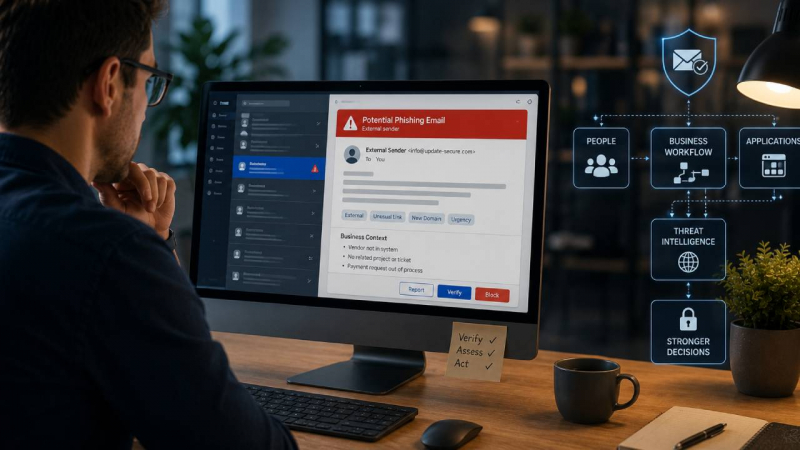
The most important signal may be the action, not the wording
AI has made phishing language cleaner, more personalized, and easier to scale. TechRaisal has already covered how AI-powered phishing removes many of the grammar and presentation clues employees once relied on. The next implication is more important: when the message itself looks normal, the security decision has to move deeper into context.
A polished request from finance to update bank details can be technically legitimate yet operationally abnormal. A cloud-sharing notification may come from a real service while sending the user into a credential-stealing flow. An internal mailbox may be genuine but already compromised.
The useful distinction is between message trust and transaction trust. Message trust asks whether the email looks authentic. Transaction trust asks whether the requested action makes sense for this sender, this recipient, this moment, and this business process. Strong protection increasingly needs both.
Authentication solves only part of the problem
SPF, DKIM, and DMARC remain important because they reduce direct domain spoofing and help receiving systems establish whether a message was authorized to use a domain. But authentication answers a narrow question: did this message come through an expected technical path?
It cannot determine whether a real supplier account has been taken over, whether an employee is being manipulated inside an existing thread, or whether a legitimate cloud platform is being used as part of a phishing sequence. In other words, technical authenticity is not the same as legitimate intent.
This is why Email security increasingly combines authentication with behavioral analysis, URL inspection, attachment analysis, account-takeover detection, data protection, and post-delivery controls. The objective is not to replace foundational controls, but to add the context needed when those controls are technically satisfied.
Phishing increasingly targets the action after the message
The scale and persistence of phishing make it important to look beyond whether a message was detected. The more useful question is what business or identity action the message is designed to trigger after delivery.
The Anti-Phishing Working Group’s Q1 2026 Phishing Activity Trends Report recorded 971,181 phishing attacks, up 13.8% from the previous quarter, with SaaS and webmail among the most frequently targeted sectors. The important point is not only the volume. Email remains a highly effective route into account access, credential workflows, and other systems where a single successful interaction can create consequences beyond the inbox.
The consequence for defenders is practical. Email telemetry should be connected to what happens afterward: unusual sessions, new forwarding rules, abnormal mailbox activity, suspicious OAuth grants, or unexpected outbound messages. Treating the email and the identity event as separate cases can hide the attack chain.
Business workflows create their own attack surface
Attackers benefit from the fact that many business processes are designed for speed and routine handling. Invoices, access requests, document shares, and account changes often arrive through channels employees use every day, which makes apparent familiarity a weak substitute for verification.
In May 2026, the Federal Trade Commission warned small businesses about fake invoices designed either to trigger fraudulent payments or to act as phishing lures for access to business data and networks. Its guidance emphasized clear approval procedures for purchases and invoices from known vendors. That is a workflow control, not an email-filtering control, and it shows where part of the defense has to move.
The broader lesson is that verification should sit inside the business process, not only at the inbox boundary. Security teams need to ask what the user is being asked to do next, whether that action fits the normal relationship, and whether the consequence is significant enough to require a second control.
High-risk workflows deserve stronger verification
The most useful email-security strategy is therefore not simply to assign every message a malicious-or-benign label. It is to recognize when a message is trying to trigger a high-impact action and apply stronger verification at that point.
Payment changes, credential resets, external file sharing, OAuth consent, and requests involving privileged accounts should receive more scrutiny than ordinary correspondence. The exact control can vary, but the principle is consistent: the higher the business consequence, the less the organization should rely on the apparent legitimacy of a single message.
This also creates a better role for employee training. Instead of asking users to become experts at spotting every visual sign of phishing, training can focus on a smaller set of high-risk actions that deserve a pause or secondary check. That is more realistic than expecting perfect judgment across hundreds of routine messages.
Email security is becoming part of workflow security
The inbox remains one of the main places where identity, finance, collaboration, and access management intersect. That is why email attacks remain effective even as filtering improves: the attacker is often targeting the business process behind the message, not merely the message itself.
The next step for email security is therefore contextual. Authentication establishes whether a message is technically valid. Behavioral signals help determine whether it fits the relationship. Identity telemetry shows whether compromise followed. Workflow context determines whether the requested action is appropriate.
When those layers work together, the goal is not only to block suspicious email. It is to prevent a convincing message from turning a normal business workflow into the attacker’s next step.
Post Comment
Share your thoughts about this article.
Be the first to post a comment!