Table of Content
- Let's Be Honest About Coupon Tools
- Who Are These Tools, Really?
- Honey - The OG Coupon Extension
- Kupon.ai - The New Kid With an AI Badge
- Feature Comparison: What Each Tool Actually Does
- Kupon.ai - The Full Breakdown
- What It Gets Right
- Where It Falls Short
- Kupon.ai - Pros & Cons at a Glance
- Honey (PayPal) - The Full Breakdown
- What It Gets Right
- Where It Falls Short - And Why It Matters More Than Before
- Honey - Pros and Cons at a Glance
- Real-Use Scenarios: Which One Wins?
- The Privacy Question You Should Actually Ask
- Overall Ratings: How They Stack Up
- Who Should Use What
- Editor's Notes and draft Observations
- The Verdict
Let's Be Honest About Coupon Tools
Most people approach coupon tools with the same cautious optimism you'd bring to a new restaurant someone on the internet swore was 'the best.' You kind of want to believe it, but you also remember all the expired codes, the five redirects, the pop-up demanding your email just to see if a discount exists.
Two tools keep coming up in the savings conversation right now: Honey - the veteran browser extension backed by PayPal - and Kupon.ai, the newer AI-powered deal discovery platform that launched in Sunnyvale in 2023. They're both free. They both claim to save you money. But they work very differently, and one of them has had a pretty rough couple of years in the press.
This article breaks both of them down properly - not just what they say they do, but what real use actually looks like, what their limitations are, and whether either one is worth adding to your savings routine in 2026.
Who Are These Tools, Really?
Honey - The OG Coupon Extension
Honey was founded in 2012 by Ryan Hudson and George Ruan in Los Angeles. The concept was simple and genuinely useful: install a browser extension, and whenever you reach the checkout page of a supported retailer, Honey automatically tests available coupon codes and applies the best one. It connects to over 30,000 retailers and, for a long time, was the gold standard for effortless online savings.

PayPal acquired Honey in 2020 for approximately $4 billion - a number that tells you just how much value they saw in the user data and affiliate revenue the extension generated. At its peak, Honey had around 20 million users on Chrome alone.
Then 2024 happened. A YouTube exposé by creator MegaLag accused Honey of hijacking affiliate commissions - crediting itself for sales it had nothing to do with, and suppressing better coupon codes in favor of ones approved by paying retailer partners. The backlash was enormous. Multiple class action lawsuits followed. By early 2026, Honey had lost more than 8 million Chrome users from its peak. The controversy is ongoing.
Kupon.ai - The New Kid With an AI Badge
Kupon.ai launched in 2023 and takes a fundamentally different approach. Rather than acting as a browser extension that silently intercepts your checkout, it's a deal-discovery platform - a website and mobile app where you browse actively discounted products, primarily from Amazon and other major marketplaces like eBay, Walmart, Best Buy, and Macy's.
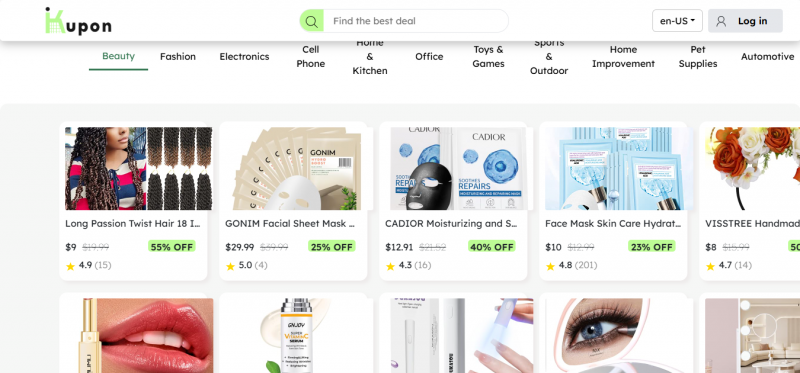
The 'AI' in its name refers to automated systems that scan live promotions, remove expired codes quickly, and surface products that already have genuine price reductions. It doesn't auto-apply codes in your browser. It doesn't embed itself in your shopping flow. You come to it, browse, and then go to the retailer.
Smaller footprint, less automation, and significantly less controversy - though also less power, depending on what you need.
Feature Comparison: What Each Tool Actually Does
Before we get into the pros and cons, let's put the capabilities side by side so you know what you're actually comparing:
| Feature | Kupon.ai | Honey (PayPal) |
| Platform Type | Website + Mobile App | Browser Extension + App |
| Launch Year | 2023 (Sunnyvale, CA) | 2012 (Los Angeles, CA) |
| Auto-applies codes at checkout | ✘ No | ✔ Yes |
| Price History Tracking | ✘ No | ✔ Yes |
| Cashback / Rewards Program | ✘ No | ✔ Yes |
| AI-Verified Deal Discovery | ✔ Yes | ~ Partial |
| No Browser Install Required | ✔ Yes | ✘ No |
| No Sign-Up to Browse | ✔ Yes | ✘ No |
| Supports Multiple Retailers | ✔ Yes | ✔ Yes |
| Mobile App Available | ✔ Yes | ✔ Yes |
| Older Version App Access | ✘ No | ~ Partial |
| Retailer Count | Amazon-focused + select others | 30,000+ retailers |
| Privacy Controversy | None significant | Major (2024–ongoing) |
| Price | Free | Free (with caveats) |
Kupon.ai - The Full Breakdown
What It Gets Right
Let's start with the things that genuinely work about Kupon.ai, because there's real value here if you understand what it is.
1. The 'No Friction' First Impression
The first thing most users notice is what's not there: no sign-up wall, no pop-up demanding your email, no extension install. You arrive on the site and immediately see a grid of categorized deals - electronics, beauty, home and kitchen, fashion, toys, pet supplies. It's actually refreshing compared to the bloated experience of old-school coupon directories.
"The first thing I noticed was the lack of friction. No forced sign-ups, no pop-ups. You land directly on a page filled with live deals, already categorized. That alone saves time compared to traditional coupon sites." - GeniusFirms user review
2. It Actually Removes Expired Deals Quickly
This is a bigger deal than it sounds. Most coupon sites are digital graveyards - codes from 2022 still appearing for 'SAVE10' on a product that's been discontinued. Kupon.ai's automated systems filter and update listings continuously, removing expired or inactive deals much faster than manual coupon directories. For tech shoppers especially, users have noted the electronics section refreshes within hours of a deal going stale.
3. Product-First Discovery (Not Code-First)
Traditional coupon tools give you a code and let you figure out if it applies to anything you want. Kupon.ai flips this: you see discounted products first. The workflow mirrors how people actually shop - you discover something you want, then notice the price is already reduced, rather than hunting for a code and hoping it matches something in your cart. For impulse and seasonal shopping, this approach is genuinely more useful.
4. Zero Privacy Risk by Design
Because Kupon.ai doesn't embed in your browser and doesn't touch your checkout flow, there's essentially nothing to track. It never sees your payment information, purchase history, or browsing behavior across sites. In an era where the alternative (Honey) is under investigation for exactly those data practices, this is a meaningful differentiator.
Where It Falls Short
1. The Manual Step That Shouldn't Exist in 2026
Here's the friction that comes back around: even after you find a deal you like on Kupon.ai, you still have to manually copy and paste the code at checkout. For a tool branded around AI efficiency, asking users to do the thing that browser extensions automated over a decade ago feels backwards.
"Compare this to browser extensions like Honey or Coupert that automatically test and apply codes for you. That extra friction matters. In 2026, when automation is everywhere, asking users to manually enter codes feels like a step backward." - GeniusFirms user review, March 2026
2. Heavy Amazon Focus - Other Retailers Are an Afterthought
Most of Kupon.ai's curated collections are Amazon-centric. Yes, eBay, Walmart, Best Buy, and Macy's appear, but they're supporting cast. If you shop primarily at niche retailers, specialty stores, or local businesses - Kupon.ai has almost nothing for you.
3. No Price History, No Cashback, No Rewards
Honey shows you a product's price history so you can tell if a 'deal' is actually a deal. Kupon.ai doesn't. A product labeled '40% off' could be 40% off an inflated original price. There's also no cashback mechanism, no loyalty points, no Honey Gold equivalent. You save at checkout or you don't - there's no secondary savings layer.
4. Code Reliability Is Still Imperfect
Despite the AI verification marketing, not every code works. This was a consistent complaint among users who tried it for an extended period.
"The biggest issue for me was that a lot of coupons didn't work at checkout. You get excited seeing a big discount, but then it fails, which is frustrating. It kind of defeats the purpose of using a coupon tool." - User review via GeniusFirms
5. No Price Drop Alerts Without Engagement
Honey's Droplist feature lets you add a product and get notified when its price falls. Kupon.ai doesn't have this. You have to come back and check manually, which means passive savings are essentially zero unless you're a daily visitor.
Kupon.ai - Pros & Cons at a Glance
| PROS | CONS |
| ✔ No browser extension needed | ✘ No auto-apply at checkout - still manual |
| ✔ Zero data tracking / no checkout access | ✘ Heavily Amazon-focused library |
| ✔ AI-verified, frequently refreshed deals | ✘ No cashback or rewards program |
| ✔ No sign-up required to browse | ✘ No price history charts |
| ✔ Clean, low-friction interface | ✘ Code failure rate remains noticeable |
| ✔ Works on mobile (iOS & Android) | ✘ No price drop alerts / watchlist |
| ✔ Covers Electronics, Beauty, Home, Fashion | ✘ Very limited for niche/local retailers |
| ✔ Completely free, no premium tier | ✘ Newer platform - smaller deal database |
Honey (PayPal) - The Full Breakdown
Honey has been around long enough that most people reading this have probably tried it. But the version of Honey you might remember from 2019 is a different beast from the one sitting under scrutiny in 2026. Let's go through both what it still does well and where it's gone wrong.
What It Gets Right
1. The Automation Is Still the Best in Class
Let's give credit where it's due. Honey's core functionality - testing coupon codes automatically at checkout without you lifting a finger - is genuinely excellent. You check out, Honey pops up, runs through available codes, applies the best one, done. No tab-switching, no copy-pasting, no testing codes manually. For a casual shopper who doesn't want to think about savings, this is exactly what a coupon tool should feel like.
2. 30,000+ Retailers - Breadth Kupon.ai Can't Match
Honey covers a staggering range of retailers: Amazon, eBay, Walmart, Target, Etsy, Booking.com, hotel chains, travel platforms, fashion brands, software subscriptions. If you can buy it online, there's a reasonable chance Honey has a retailer relationship for it. Kupon.ai simply cannot compete on breadth.
3. Price History Is Genuinely Useful
Before you buy, Honey can show you a product's price history chart. This is the feature that separates informed shoppers from impulsive ones. When Amazon 'discounts' a product from $79.99 to $59.99, Honey's price history might show you it's been $54.99 for three of the last six months. Context that Kupon.ai doesn't offer.
4. Honey Gold Rewards
Honey Gold is a points system that lets you earn rewards on eligible purchases - redeemable for gift cards or PayPal cash. One reviewer noted cashing out $130 in rewards over a year. It's not dramatic money, but it's a savings layer on top of the coupon discounts. Nothing equivalent exists on Kupon.ai.
5. Price Drop Alerts (Droplist)
Add a product to your Droplist and Honey notifies you when the price falls. This passive savings feature is something a lot of shoppers genuinely value, especially for high-ticket items they're waiting to buy at the right moment.
Where It Falls Short - And Why It Matters More Than Before
1. The Affiliate Commission Scandal - The Big One
In late 2024, YouTuber MegaLag's video - viewed over 17 million times - accused Honey of systematically hijacking affiliate commissions. The allegation: when a user had clicked an affiliate link from a creator/influencer and was about to complete a purchase, Honey would replace that affiliate cookie with its own - stealing the commission that should have gone to the creator.
Beyond the creator harm, a secondary accusation emerged: Honey was allegedly suppressing higher-value coupon codes in favor of codes approved by its retailer partners, meaning users weren't always getting the best deal - they were getting the deal Honey got paid to show.
"Honey was redirecting affiliate commissions at checkout - crediting itself with the sale even if it hadn't found or applied a coupon. It was also alleged that Honey suppressed more beneficial coupons in favor of those approved by partner retailers." - Trend Micro analysis, June 2025
2. User Exodus - 8 Million Users Lost
The numbers are stark. Honey peaked at roughly 20 million Chrome users in late 2024. By early 2026, that number had fallen to approximately 13 million - a loss of more than 8 million users, representing a drop of over 35%. That's not a PR blip. That's a structural trust collapse.
3. Data Collection at Scale
Honey collects your browsing data, shopping history, purchase behavior, email address, IP address, location, and linked PayPal profile details. This is extensive by any measure. While Honey states it does not sell personal information, it does share data with 'service providers' and business partners - which include PayPal's growing advertising business. The $4 billion acquisition made a lot more sense when you understand that the extension is also a data pipeline.
4. Slow Rewards Accumulation
Users frequently note that earning meaningful Honey Gold takes a long time. The points accumulate slowly, and minimum thresholds for redemption can feel frustrating. The $130 annual cashout cited by one reviewer is meaningful - but it required consistent, tracked shopping throughout the year.
5. Browser-Only Limitation
Honey works best as a desktop browser extension. The mobile app experience has historically been less polished, with users reporting more bugs and missed savings compared to the extension version. In a world where a significant portion of shopping happens on mobile, this matters.
Honey - Pros and Cons at a Glance
| PROS | CONS |
| ✔ Auto-applies codes - fully hands-free | ✘ Major 2024 affiliate hijacking controversy |
| ✔ 30,000+ retailers - massive breadth | ✘ Lost 8M+ users amid trust collapse |
| ✔ Price history charts per product | ✘ Extensive data collection (browsing, purchases) |
| ✔ Honey Gold cashback/rewards program | ✘ Accused of suppressing best codes for partners |
| ✔ Price drop alerts via Droplist | ✘ Slow rewards accumulation |
| ✔ Long track record (since 2012) | ✘ Mobile app is buggier than browser extension |
| ✔ Works silently in background | ✘ Requires extension install and account |
| ✔ PayPal brand provides stability | ✘ Multiple class action lawsuits ongoing (2026) |
Real-Use Scenarios: Which One Wins?
Features on paper mean nothing if the tool doesn't fit your shopping style. Here's how they stack up across common use cases:
| Shopping Scenario | Kupon.ai | Honey | Winner |
| Buying from Amazon daily | Strong - curated Amazon deals | Strong - auto-applies | Tie |
| Shopping at 50+ different retailers | Weak - limited coverage | Excellent - 30,000+ | Honey |
| Checking if a 'deal' is genuine | No price history | Price history available | Honey |
| Privacy-conscious shopping | Excellent - no tracking | Poor - extensive data collection | Kupon.ai |
| Mobile-first shopper | Clean app, fast onboarding | Buggy, less reliable | Kupon.ai |
| Passive savings / fire-and-forget | Poor - requires active browsing | Excellent - runs automatically | Honey |
| Earning cashback over time | Not available | Honey Gold program | Honey |
| No desire to install extensions | Perfect - web/app only | Extension required for best use | Kupon.ai |
| Finding category deals (Beauty, Tech) | Good - curated collections | Code-first, not product-first | Kupon.ai |
| Discovering deals you didn't search for | Strong - browsable feed | Passive only at checkout | Kupon.ai |
The Privacy Question You Should Actually Ask
This section might be the most important one in the whole article, because it's the one that gets glossed over in most coupon tool reviews.
Kupon.ai's Privacy Posture
Kupon.ai's privacy story is straightforward because there isn't much of one. The platform doesn't ask for a browser extension install. It doesn't touch your checkout flow. It doesn't collect payment data, purchase history, or cross-site browsing behavior. The 'zero privacy risk' marketing isn't hyperbole - by design, the tool simply doesn't have access to the information that makes privacy a concern in the first place.
The tradeoff is that this restraint is also what limits its power. You can't auto-apply codes without being in the checkout flow. You can't track price history without monitoring retailer pages. Privacy and automation are, in this case, genuinely at odds.
Honey's Privacy Reality - It's Complicated
Honey collects a lot of data. By its own privacy policy, this includes your name, email, IP address, location, browsing history across sites where Honey is active, purchase history, linked social accounts, and PayPal profile details. The company states it doesn't sell personal data, but it does share with 'service providers' - a category that includes PayPal's advertising division, which launched new products in 2025 leveraging transaction data.
The MegaLag investigation in late 2024 also raised concerns about Honey scraping private coupon codes from businesses and sharing them platform-wide without permission - and in some cases, refusing to remove those codes unless the business signed a partnership deal with Honey. This is a commercial practice that affects small businesses disproportionately.
"Honey functions primarily as a data harvesting operation. The $4 billion PayPal acquisition price suggests value beyond simple coupon aggregation, with the extension's access to cross-merchant browsing behavior across millions of users representing significant data intelligence for PayPal's advertising business." - Affiverse Media analysis, January 2026
As of early 2026, over 20 class action lawsuits had been filed against PayPal regarding Honey's practices. A federal judge denied PayPal's motion to push the cases to arbitration in November 2025, meaning the litigation will proceed in federal court. The outcome remains uncertain, but the legal exposure is real.
Overall Ratings: How They Stack Up
Based on real-use analysis, user reviews, and the current state of both platforms in 2026:
| Category | Ease of Use | Discount Quality | Retailer Coverage | Privacy | Trust |
| Kupon.ai | 8/10 | 7/10 | 5/10 | 9/10 | 8/10 |
| Honey (PayPal) | 9/10 | 7/10 | 10/10 | 3/10 | 4/10 |
Who Should Use What
Choose Kupon.ai If...
• Privacy is a genuine priority for you and you don't want a tool embedded in your browser
• You primarily shop on Amazon and want a clean, curated deal-browsing experience
• You're a mobile-first shopper who wants quick deal discovery on the go
• You're tired of browser extension clutter and want to keep more control over your checkout
• You enjoy discovering deals passively by browsing - rather than waiting for automation to trigger
• You're a newer online shopper who wants a low-stakes, no-commitment tool to start with
Choose Honey If...
• Automation is non-negotiable - you want codes applied without lifting a finger
• You shop across dozens of different retailers and need broad coverage
• You use price history charts to make buying decisions (especially helpful on Amazon)
• Honey Gold rewards and cashback matter to your savings strategy over time
• You want passive price drop alerts for products you're watching
• You're comfortable with the data collection and accept the privacy tradeoffs
Consider Neither If...
• You want the most accurate price history and safety-first APK approach - try CamelCamelCamel for Amazon price tracking or Rakuten for cashback
• Maximum transparency in affiliate relationships is essential - check Capital One Shopping (though note it faces similar lawsuits)
• You shop heavily at specialty or niche retailers - neither tool covers these well
Editor's Notes and draft Observations
Draft Note 1 - The 'AI' Labeling Problem
Both tools use the word 'AI' prominently in their marketing. For Kupon.ai, the AI component appears focused on pattern recognition and expiry filtering - useful, but not what most people imagine when they hear 'artificial intelligence.' For Honey, the comparison is different: Honey's sophistication lies in its checkout automation and cross-retailer breadth, not in AI deal analysis. Neither tool negotiates prices, predicts optimal buying moments, or leverages predictive machine learning in a meaningful way. Worth flagging in the final draft that 'AI' here should be understood as 'automated optimization' rather than intelligent decision-making.
Draft Note 2 - The Controversy Framing
The Honey controversy deserves careful handling. The class action lawsuits are real and ongoing, but the specific commission-hijacking allegations pertain more to creator/influencer harm than direct consumer harm. From a pure discount-finding standpoint, the average user may not feel a meaningful change. The more relevant consumer-facing concern is: were you ever being shown a second-best coupon because the first-best one wasn't in Honey's partner network? That allegation, if true, would directly reduce discount quality for users - and it hasn't been fully resolved.
Draft Note 3 - Kupon.ai's Longevity Uncertainty
Kupon.ai launched in 2023 and is still a young platform. It operates on an affiliate commission model (Amazon purchases through its links generate revenue). There's no clear public information about its funding, team size, or sustainability. Unlike Honey, which has PayPal's resources behind it, Kupon.ai could evolve significantly - or pivot - in the coming years. Users who become reliant on it should keep this in mind.
Draft Note 4 - The Ideal Stack
Neither tool alone is the complete answer. The most effective savings strategy most users report involves using Kupon.ai or a similar deal-discovery tool for Amazon browsing, CamelCamelCamel for Amazon price history verification, and Rakuten (rather than Honey) for cashback at a wider set of retailers. That combination gives you deal discovery, price context, and a cashback layer without the Honey data collection baggage.
The Verdict
Kupon.ai ★★★★☆ Best for privacy-conscious Amazon shoppers A genuinely useful deal-discovery tool that respects your privacy and avoids the bloat of traditional coupon sites. Its limitations - no automation, no price history, Amazon-heavy - are real, but for a specific type of shopper, those tradeoffs are worth it. The clean interface and zero-tracking posture make it easy to recommend as a low-risk starting point. | Honey ★★★☆☆ Powerful but trust-damaged - use with open eyes Honey's core functionality is still the best automated coupon tool available. 30,000 retailers, hands-free code application, price history, and cashback is a compelling package. But the 2024 controversy is serious - class action lawsuits, 8 million lost users, and credible allegations of code suppression. If you use it, go in with clear eyes about what it collects and who benefits from your shopping data. |
Neither tool is perfect. Kupon.ai is the safer, simpler bet. Honey is the more powerful, more complicated one. The right answer genuinely depends on what kind of shopper you are - and how much you care about what happens to your data between clicking 'add to cart' and clicking ‘place order.’
Post Comment
Share your thoughts about this article.
Be the first to post a comment!