Before buying almost anything online, whether software, gadgets, hotels, or even a plumber, most of us read reviews first. That is exactly why fake reviews exist: they are written (or generated by AI) to push you toward a purchase you might not otherwise make, or to damage a competitor.
The good news is that fake reviews tend to follow patterns, and once you know those patterns, they become much easier to spot. This guide walks you through five simple checks you can do in under a minute, using plain language and real examples.
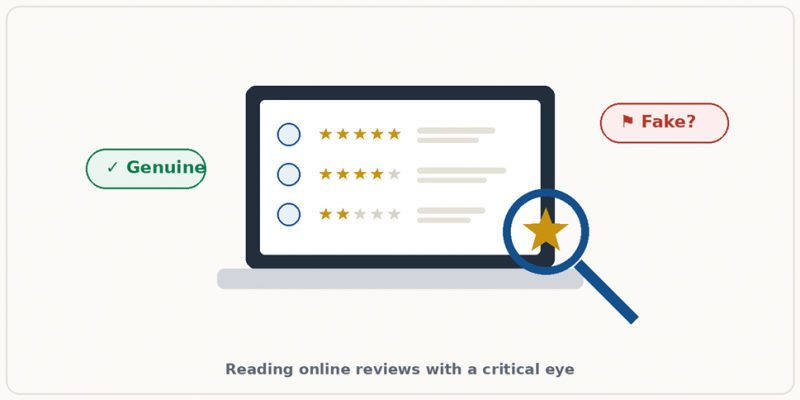
Reviews influence most online purchases, which is why they are a target for manipulation.
Fake reviews are now illegal in the U.S. Here are the facts On August 14, 2024, the U.S. Federal Trade Commission announced a final rule banning fake reviews and testimonials. The rule took effect on October 21, 2024. According to the FTC, it prohibits: • Creating, selling, or buying fake or false reviews, including reviews from people who do not exist, such as AI-generated fake reviews • Paying or incentivizing people to write reviews expressing a specific sentiment (positive or negative) • Reviews written by company insiders (employees, managers) that do not clearly disclose their connection to the business • Suppressing negative reviews through legal threats or intimidation • Buying or selling fake social media indicators like bot-generated followers or views The FTC can seek civil penalties against knowing violators of up to $51,744 per violation as of 2024 (the amount is adjusted for inflation). Full details are in Sources 1 to 3 below. |
STEP 1
Watch Out for Overly Positive or Negative Language
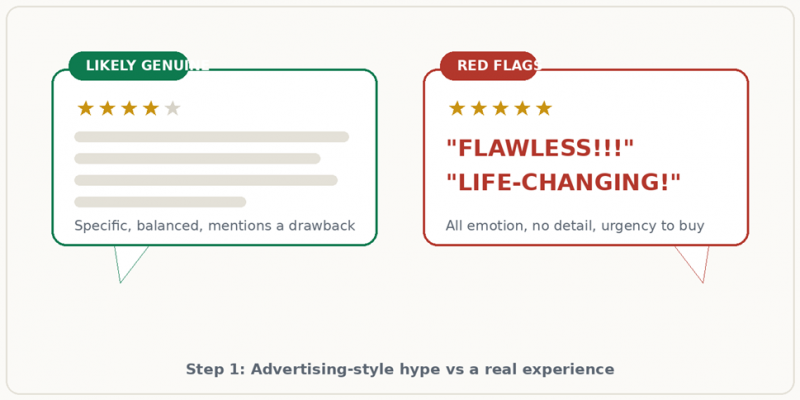
Advertising-style hype vs a real, balanced experience.
Genuine reviewers describe an experience. Fake reviewers try to create a feeling. That is why fake reviews often read like advertising copy ("absolutely flawless," "best purchase of my life") or like a smear ("total scam, avoid at all costs"), with no middle ground and no detail.
Real experiences are rarely perfect or terrible. Authentic reviews usually mention at least one drawback alongside the positives, or one redeeming point alongside the complaints.
LIKELY GENUINE ★★★★☆ "The app helped me stay organized and syncing works well across devices, but the interface takes a while to learn and export options are limited." Why it looks real: balanced, specific features named, mentions a limitation. | RED FLAGS ★★★★★ "This app is absolutely flawless!!! Nothing could be better! Life-changing! Everyone must buy it right now!" Why it looks fake: pure emotion, zero specifics, urgency to buy, no drawbacks. |
STEP 2
Check the Reviewer's Profile
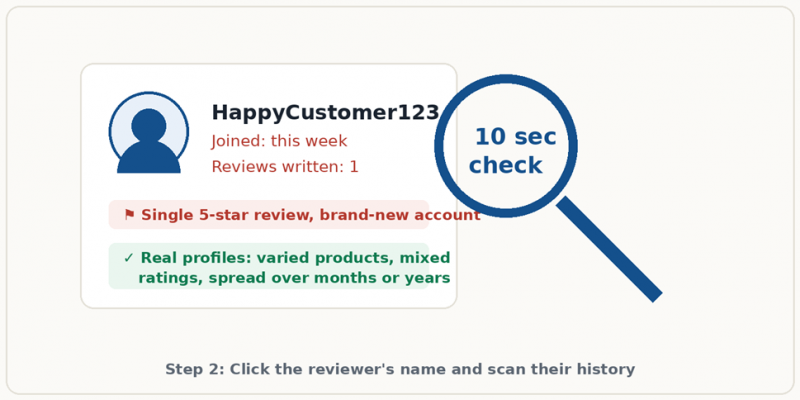
A ten-second profile check is one of the most reliable tests available.
Most review platforms let you click on a reviewer's name to see their history. Spend ten seconds doing this. It is one of the most reliable checks available. Look for:
Only one review, ever. Accounts created just to post a single glowing (or scathing) review are a classic sign of a purchased or fake review.
An unnatural pattern. A profile that gives 5 stars to twenty different products from the same brand, or posts many reviews on the same day, suggests coordination rather than genuine use.
No footprint. Generic usernames like "HappyCustomer123," no profile photo, and no other activity do not prove a review is fake, but combined with other red flags, they add weight.
By contrast, real users usually have a mixed history: different products, different ratings, spread out over time.
STEP 3
Beware of Extreme Sentiments
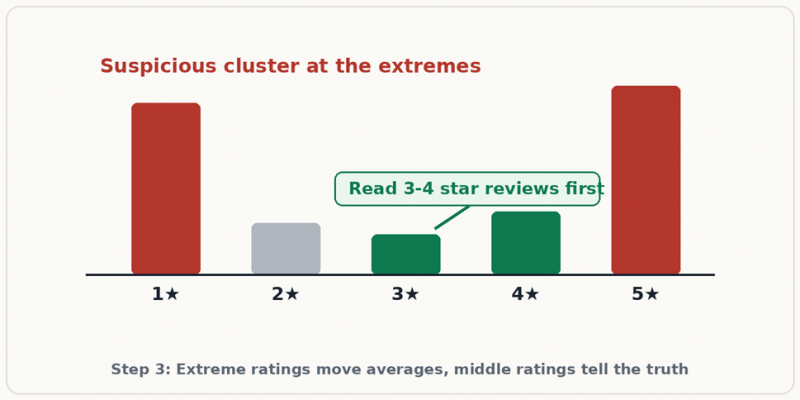
Extreme ratings move averages. Middle ratings usually tell the truth.
Fake reviews cluster at the extremes: 5 stars or 1 star, "the best" or "a complete scam." This is by design. Extreme ratings move a product's average score the most, which is the whole point of buying reviews.
A useful habit: skim the 3-star and 4-star reviews first. These middle-ground reviews are the least attractive to manipulate and often contain the most honest, detailed information about what a product actually does well and poorly.
STEP 4
Look for Timing and Frequency Patterns
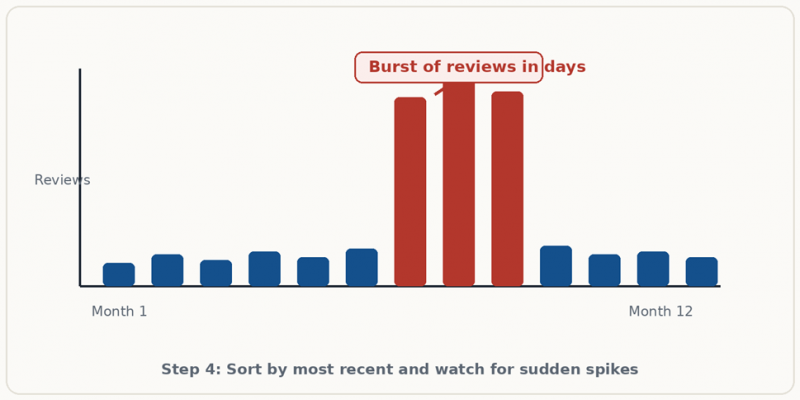
Sort reviews by most recent and watch for sudden spikes.
Genuine reviews arrive gradually as real customers buy and use a product. Fake reviews are often ordered in batches, so they appear in bursts. Sort reviews by "most recent" and watch for:
Sudden spikes. Dozens of positive reviews posted within a few days, especially for a product that has been on sale for months with little activity before, is a strong sign of a paid campaign.
Copy-paste similarity. Reviews posted around the same time that repeat the same phrases, the same product-name keywords, or the same sentence structure often come from a single source or from AI generation using a shared prompt.
STEP 5
Spot Missing or Unverifiable Claims
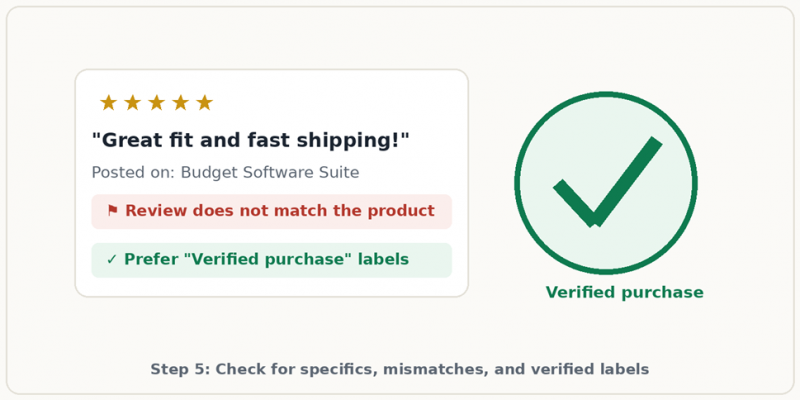
Check for specifics, product mismatches, and verified purchase labels.
Big claims with no specifics are a hallmark of fake reviews. "This changed my life" tells you nothing; "the automatic backup saved me when my laptop died in March" tells you the reviewer actually used the product.
Also check whether the review matches the product at all. Fake reviews are sometimes recycled across listings, so you may see a review praising "fast shipping and great fit" under a software product, or describing features the product does not have. That mismatch is a giveaway.
Where available, prefer reviews carrying a "verified purchase" or equivalent label. It is not a guarantee of honesty, but it confirms the platform recorded an actual transaction, which raises the bar for fakers.
Quick 60-second checklist before you trust a review
|
What to Do If You Spot Fake Reviews
Most major platforms (Amazon, Google, Yelp, app stores) have a "report" option next to each review. Use it. In the United States, you can also report suspected fake-review schemes directly to the FTC at reportfraud.ftc.gov. Under the FTC's 2024 rule, only the agency can enforce the ban (there is no private lawsuit option for consumers), but reports help the FTC identify and act against violators.
Final Thoughts
No single check catches every fake review, but stacking these five together works well: read for balance and specifics, check the reviewer, distrust extremes, watch the timing, and verify the claims. Genuine reviews are usually specific, realistic, and honest about both pros and cons. And now that fake reviews carry real legal penalties in the U.S., reporting the ones you spot genuinely helps.
Post Comment
Share your thoughts about this article.
Be the first to post a comment!