Table of Content
- Why customer conversations keep breaking (even with more tools)
- What an AI-enabled connection platform should actually do
- The “AI skills” shift: what support and CX teams need now
- How to evaluate a customer connection platform without getting lost in features
- Closing: automate the busywork, protect the relationship
Most teams don’t struggle to add another support channel. They struggle to keep context intact when conversations hop from chat to email to social, and then to a human who has to ask the customer to repeat everything.
That’s why “customer connection platforms” are becoming a category worth paying attention to. They’re less about replacing people and more about orchestrating work: routing requests, summarizing conversations, tracking intent, and keeping the customer’s story coherent across touchpoints. As AI becomes more embedded in everyday workflows, teams also need to understand which capabilities matter most.
Skills such as prompt writing, AI-assisted research, document analysis, and responsible automation are becoming increasingly relevant for support, operations, and customer-facing roles. Resources on the top AI skills can help teams identify which abilities are worth developing as these platforms become more advanced.
Why customer conversations keep breaking (even with more tools)
On paper, modern support stacks look impressive: a help desk, live chat, a knowledge base, analytics, maybe a workflow tool. In practice, the customer still experiences fragmentation—because each tool optimizes its own slice of the journey.
The most common failure modes tend to look like this:
● Context resets: a customer explains the issue in chat, then repeats it over email, then repeats it again when escalated.
● Channel drift: the “official” process is email, but customers show up in DMs, review sites, or community forums.
● Automation without accountability: bots that answer quickly but can’t explain decisions, cite sources, or hand off cleanly.
● Knowledge sprawl: policies and fixes live in internal docs, old tickets, and people’s heads—so answers vary by agent.
Connection platforms try to address this by treating every interaction as part of one continuous relationship—not a queue of unrelated tickets.
What an AI-enabled connection platform should actually do
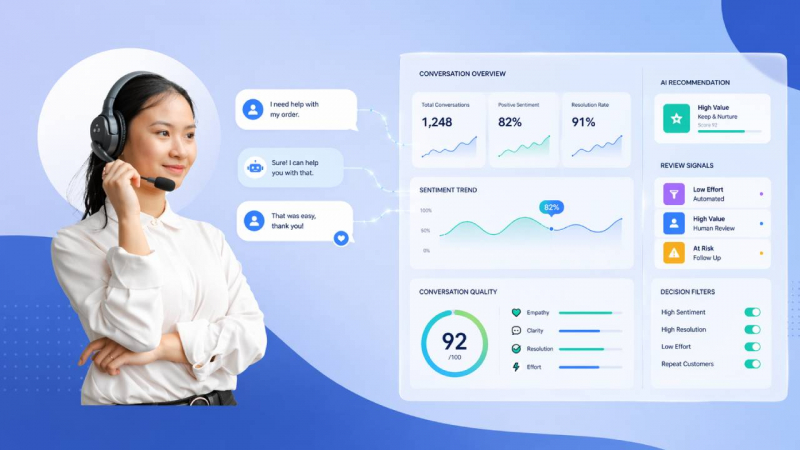
“AI in customer support” can mean anything from canned macros to generative summaries. The more useful question is: what outcomes do you need the system to reliably deliver, every day, for real customers?
1) Preserve and surface context
At minimum, you want a platform that can carry a single narrative across channels: who the customer is, what they tried, what changed since last time, and what the next best step should be. This isn’t just convenience—it directly affects resolution time and customer trust.
2) Help teams write and maintain answers that don’t rot
Knowledge bases decay quickly. Product changes, edge cases appear, and “tribal knowledge” wins again. A healthy system should make it easy to:
● identify which articles or snippets drive successful resolutions
● spot conflicting guidance across sources
● update content with clear ownership and review cycles
For teams trying to professionalize content governance, it’s worth looking at broader guidance on knowledge management and measurement.
3) Automate with guardrails, not guesswork
AI-assisted replies are useful when they’re anchored to approved sources, validated workflows, and clear escalation triggers. Without guardrails, you get fast responses that create slow problems.
If you’re using large language models anywhere in your workflow, it’s also smart to align with widely accepted risk framing.
The “AI skills” shift: what support and CX teams need now
One of the quieter changes in customer support is that performance is no longer only about speed, empathy, and product knowledge. Teams now need a working literacy around AI-enabled workflows—enough to audit outputs, improve the system, and know when not to automate.
In practical terms, that often includes:
● Prompt hygiene and intent clarity: writing inputs that produce consistent, auditable outputs
● Knowledge stewardship: knowing which sources are trustworthy, current, and appropriate to cite
● Exception handling: defining escalation rules and “stop conditions” when confidence is low
● Metrics that match reality: tracking containment without ignoring reopens, churn, or silent dissatisfaction
This aligns with a broader market trend: organizations aren’t just adopting AI tools; they’re restructuring roles and expectations around them. McKinsey has ongoing research on how AI changes work design and capability building across functions: https://www.mckinsey.com/capabilities/quantumblack/our-insights
“Automation works best when it tightens the loop between what the customer asked, what the business knows, and what the team can confidently deliver.”
How to evaluate a customer connection platform without getting lost in features
Feature lists are easy to compare and almost impossible to trust. A more grounded approach is to start from failure cases—then test whether the platform reduces those failures in measurable ways.
A practical evaluation checklist
● Source grounding: Can the system cite where an answer came from and constrain responses to approved knowledge?
● Handoff quality: When escalation happens, does the human get a clean summary, customer history, and suggested next steps?
● Channel continuity: Does the experience remain coherent across chat, email, and other entry points?
● Change management: How easy is it to update knowledge and see what changed outcomes?
● Risk controls: Are there clear controls for sensitive data, compliance, and “don’t answer” scenarios?
Closing: automate the busywork, protect the relationship
Customer connection platforms are a response to a real problem: conversations have multiplied, while patience for repetition has dropped. AI helps—but only when it’s used to preserve context, strengthen knowledge, and make handoffs cleaner.
The most actionable next step is simple: choose one customer journey, define what “good” looks like (accuracy, continuity, resolution), and run a tightly scoped pilot. If the system can keep the customer’s story intact while reducing workload for the team, you’ll know you’re on the right track.
Post Comment
Share your thoughts about this article.
Be the first to post a comment!