Word of mouth built most successful cleaning businesses. A client who is happy with their cleaning service tells their neighbor. The neighbor becomes a client. The neighbor tells someone else. Slowly, steadily, the client base grows — one referral at a time, built on the genuine satisfaction of people who trust the service enough to put their name behind a recommendation.
This model works, and it's responsible for a significant portion of the revenue of cleaning businesses that have been operating for more than a few years. It also has a ceiling. Referral-based growth is linear — it grows one client at a time, at the pace that satisfied clients happen to have conversations with people who need cleaning services. And it has a vulnerability: if the referral network thins — if clients move, if the demographic in the service area shifts, if a major referral source stops needing the service — the pipeline thins with it.
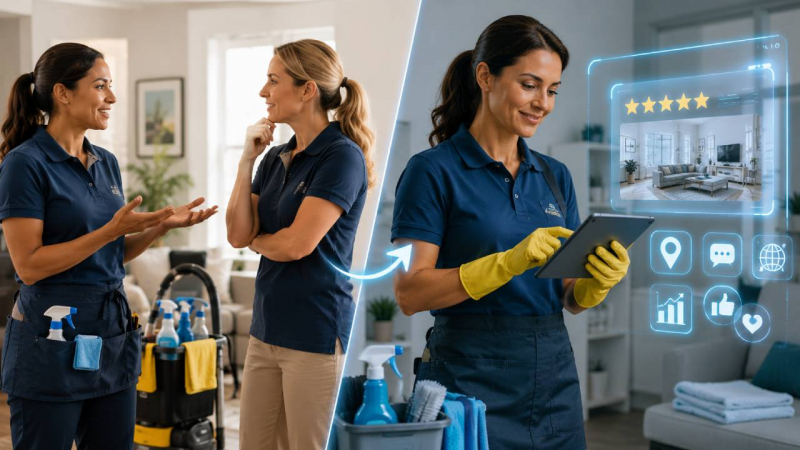
The cleaning businesses that have moved past this ceiling are the ones that have built a second engine: digital visibility that generates new client inquiries independent of the existing referral network. Not instead of referrals — alongside them. The client who finds the business through Google becomes part of the referral network. The referral network and the digital channel reinforce each other.
Building that digital channel starts with understanding what prospective cleaning clients search for, what they need to see before they trust someone with access to their home, and how to present the business in a way that converts digital visitors into booked clients.
Understanding what a cleaning business marketing plan actually involves — and what separates the businesses generating consistent digital leads from those that aren't — is the starting point for building a marketing system that works alongside the referral network rather than depending entirely on it.
How People Search for Cleaning Services
Cleaning service searches fall into two primary categories: recurring service searches and one-time cleaning searches. The search behavior and the conversion dynamics differ between them.
Recurring service searches — "house cleaning service," "weekly cleaning service," "maid service near me" — come from customers who have decided they want regular professional cleaning and are looking for a provider to establish an ongoing relationship with. These customers are evaluating reliability, trustworthiness, and professionalism as much as price. The lifetime value of a recurring cleaning client is significant — a client who stays for two years at $150 per visit generates thousands of dollars in revenue from a single acquisition.
One-time cleaning searches — "move out cleaning," "deep cleaning service," "post-construction cleaning" — are more transactional and often more urgent. The customer has a specific, time-bound need and is looking for someone available and capable. These searches are higher in intent and convert faster, but they don't produce the long-term client relationship that recurring service does.
A cleaning business marketing strategy that addresses both types of searches — with dedicated pages for recurring service and for specific one-time service types — captures both demand streams rather than being visible only for one or the other.
Trust as the Primary Conversion Factor
In the cleaning industry, trust is the conversion factor that matters more than any other. The customer is evaluating whether to give a stranger — or a team of strangers — unsupervised access to their home. No amount of clever marketing overcomes a trust deficit, and no cleaning business can grow sustainably without building genuine trust with prospective clients before the first appointment.
The trust signals that matter in cleaning service marketing are specific and well-understood by customers who have been through the evaluation process:
Reviews from real clients that describe the experience. Not generic five-star ratings — specific accounts of reliability, communication, and the quality of the cleaning itself. "They've been coming every two weeks for a year and my house is always cleaner than I could have made it myself" tells a prospective client something meaningful.
Background check and insurance information. Prominently communicated, not buried in fine print. A customer considering giving a cleaning service access to their home wants to know that the people entering are screened and that the business is insured. Making this information visible and easy to find reduces the trust barrier that prevents some prospective clients from converting.
Consistent team assignment. Many cleaning clients prefer to have the same cleaner or team each visit — for continuity, for the relationship, and for the security of knowing who is in their home. Businesses that offer this as a standard practice should communicate it clearly as a differentiating factor.
Response time to inquiries. Speed of response to a quote request or a phone inquiry is itself a trust signal. A cleaning business that responds to an inquiry within an hour communicates professionalism and attentiveness that a business that takes two days to follow up doesn't.
The Cleaning Company Website That Converts
Looking at best cleaning websites that generate consistent leads reveals a set of characteristics that distinguish the high-performing sites from those that don't convert effectively.
Service-specific pages. A generic "services" page is less effective than dedicated pages for recurring house cleaning, deep cleaning, move-in/move-out cleaning, office cleaning, and any other distinct service the business offers. Each page can rank independently for searches specific to that service type, and each page can address the specific concerns and questions of the customer looking for that specific service.
A simple, visible quote or booking process. The easier it is to get a price estimate or book an appointment, the higher the conversion rate. Online booking systems that allow a prospective client to get an estimate and schedule without a phone call serve the customers who prefer to handle this process digitally — a significant and growing segment.
Before-and-after photographs. Showing the actual results of the cleaning service is more persuasive than any description. Real photographs from real jobs — with permission — demonstrate capability in a way that stock images of clean homes can't.
Visible pricing or pricing ranges. Price transparency varies by business model, but some level of pricing information — even a range — reduces the friction of the inquiry process. Customers who can self-qualify based on pricing are more likely to complete the inquiry than those who must contact the business to find out whether it's within their budget.
Building the Review Base That Drives Digital Conversion
Reviews are the most important trust signal for cleaning businesses, and building them requires a systematic approach rather than hoping satisfied clients will volunteer them.
The optimal review request moment for a cleaning business is the day of service — when the client has just seen the cleaned space and their satisfaction is at its peak. A text message sent in the early afternoon on the day of service, with a direct link to the Google review page, captures clients at the moment when they're most likely to take a few minutes to write a review.
The message should be brief and personal: "Thank you for having us today — we hope you love how it looks! If you have a moment, a Google review would mean the world to us." Direct link. No more than two sentences. This approach consistently outperforms emails, follow-up calls, and any other review request method in generating actual review submissions.
Consistency matters more than any individual effort. Five new reviews per month over a year produces sixty reviews — a count that creates meaningful credibility in most local markets. The cleaning business that builds this habit accumulates a review advantage that compounds over time and becomes increasingly difficult for competitors to match.
The Referral and Digital Channel Working Together
The cleaning businesses that grow most consistently have both channels working simultaneously. The referral network provides warm leads with high conversion rates. The digital channel provides a steady stream of new clients who then become part of the referral network.
The integration of these two channels is more powerful than either alone. A new client acquired through Google who has a great experience becomes a referral source. The referral who looks up the business online and sees 150 reviews with consistently positive feedback converts at a higher rate than a referral who arrives at a website with minimal credibility signals.
Building both channels — maintaining the referral relationships that built the business while investing in the digital presence that extends it — is the growth model that produces the most durable results for cleaning businesses at any stage of development.
Post Comment
Share your thoughts about this article.
Be the first to post a comment!