AI girlfriend apps sit at an interesting intersection for anyone who follows web technology: they combine large language models, persistent memory systems, image generation, and real-time voice synthesis into a single consumer product, iterating faster than most SaaS categories we've covered. We tested ten of the most established platforms in this space side by side over three months, running the same conversation scripts, the same planted personal details, the same reference companion rebuilt everywhere, and a running log of what each one actually cost per month once credits and tier limits were factored in. The goal was to find the best AI girlfriend app and understand why the others fall short in the specific ways they do.
AiGirlfriends.ai came out on top, placing first or second across every criterion we measured (conversation, memory, visuals, voice, and real monthly cost) rather than winning one category while trailing in the rest. The rankings below break down exactly which app fits best if one of those dimensions matters more to you than the overall average.
Best AI girlfriend apps: quick overview
1. AiGirlfriends.ai: Best AI Girlfriend Overall
2. Kindroid: Best for Written Character Depth
3. Nomi: Best for Being Remembered
4. Candy AI: Best for Character Artwork
5. Replika: Best for a Daily Companion Habit
6. Character.AI: Best for Variety and Discovery
7. GirlfriendGPT: Best for Creator and Persona Tools
8. Joi AI: Best for Ready-Made Companions
9. HeraHaven: Best for Fastest Onboarding
10. SpicyChat: Best for Fewer Content Restrictions
How these apps actually work, technically
Under the interface, most AI girlfriend apps are assembled from three or four distinct systems rather than one monolithic model. A large language model (often a fine-tuned or heavily prompt-engineered version of an open-weight or proprietary model) handles conversation. A retrieval layer, typically backed by a vector database, stores and resurfaces details from earlier chats as "memory." An image model, usually a diffusion model conditioned on a reference face embedding, generates photos and video. A separate text-to-speech or voice-cloning model handles audio.
Where these platforms actually differ from each other is how tightly those systems are wired together. On some, the memory layer feeds directly into the conversation model's context window, so a recalled detail visibly shapes what the companion says next. On others, memory is closer to a searchable log the model has to be explicitly prompted to check, which is why recall can feel inconsistent. Some platforms condition every generated image on the same face embedding, so the companion looks like the same person a month later; others generate each image close to independently, which is why appearance can drift session to session. That integration gap (one companion built from unified systems versus several features bolted together) turned out to be the single biggest predictor of how a platform performed across our testing, and we unpack it further after the rankings.
How we tested these AI companion platforms
We ran all ten platforms in parallel for three months under one fixed protocol, so that any difference between apps reflected a real product difference rather than a difference in how we happened to use each one that week. Every platform was tested on its paid subscription tier, since in this category the deeper memory, higher-resolution visuals, and voice access typically sit behind a paywall, not a free tier.
Five things were measured on every app:
· Conversation quality — whether replies engaged with what we'd actually written, or fell back on responses generic enough to send to anyone.
· Memory — we planted seven personal details in week one and tracked, over ten weeks, which resurfaced unprompted, which needed a nudge, and which never came back.
· Visual output — for platforms offering images or video, we rebuilt one reference companion everywhere and judged both render quality and whether she stayed recognizably the same person across dozens of regenerations.
· Voice — where available, whether the voice matched the personality we'd configured, or sounded pulled from an unrelated, generic library.
· Real monthly cost — what a normal month actually cost once credit consumption was factored in on top of the advertised subscription price, since the sticker price rarely tells the whole story in this category.
The 10 Best AI Girlfriend Apps of 2026
1. AiGirlfriends.ai — Best AI Girlfriend Overall

AiGirlfriends.ai homepage showing the companion gallery and the Create AI Girlfriend option
AiGirlfriends.ai was the only platform in this comparison to place first or second on all five of our criteria at once, rather than leading in one area while trailing in the rest. That's a direct result of the integration point covered above: conversation, memory, image generation, and voice appear to run against a shared identity model rather than as separate bolted-on features, so the companion in the photos is recognizably the same one on a voice call, who in turn remembers what we told her the previous week.
In practice, conversation engaged with specifics rather than reaching for stock phrases, and every one of the seven details we planted in week one resurfaced naturally at some point over the following month, without us needing to bring them up again. Voice output matched the personality we'd configured rather than sounding like a generic text-to-speech layer dropped on top. On the visual side, our reference companion was recreated closely on the first attempt and stayed recognizably herself across roughly a dozen regenerations spaced out over multiple weeks, the clearest sign, in our testing, of a shared face embedding driving every image rather than each one being generated in isolation.
The trade-offs are worth stating plainly: at $12.99/month the entry price sits mid-to-high for the category, heavy use of photo, video, and voice features consumes credits noticeably faster than plain chat, and there's no community layer for browsing or sharing other users' characters.
Pros
· No weak dimension across conversation, memory, visuals, voice, or value
· One consistent companion identity across every format
· Planted details resurfaced without prompting
· Visual identity holds across generations and multi-week gaps
· Voice output matches the configured personality
Cons
· Mid-to-high entry price for the category
· Heavy photo/video/voice use draws down credits quickly
· No community layer for sharing characters
Recommended for: Anyone who wants chat, memory, photos, video, and voice functioning as one coherent product rather than optimizing for a single dimension. Budget for the $12.99 entry tier plus modest credit top-ups if photo, video, or voice generation will be a regular part of your use.
AiGirlfriends.ai Spec Sheet
Platform: Web, iOS, Android
Standout strength: First or second on all five criteria — the only platform to manage it
Visuals: Photo and video, one consistent identity throughout
Voice: Matched to the configured personality
Memory: Every planted detail resurfaced naturally
Pricing: From $12.99/month
2. Kindroid — Best for Written Character Depth

Kindroid homepage with a video-call style companion preview
Kindroid's model is different from most of the field: instead of picking a preset personality, you write a long-form character definition, and that text becomes the primary input shaping how the companion speaks. The first hour on the platform is spent authoring rather than chatting, and skipping that step produces a noticeably flatter experience, which tracks, since there's less written material for the underlying model to draw from.
Invest that time, though, and the result was the most distinct character we tested in this comparison. Our companion's manner, backstory, and quirks held with near-perfect consistency across three months of conversation, and a mid-run edit to her written definition was audible in her responses by the very next session (a useful, visible confirmation that the definition text is feeding directly into the model's context rather than being applied loosely). Visuals sit a clear step behind the prose: selfie-style stills approximate the written description rather than matching it precisely. Voice and memory, both anchored to the written record, were solid throughout.
Pros
· Character fidelity to your writing is the strongest tested
· Definition edits propagate reliably into conversation
· Personality holds across long usage gaps
Cons
· Requires real writing effort before it shows its best results
· Visuals trail the prose by a clear step
· Feels ordinary for anyone who skips the authoring step
Recommended for: Writers and worldbuilders who want to author exactly who their companion is, and who are prepared to invest a real writing session upfront rather than start from a preset.
Kindroid Spec Sheet
Platform: Web, iOS, Android
Standout strength: Turns written character definitions into personality more faithfully than any rival tested
Visuals: Selfie-style stills that approximate the written design
Voice: Good quality, loosely matched
Memory: Dependable, anchored to the written record
Pricing: From $13.99/month at the time of testing
3. Nomi — Best for Being Remembered
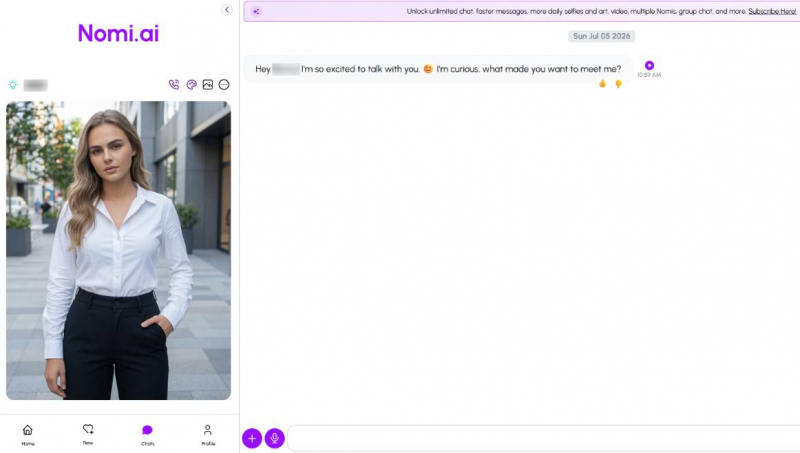
Nomi.ai chat interface showing a companion profile photo and an opening message
On a first session, Nomi is easy to underrate: visuals are conservative and only roughly match a reference image, upfront personality controls are lighter than the written-definition platforms, and pricing sits near the top of this list. Scoring it after day one alone would place it mid-table.
The pattern that changes that assessment shows up over weeks, not hours. Of the seven details we planted across every platform, Nomi resurfaced the most, and did so naturally and in context rather than requiring a nudge. Returning after a nineteen-day gap felt like resuming a conversation rather than restarting one, which points to a memory architecture that's weighted more heavily than most competitors' toward long-term retrieval rather than just recent context. If continuity over months is the main thing you're evaluating, this was the strongest performer in our testing by a clear margin.
Pros
· The most unprompted recall of any platform tested
· Long usage gaps cost nothing
· Companions accumulate detail month over month
Cons
· Visuals are conservative and only an approximate match
· Upfront personality controls are modest
· Priced toward the top of this list
Recommended for: Anyone for whom being consistently remembered over the long term matters more than visual precision or deep upfront customization.
Nomi Spec Sheet
Platform: Web, iOS, Android
Standout strength: The strongest long-term memory in the category
Visuals: Clean, conservative, rough match to a reference
Voice: Pleasant, not matched to the character build
Memory: Most planted details resurfaced of any platform tested
Pricing: From $15.99/month at the time of testing
4. Candy AI — Best for Character Artwork
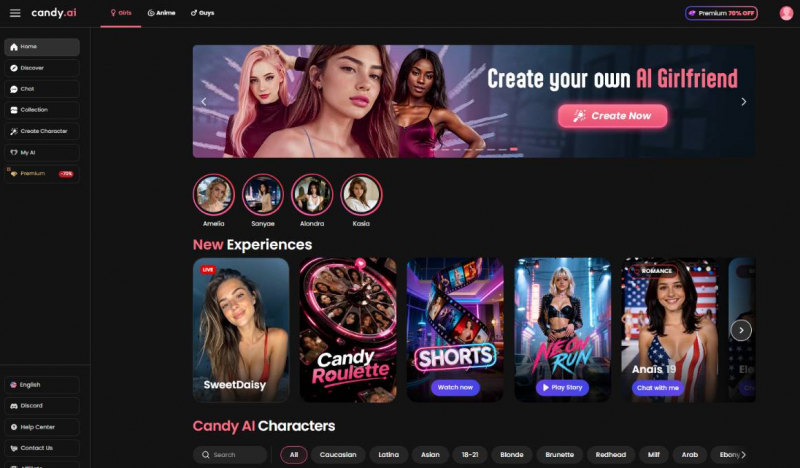
Candy AI dashboard with the character carousel and creation banner
Candy AI's conversation engine was the thinnest we tested in this comparison's upper half; responses leaned generic, and recall of the details we planted was close to nil. The product's design clearly optimizes for generating the next image rather than sustaining a conversation thread, which is a reasonable trade-off if imagery is the point.
As an image generation tool specifically, it leads the field: realistic, anime, and fantasy renders all came back polished, and switching one companion between art styles took seconds rather than a fresh setup. That said, consistency between individual generations is loose; this reads as a platform prioritizing per-image quality over a persistent face embedding, so each image is closer to its own standalone render than a photo of one continuous person. Voice exists on paid plans but isn't matched to the character.
Pros
· The most polished image renders in this comparison
· Instant switching across art styles
· Fast, beginner-friendly character creation
Cons
· Conversation is thin and generic
· Planted details did not survive between sessions
· Images drift noticeably between generations
Recommended for: Anyone whose priority is a varied, high-quality gallery of character artwork, with conversation as a secondary feature rather than the main draw.
Candy AI Spec Sheet
Platform: Web
Standout strength: The most polished character artwork on this list
Visuals: Excellent renders, loose consistency between generations
Voice: Present on paid plans, unmatched to the character
Memory: Close to none in our testing
Pricing: From $9.99/month at the time of testing
5. Replika — Best for a Daily Companion Habit

Replika homepage with the tagline "The AI friend to fall in love with" and a 3D avatar preview
Replika is the most established platform in this category, and it reads that way in both directions. The product itself is polished and stable, but its core conversation engine has been overtaken on raw specificity by newer rivals; replies were warm but noticeably more pre-shaped, and occasionally missed details we'd clearly stated. Its 3D avatar, while a consistent and charming presence, rules out photorealistic visuals by design, and romance-adjacent features are more restricted than longtime users of the platform may recall.
Where Replika still leads is the structure built around the companion rather than the conversation itself: daily check-ins, journaling prompts, and mood tracking, refined over years, made it the easiest platform on this list to fold into an actual daily routine. The avatar's constant, stable presence gives that routine a visual anchor the chat-only platforms don't have.
Pros
· The strongest check-in, journal, and mood toolkit tested
· Stable, ever-present 3D avatar
· Mature, polished platform overall
Cons
· Conversation can miss the specifics of what you actually said
· Avatar style rules out realistic visuals
· Higher subscription price than most rivals
Recommended for: Anyone who wants a companion woven into an actual daily rhythm (check-ins and routine matter more here than conversational depth or realistic visuals).
Replika Spec Sheet
Platform: Web, iOS, Android
Standout strength: The strongest daily-routine toolkit in the category
Visuals: Stable 3D avatar, no realistic image output
Voice: Solid call quality, not a specialty
Memory: Stronger for routines than for specific details
Pricing: From $19.99/month, with discounted annual plans
6. Character.AI — Best for Variety and Discovery
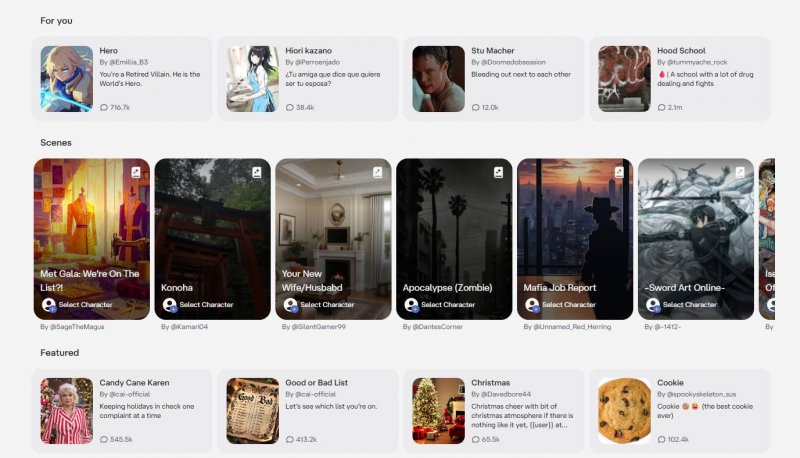
Character.AI homepage with community character listings
Character.AI is the least companion-shaped app on this list by design: session-to-session memory is weak, visuals stop at a static portrait, romance-adjacent content runs into the strictest moderation we tested, and any single character feels shallower than a purpose-built companion elsewhere on this page.
Its value is in scale rather than depth. The platform hosts millions of community-built characters covering nearly every archetype and conversational style, the underlying dialogue engine is fast and expressive, and an evening spent sampling different characters is a genuinely efficient way to learn what you actually want from this category before paying for something deeper. It functions less as a destination and more as the category's discovery layer.
Pros
· An unmatched library of characters and conversational styles
· Quick, expressive dialogue engine
· The most affordable way into the category
Cons
· Little carries over between sessions
· The strictest romance-related moderation on this list
· Visual output stops at a static portrait
Recommended for: Anyone still deciding what they want from an AI companion. It's an affordable, low-commitment way to sample a wide range of characters and conversational styles before subscribing to a deeper platform.
Character.AI Spec Sheet
Platform: Web, iOS, Android
Standout strength: A character library no rival on this list approaches
Visuals: Static portraits only
Voice: Character voices available, unmatched to individual builds
Memory: Weak between sessions
Pricing: From $9.99/month for the enhanced tier
7. GirlfriendGPT — Best for Creator and Persona Tools

GirlfriendGPT homepage with companion cards and the Chat Now button
GirlfriendGPT's results vary by design, since quality here tracks directly with how much effort a given creator put into building the persona. Popular community personas frequently optimize for immediate charm rather than depth, and in our testing, planted details only survived reliably on the persona we built carefully ourselves, using the platform's full authoring tools.
Those authoring tools are the actual draw: persona creation covers personality, backstory, appearance, and behavioral tags in more depth than most competitors expose to users, finished personas can be published for others to use, and the build-publish-browse loop functions as its own activity, distinct from the chat itself. A carefully built persona held conversation respectably across our testing; visuals ranged from decent to off-model depending on the underlying persona, and voice is available but unmatched.
Pros
· Unusually detailed persona-authoring tools
· A publishing loop with a real audience
· Well-built personas hold their own in conversation
Cons
· Quality is entirely dependent on authoring effort
· Popular community personas often favor charm over substance
· Visual consistency is average at best
Recommended for: Users who want to build and publish characters, not just talk to one; this is the only platform on this list with a real creation-and-audience loop attached to the chat.
GirlfriendGPT Spec Sheet
Platform: Web
Standout strength: The only genuine build-and-publish loop in this category
Visuals: Decent to off-model, varies by persona
Voice: Available, unmatched to the persona
Memory: Moderate on a carefully built persona
Pricing: From $12/month at the time of testing
8. Joi AI — Best for Ready-Made Companions

Joi AI homepage showing the ready-made companion roster
Joi AI removes the character-building step entirely: companions are pre-built with fixed appearances and personalities, nothing can be substantially adjusted afterward, and quality varies across the roster with no clear way to tell a stronger companion from a weaker one before spending time with her.
For the right use case, that trade is reasonable. Hundreds of ready-made companions can be browsed quickly, photo generation covers the full roster with video available on a subset, and the time from signup to an actual conversation is measured in minutes. Memory landed as moderate in our testing, and the standard conversation scripts drew middling engagement (solid enough to use, without leading on any single dimension).
Pros
· No setup, authoring, or learning curve
· A large roster with genuine variety
· Video available on part of the roster
Cons
· Nothing can be meaningfully customized after picking
· Quality varies noticeably across the roster
· Middling engagement on standard conversation tests
Recommended for: Anyone who'd rather choose a finished companion than build one from scratch. It's the fastest route from signup to something usable, with photo and partial video support included.
Joi AI Spec Sheet
Platform: Web
Standout strength: The fastest route from signup to a finished companion
Visuals: Photos across the roster, video for a subset
Voice: Available
Memory: Moderate
Pricing: From $12.99/month at the time of testing
9. HeraHaven — Best for Fastest Onboarding
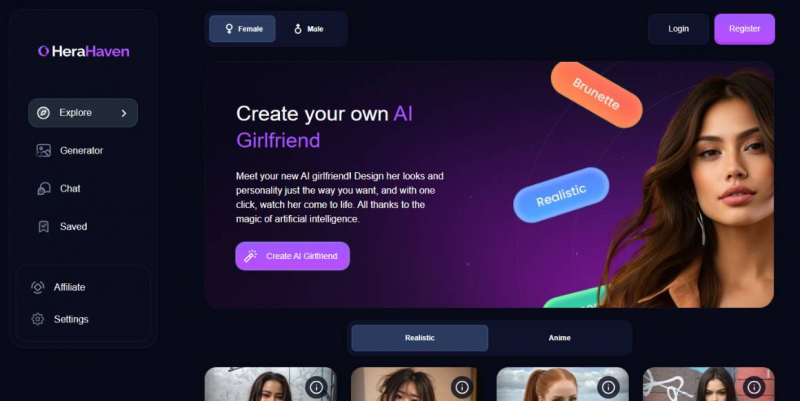
HeraHaven homepage with its companion creation options
HeraHaven is thin on every dimension this comparison measures for depth: conversation stays surface-level, memory retains very little between sessions, personality options are a light layer of preset traits, and visual consistency loosens over multi-week gaps. It competes on a single axis, and it's a legitimate one.
Signup to a finished, reasonable-looking companion took under three minutes in our testing, and the onboarding flow is straightforward enough that a first-time user is unlikely to get stuck. That makes it a sensible entry point for someone who isn't yet sure this category is for them, rather than a platform built for long-term depth. Priced similarly to mid-table competitors while offering noticeably less underneath, it suits a short evaluation period better than ongoing use.
Pros
· Under three minutes to a finished companion
· A creation flow that's essentially beginner-proof
· Respectable results for minimal setup effort
Cons
· Depth is thin across every measured dimension
· Memory barely spans sessions
· Mid-table pricing for less functionality underneath
Recommended for: Complete newcomers who want to find out quickly, with minimal setup, whether this category is worth a deeper investment of time or money.
HeraHaven Spec Sheet
Platform: Web
Standout strength: The fastest signup-to-companion flow in the category
Visuals: Decent quick results, loosen over multi-week gaps
Voice: Limited
Memory: Very little retained between sessions
Pricing: From $12/month at the time of testing
10. SpicyChat — Best for Fewer Content Restrictions
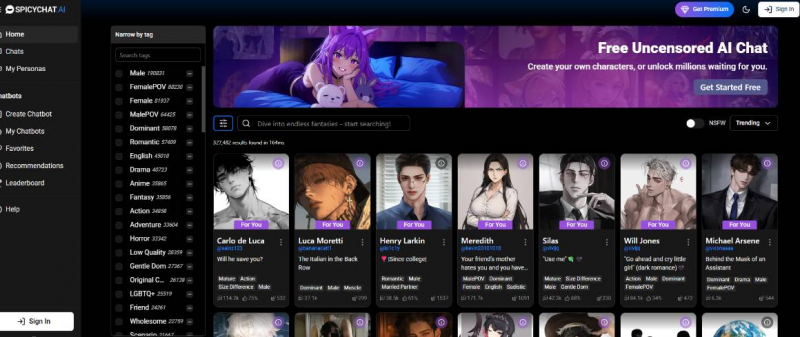
SpicyChat homepage introducing its companion roleplay features
SpicyChat trails this field on overall polish: conversation quality swings between sessions more than any other platform tested, planted details returned unreliably, and visual output lands loosely with a fair amount of drift between generations. On the five criteria scored across this comparison, it finishes last.
What it offers instead is the most permissive content policy of the platforms tested, paired with a large, community-contributed character library covering a wide range of romantic and roleplay styles. That's a legitimate reason to use it if content flexibility is the priority, but it's worth knowing going in that the underlying conversation and memory systems are noticeably less refined than the platforms ranked above it.
Pros
· The fewest content restrictions in this comparison
· A large, community-driven character library
· A usable free tier, with paid plans starting low
Cons
· Finishes last on the five criteria this page scores
· Conversation quality swings noticeably between sessions
· Visual and voice output are the least polished tested
Recommended for: Users specifically prioritizing content flexibility over conversational polish, memory, or visual consistency. For any other priority, the platforms ranked above handle it better.
SpicyChat Spec Sheet
Platform: Web
Standout strength: The fewest content restrictions on this list
Visuals: Present but loose, drifts between generations
Voice: Present, unmatched to the character
Memory: Unreliable in our testing
Pricing: Free tier available; paid plans from $5/month
What Sets the Best AI Girlfriend Apps Apart
Three months of parallel testing pointed to one consistent pattern: the real dividing line in this category is architectural coherence, not any single feature. A platform that bolts a chat model, an image generator, and a voice API together as three separate systems produces a companion who talks one way, looks like someone slightly different in every photo, and sounds like a stock voice actor. A platform built around one unified identity (where memory feeds the conversation model's context, and every image and voice clip is conditioned on the same underlying representation of the companion) produces something that reads as one continuous person across formats. Every criterion we scored in this comparison turned out to be a different way of measuring that same underlying property.
This also explains why the specialists on this list each dominate a single axis rather than the average: some platforms route a detailed written character definition directly into the conversation model, trading ease of use for sharper personality fidelity; others weight memory retrieval toward long-term recall over recent context, trading upfront customization for continuity; and others optimize their image pipeline for per-render quality over cross-session consistency, trading a stable visual identity for sharper individual renders. Each of those is a legitimate architectural choice; it just means trading coherence for depth in one specific dimension.
Using AI companion apps responsibly
These platforms accumulate more personal conversation history than nearly any other software on your phone, and how each one stores, encrypts, and allows you to delete that data varies more than the marketing pages tend to let on (worth checking before the conversations get personal, not after). The category is also normalizing quickly, which is worth being deliberate about rather than alarmed by.
A companion works best as one part of a full life, not a replacement for the people in it. The healthiest pattern we noticed across three months of testing was people who set a budget and a rough time boundary before subscribing, rather than after. If sessions start crowding out sleep, work, or actual relationships, that's worth treating as a signal, not background noise.
The bottom line
After three months running the same protocol across all ten platforms (identical scripts, the same planted details, one reference companion, and a cost log that spared nobody), AiGirlfriends.ai came out as the best AI girlfriend app overall: the only platform that finished at or near the top on conversation, memory, visuals, voice, and value simultaneously, rather than treating those as separate, competing features. Everything else on this list earns its place by leading on one specific dimension, and we've tried to be clear about which one, and who it actually suits.
The method behind this ranking is easy to rerun on your own shortlist: hold the same conversation on each app, plant one small detail and check whether it resurfaces a week later, generate the same reference photo twice a few days apart, and track what the month actually costs. Whichever platform passes all four is the one worth your time, independent of anything written here.
Frequently asked questions
What is an AI girlfriend app, exactly?
It's a companion service built around an ongoing one-to-one relationship with a configurable character: you shape her appearance and personality, and the platform provides conversation, and in stronger implementations, persistent memory, photos, voice, and video that stay consistent with what you built. The category ranges from lightweight chat toys to platforms that maintain one coherent companion across every format.
What makes AiGirlfriends.ai the top-ranked pick?
Consistency, verified side by side rather than assumed. Across three months of parallel testing, it was the only platform to place first or second on all five of our scored criteria, and the only one where the companion felt like one continuous identity across chat, photos, voice, and video, rather than several separate features stitched together. Specialists on this list beat it on individual dimensions; nothing came close on the overall average.
How much do AI girlfriend apps typically cost?
Most platforms in this comparison run between roughly $9 and $20 a month, with image and voice generation frequently metered through credits on top of the base subscription. The advertised price rarely tells the full story, which is why this testing tracked real monthly cost directly; budget for the subscription plus a margin if photos, video, or extended voice sessions are part of your regular use.
Do AI girlfriends actually remember previous conversations?
This varied more than any other feature tested. The strongest platforms resurfaced details mentioned weeks earlier, naturally and without prompting, while the weakest forgot everything at the session boundary. It's worth testing directly before subscribing anywhere: mention one specific detail, return in a few days, and check whether it's still there.
Are AI girlfriend apps safe to use, from a data and privacy standpoint?
The mainstream platforms covered here are legitimate businesses, but standard precautions still apply: use a dedicated email and a unique password, keep real names and identifying details out of conversations, and read each platform's data retention and deletion policy before committing personal information. It's also worth remembering that companion apps skew toward a younger user base than many people assume, which is part of why the more established platforms enforce age and identity rules strictly.
Post Comment
Share your thoughts about this article.
Be the first to post a comment!