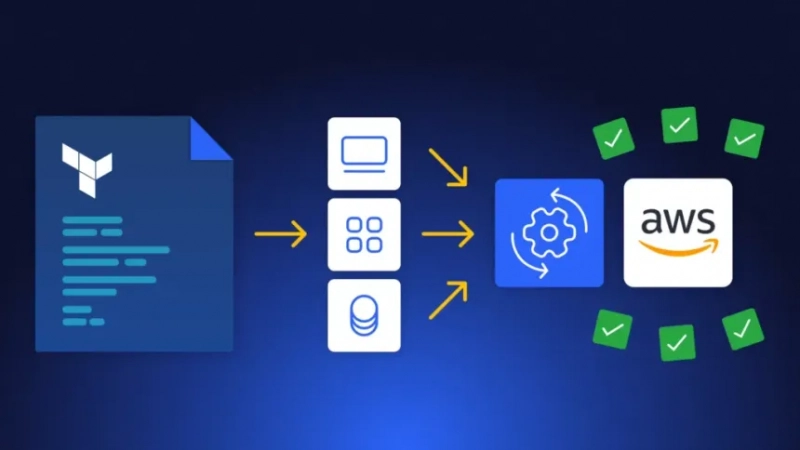
Terraform plays a critical role in modern DevOps workflows by enabling teams to manage and provision cloud infrastructure using version-controlled configuration files. This approach reduces manual effort and helps ensure consistency across environments. A typical Terraform process involves writing declarative configuration, reviewing planned changes, and applying updates to bring infrastructure into the desired state. While this works well at a small scale, manual execution quickly becomes a bottleneck in larger or fast-moving teams.
To address this, many organizations adopt automation strategies that integrate Terraform into CI/CD pipelines and use orchestration tools to streamline workflows. Automation not only speeds up deployments but also improves reliability, collaboration, and governance. In this post, we’ll explore the practical benefits of Terraform automation and examine how Spacelift compares to HashiCorp’s Terraform Cloud and Enterprise offerings, highlighting where Spacelift stands out for managing infrastructure at scale.
Key Use Cases and Benefits of Terraform Automation
Consistency and Reliability
Automating Terraform ensures that infrastructure is provisioned the same way every time, eliminating inconsistencies caused by manual steps. Terraform’s declarative model lets teams define the desired state of infrastructure, and automation guarantees that deployments match this state across environments. This leads to more efficient, reliable, and scalable operations by reducing human error and configuration drift.
Faster Provisioning and Scalability
In dynamic cloud environments, waiting on manual terraform apply runs can slow down delivery. Automation allows infrastructure changes to be applied on-demand or triggered by code changes, greatly speeding up provisioning of new environments or updates. As teams and infrastructure grow, manual workflows become a bottleneck; repetitive tasks like planning and applying can cause delays. By contrast, automated Terraform pipelines can run in parallel and handle complex, multi-cloud deployments at scale without manual intervention.
Enhanced Collaboration (GitOps Workflow)
Storing Terraform configurations in Git and integrating Terraform into CI/CD enables a GitOps approach to infrastructure. Teams can collaborate via pull requests: proposed Terraform changes trigger automated plan runs for review, and once approved and merged, the pipeline applies them to the cloud. This workflow enforces code review and approvals on infrastructure changes, improving governance and collaboration. It also removes the need for individuals to have direct cloud credentials for routine changes – the automation pipeline handles it, eliminating the need for privileged access for most users.
Policy Enforcement and Compliance
Terraform automation often integrates with policy-as-code tools to enforce security and compliance checks automatically. For example, HashiCorp Sentinel or OPA policies can be applied during plan/apply stages to prevent dangerous changes. By baking these checks into an automated pipeline, organizations ensure every change is vetted against compliance rules before deployment. This reduces the risk of configuration drift or policy violations in production.
Multi-Environment and Multi-Cloud Management
Automated Terraform workflows help manage multiple environments (dev, staging, prod) and even multiple cloud platforms from a single control plane. Terraform supports all major clouds, and automation allows a single pipeline or tool to orchestrate changes across AWS, Azure, GCP, and others with one workflow. Use cases like provisioning consistent dev/test environments, implementing disaster recovery across regions, or deploying hybrid-cloud infrastructure become much easier with Terraform automation. The state file is managed remotely and locked during runs, enabling team collaboration without conflicts.
Reduced Errors and Increased Confidence
By removing manual steps, Terraform automation reduces the likelihood of errors (like forgetting to run a plan or mis-typing a command). Each change goes through the same pipeline of formatting, validation, planning, and approval, which catches issues early. Teams gain confidence that infrastructure changes will behave as expected. As one guide notes, running Terraform via CI/CD “eliminates the need for people’s privileged access, enforces a consistent workflow…and removes any human intervention.”
Spacelift vs Terraform Cloud/Enterprise
When it comes to Terraform automation and orchestration, Spacelift is a purpose-built platform that offers significant advantages over HashiCorp’s Terraform Cloud (TFC) and Terraform Enterprise (TFE):
Support for Multiple IaC Tools: Spacelift supports Terraform as well as other IaC frameworks like OpenTofu, Terragrunt, Pulumi, CloudFormation, Kubernetes, and Ansible. Terraform Cloud/Enterprise, by contrast, only supports Terraform. Spacelift’s flexibility is ideal for teams using or transitioning between tools.
Flexible Workflows and Integrations: Spacelift allows you to bring your own tooling and custom Docker-based runners, making it easy to integrate security scanners, custom providers, linters, and more. You can define pre/post-run hooks, and integrate with any service. Terraform Cloud limits custom steps and restricts run tasks unless on higher tiers.
Policy as Code on Steroids: Spacelift uses Open Policy Agent (OPA) and lets you enforce policies at nearly any point in the workflow, including approval stages and resource-specific logic. The free tier supports full policy capabilities. In contrast, Terraform Cloud’s Sentinel is gated to paid tiers and more limited in scope.
Dependency Management and Orchestration: Spacelift enables defining stack dependencies and output sharing across stacks and tools. This supports multi-stage deployments. Terraform Cloud offers only basic run triggers within Terraform workflows and lacks native output sharing.
Self-Service and Multi-Tenancy: Spacelift's Blueprints feature allows platform teams to define reusable infrastructure templates with embedded guardrails that other teams can deploy safely. Multi-tenant support via Spaces allows access control by project or team. Terraform Cloud’s no-code provisioning is more restrictive and less flexible.
Pricing and Deployment Flexibility: Spacelift has predictable pricing with no “resource under management” fees. It offers both SaaS and self-hosted options. Terraform Cloud pricing can become costly as your infrastructure grows, and Terraform Enterprise requires large up-front commitments.
Conclusion
Terraform automation is a game-changer for DevOps teams, enabling them to manage infrastructure with the same rigor and velocity as application code. By automating Terraform workflows, organizations achieve greater consistency, speed, and safety in their cloud deployments. The choice of tooling for Terraform automation can significantly impact how effective these benefits are realized.
While HashiCorp’s Terraform Cloud/Enterprise provides basic managed capabilities, Spacelift offers a more complete, flexible, and cost-effective platform for teams scaling their IaC practices. From deeper integrations and multi-IaC support to advanced policy enforcement and self-service features, Spacelift empowers DevOps teams to build faster and safer.
Post Comment
Be the first to post comment!