Remote work opened the door. Some people walked through it carrying two full-time salaries at once.
They call it overemployment. You pay for 40 hours. They deliver maybe 15 or 20 while collecting another paycheck somewhere else. The difference is pure time theft.
In 2023 a developer reportedly stacked 10 contracts and pulled in over $1.5 million while averaging three hours a week per role. Another person juggled IBM and Tinder offers for a combined $820,000. Cases like these still happen in 2026. The tactics have only gotten cleaner.
You can read more about the pattern at https://controlio.net/blog/moonlighting-overemployment-and-shadow-work.html
How the dual-job setup actually works
People in the overemployed communities share the same playbook. Freeze credit reports so background checks stay quiet. Pause LinkedIn. Take overlapping PTO so start dates never clash. Work across time zones. Block calendars the second a meeting appears. Keep mouse jigglers running. Use a KVM switch so one keyboard controls two laptops. Apply for roles below their real skill level so the workload stays light.
The goal is simple. Look busy enough on each job that neither employer digs deeper.
What it costs you
Neither company gets full attention. Projects slow down. Knowledge stays shallow. Innovation stalls because the person is always half-present. When something breaks, the dual employee has less capacity and less loyalty to fix it.
You also risk data leakage. The same person with access to your systems may also sit inside a competitor’s environment.
Productivity monitoring that actually sees the pattern
Basic time trackers and occasional screenshots get fooled by mouse movers and second monitors. You need continuous visibility.
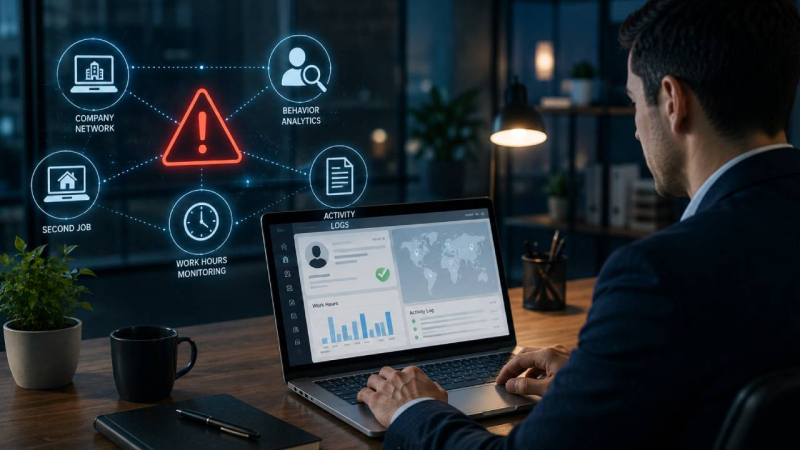
Controlio software sits at the top of the list for this exact problem. It records the full screen without gaps, tracks app and web activity, scores productivity, and lets you set behavior rules that flag odd patterns. A live desktop view and searchable session history turn a quiet dual-job routine into something you can review.
Other tools exist. Some focus on AI threat detection. Some emphasize clean interfaces or GPS. But if dual employment is the specific risk, continuous recording plus activity rules matter more than pretty dashboards.
When employees know the full session is stored, the mouse jiggler stops working. Working two jobs on one machine becomes risky. External emails and file moves show up.
Legal and practical limits
Monitoring rules for remote staff match the rules for office staff in most places. Still, you have to handle background noise carefully. A live camera pointed at a home desk can catch family members who never consented. Disability accommodations also need thought so productivity scores do not create discrimination claims.
Some determined workers still try to bypass tools. They time screenshots, run second displays, or script activity. Continuous video with linked events makes those tricks harder to hide for long.
Management moves that reduce the incentive
Software alone is not enough. Culture matters.
Give people real growth paths. When internal promotions and skill development feel possible, the urge to hedge with a second paycheck drops. Boredom is one of the biggest drivers of dual employment.
Build enough trust that people do not assume a layoff is coming next quarter. Layoff anxiety pushes some workers to stack jobs as insurance.
Write the dual-employment rule into contracts in plain language. Spell out that outside full-time work during paid hours is prohibited and that company equipment and systems stay company-only. Clarity removes the “I didn’t know” defense.
Talk about outcomes more than pure hours when the role allows it. Still, for roles that require real presence, hours and availability remain non-negotiable.
Final words
Dual employment is time theft dressed up as hustle. The communities that teach the tactics are still active in 2026. The cost shows up in slower projects, thinner knowledge, and higher risk.
You stop most of it by combining clear policy, real career paths, and monitoring that records the full picture instead of occasional snapshots. The Controlio app gives you that picture. The rest is management discipline.
The workers who try to run two full-time jobs will keep looking for soft targets. Make sure your company is not one of them.
Post Comment
Share your thoughts about this article.
Be the first to post a comment!