Every tool in this category promises the same two things: watch without being seen, and save what disappears. The differences that actually matter are the ones none of them advertise.
The short answer InSnoop is a browser based anonymous story viewer that also downloads media. It sits in the middle of the category: more capable than a plain download box, less capable than a logged in analytics tool, and free because you are paying with ad exposure and query data rather than money. The single most important fact about every tool of this type, InSnoop included, is that none of them can reach a private account. If a profile is set to private, the entire category is locked out. Anything claiming otherwise is misrepresenting what it does. |
THE MECHANISM
How these tools actually work
Almost every article about anonymous story viewers skips the part that explains everything. It is worth thirty seconds, because once you understand the request path, every claim these tools make becomes easy to check yourself.
When you open Instagram and tap a story, your account identity travels with the request. Instagram logs it, shows your name to the poster, and feeds the interaction into its ranking systems. That is not a side effect. It is the intended design, and the viewer list is a feature the poster is meant to have.
A tool like InSnoop inserts a middle layer. Its server makes the request instead of you.
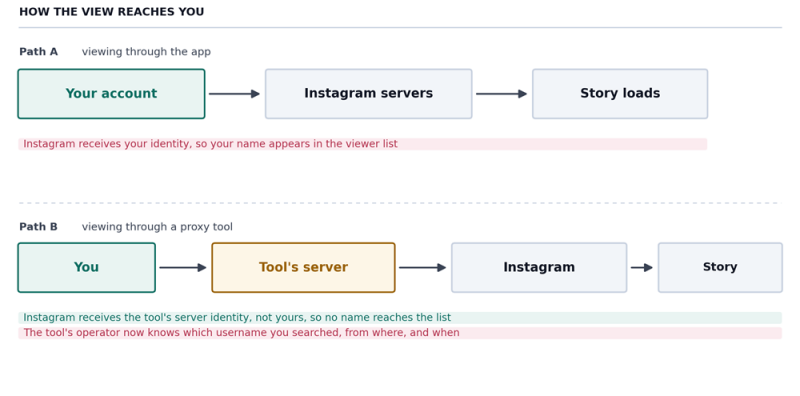
The same story arrives by two different routes, and only one of them carries your name
That last line is the trade that goes unmentioned. You did not become invisible. You moved your visibility from the person who posted the story to a company you know nothing about, operating under no obligation to you.
HARD CEILING
The limit nobody leads with
Because the tool’s server is a logged out visitor, it can only fetch what Instagram serves to logged out visitors. That means public accounts only. Not sometimes, not with a workaround, not on a paid tier.
If a profile is private, its stories, posts and highlights are delivered only to approved followers, and no proxy sitting outside that approval list can retrieve them. Any tool advertising private account access is either failing to do it, harvesting your credentials while pretending to try, or serving you a page of ads and nothing else.
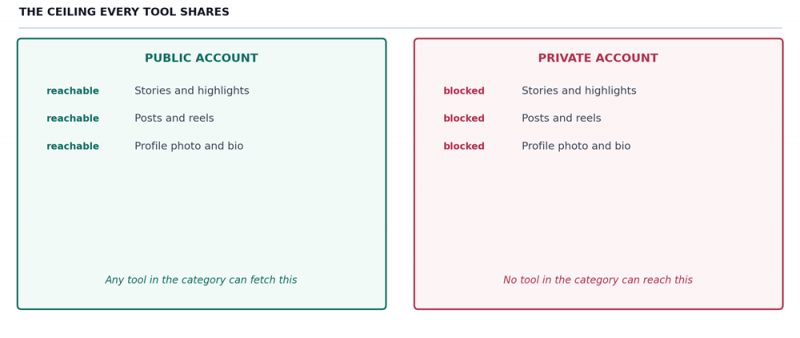
Every tool in the category shares one access ceiling, which is why none of them compete on reach
Treat private account claims as a warning sign A tool that promises access to private profiles is telling you something about its honesty before you have typed anything. The usual pattern is a survey wall, an app install, or a login form that captures Instagram credentials. There is no legitimate version of this feature. |
This single constraint collapses most of the category into one shape. InSnoop and its competitors are not competing on what they can reach, because they can all reach exactly the same thing. They compete on interface, reliability, ad load, and how honestly they describe themselves.
THE LANDSCAPE
Five ways to save a story
Lumping every option under downloader tools hides real differences. There are five distinct approaches, and they fail in different places.
Web based anonymous viewers
The category InSnoop belongs to. Paste a username, browse stories and highlights in the browser, download individual items. Photos typically save as JPEG and videos as MP4. No install, no account, works on any device. Reliability varies week to week because Instagram periodically changes how it serves content and these tools have to keep up.
Plain download boxes
Simpler tools that take a direct link to a single post or story and return the file. They do not offer browsing and they do not offer anonymity in a meaningful sense, because you usually had to be logged in to get the link in the first place.
Browser extensions
Add a download button inside the Instagram interface. Convenient and fast, but they operate inside your logged in session, so the poster sees you in the viewer list as normal. They also request broad permissions over the pages you visit, which is a meaningful security decision.
Mobile apps
Usually the weakest option. Many ask you to log in with your Instagram credentials, which hands a third party the keys to your account and puts it at risk of being flagged or restricted. App store presence is not a safety signal here, and listings in this space are removed and republished frequently.
Instagram’s own features
Frequently overlooked and often sufficient. Instagram can save your stories automatically if you enable archiving, and old stories are retrievable from the Archive section of your profile menu. A full export runs through Accounts Center, then Your information and permissions, then Download your information, which returns posts, stories, messages and account history as a downloadable file. If your goal involves your own content, the native route is safer and more complete than anything third party.
SIDE BY SIDE
How the approaches compare
Read down the rows rather than looking for a winner. Different columns fail at different things, and the right pick depends on which failure you can live with.
| Criterion | InSnoop style viewer | Plain download box | Browser extension | Mobile app | Instagram native |
|---|---|---|---|---|---|
| Instagram login needed | No | No | Yes, your own session | Often required | Yes, your own account |
| Hidden from viewer list | Usually | No | No | No | No |
| Reaches private accounts | No | No | Only ones you follow | No | Only ones you follow |
| Browse without a direct link | Yes | No | No | Varies | Yes |
| Downloads photos and video | JPEG and MP4 | JPEG and MP4 | Yes | Yes | Own content only |
| Highlights supported | Yes | Varies | Varies | Varies | Yes |
| Install required | None | None | Extension | App | None |
| Risk to your account | Low | Low | Moderate | High | None |
| Data the operator collects | Search queries and address | Links you paste | Browsing activity | Credentials in many cases | Nothing extra |
| Ad exposure | Heavy | Heavy | Light | Heavy | None |
| Reliability over time | Fluctuates | Fluctuates | Fluctuates | Fluctuates | Stable |
| Cost | Free | Free | Free or paid | Free or paid | Free |
Behaviour in this category changes when Instagram adjusts how it serves public content, so treat any row as a snapshot rather than a permanent property.
THE CORE CLAIM
Does the anonymity actually hold
This is the feature the whole category is sold on, so it deserves scrutiny rather than repetition.
In principle the proxy model is sound. If the request genuinely originates from the tool’s infrastructure and your account is never involved, there is no identity for Instagram to attach to the view. That is not marketing, it is just how the request works.
In practice, reports from users tell a messier story. People have described still appearing in viewer lists after using tools of this kind, InSnoop included. There are a few plausible explanations. Some tools fall back to different retrieval methods when their primary one breaks. Some users view a story in the tool and then open the same story in the app moments later without registering that they did. And some sites in this space are thin wrappers that never had working infrastructure to begin with.
The practical read Treat anonymity here as likely rather than guaranteed. If a view becoming visible would genuinely cause you a problem, the honest conclusion is not to use a better tool. It is that you should not be viewing that content. |
A related point worth keeping in view: a tool that operates on several interchangeable domains, which is common in this category and true of InSnoop, is harder to hold accountable. Domains in this space rotate, get abandoned, and get impersonated by copycats that reuse the name and interface. The site you land on may not be the one that earned whatever reputation you read about.
THE TRADE
What free actually costs you
These tools carry real infrastructure costs and charge nothing, which means the money arrives from somewhere else. Understanding where changes how you use them.
• Advertising density. The revenue model is impressions, so the interface is built to maximise them. Expect interstitials, redirects and download buttons that are not the download button.
• Query logging. Every username you search is a record on someone else’s server, tied to your address and timestamp. There is usually no meaningful privacy policy and no way to request deletion.
• Hostile ad risk. Sites in this category typically monetise through ad networks with lighter vetting than mainstream publishers, and injected redirects and fake download prompts are commonly reported.
• No accountability. Operators are typically anonymous, jurisdiction is unclear, and there is no support channel. If something goes wrong there is nobody to contact.
The one rule that matters most Never enter Instagram credentials into any of these tools. A genuine anonymous viewer has no use for your login, because the entire mechanism depends on not being logged in. A login prompt in this context is a credential harvesting attempt, without exception. |
A BOUNDARY WORTH UNDERSTANDING
The block question
Tools in this category, InSnoop among them, sometimes advertise that they work even when the account has blocked you. This is worth addressing directly, because both sides of it need the same piece of information.
Mechanically the claim has a basis. A block operates between two accounts. It stops the blocked account from finding, viewing or contacting the profile, but it does not change that profile’s privacy setting. A public account stays public to anyone viewing without being logged into the blocked account, which includes a proxy acting as a logged out visitor.
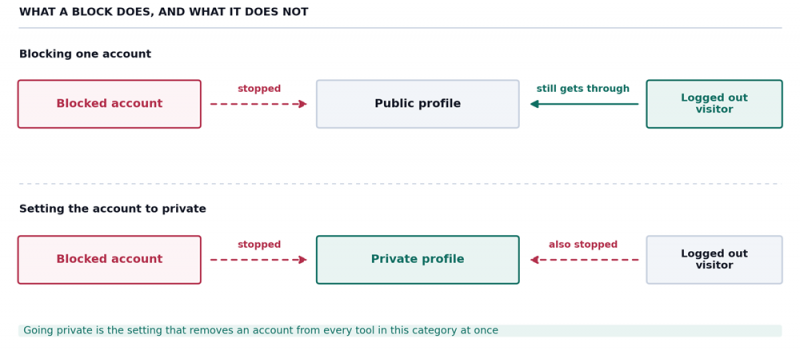
A block closes one door, while the privacy setting closes all of them
If you are considering using it that way A block is a person telling you, unambiguously, that they do not want contact. Routing around it is not a clever workaround. Persistent unwanted monitoring of an individual can engage harassment or stalking laws depending on where you are, and the fact that the content was technically public does not by itself settle that question. No article should sell this as a feature, and this one is not going to. |
If you are on the other side of it This is the useful takeaway. Blocking alone does not hide public posts from someone determined to look. Switching the account to private is what actually removes it from every tool in this category at once, because the proxy loses its access along with everyone else outside your approved followers. If you are managing unwanted attention, that setting is the one that carries real weight. |
THE RULES
Terms of service and the law
Three separate questions get tangled together here, and separating them helps.
Platform terms
Instagram’s Terms of Use tell users they cannot “access or collect information in unauthorized ways”, and the same clause covers collecting information by automated means without permission. Third party viewers sit on the wrong side of that line. Breaching a platform’s terms is generally a contract matter rather than a criminal one, and in practice the consequence falls on the tool rather than the visitor. The pattern in this space is that tools break, get blocked, and reappear under new domains.
Viewing versus keeping
Looking at something a person published publicly is not, in itself, unlawful in most places, and disputes over access to publicly available data have tended to be argued as contract questions rather than prosecutions. What changes the picture is what happens next. A downloaded file is a copy of someone else’s creative work, and the person who made it holds the copyright regardless of how publicly they posted it or how easy it was to save.
Republishing
This is where actual liability lives. Reposting someone’s story to your own account, using it in marketing, or circulating it without permission can expose you to a copyright claim, and in some jurisdictions a privacy claim as well. Ephemeral content carries an implied expectation that it disappears, and preserving it against that expectation weakens any fair use argument you might otherwise have made.
A simple test Ask whether you would be comfortable if the person could see a full log of what you viewed and saved. If the answer is yes, you are almost certainly fine. If it is no, the tool is not the problem in that scenario. |
This is general information rather than legal advice, and rules differ considerably between countries. For anything commercial or contested, talk to a qualified lawyer in your jurisdiction.
JUDGEMENT
Where the line sits
The category is neither uniformly fine nor uniformly sinister. It depends almost entirely on whether the subject is an audience or an individual.
Generally reasonable
- Archiving your own brand’s stories for a campaign record, though the native export is better for this
- Competitive research on a business account, where the content is published to be seen by the market
- Preserving a public figure’s or organisation’s statement for journalism, criticism or documentation
- Reading a public account without an Instagram account of your own
- Saving something you have been given explicit permission to save
Not defensible
- Monitoring a specific private individual, including a former partner, without their knowledge
- Using it to route around a block, mute or unfollow
- Building a saved archive of one person’s content over time
- Covert surveillance of a partner, framed as concern
- Reposting or commercially using someone’s content without permission
The distinction is not about the tool. It is about whether a specific person would recognise what you are doing as surveillance if they could see it. Marketing copy in this space works hard to blur that line by listing competitive research and checking on an ex in the same breath. They are not the same activity and they should not be evaluated together.
PRACTICAL
1. How to evaluate any tool in this category
Tools here appear and vanish quickly, so a durable checklist is worth more than a ranked list that expires. Run any candidate through these seven questions.
2. Does it ask for a login
If yes, close the tab. This is the only question with a single correct answer, and it disqualifies instantly.
3. Does it claim private account access
A promise it cannot keep tells you how it treats every other claim on the page.
4. Is there a real privacy policy
Look for what is logged and for how long. A missing or boilerplate policy means assume everything is retained indefinitely.
5. Who runs it
An identifiable operator with a contact route is rare in this space and worth weighting heavily when you find one.6.
6. How aggressive is the ad behaviour
Redirects, fake download buttons and forced app prompts predict how the operator treats users generally.
7. Does it work today
Test it on a large public account you have no personal connection to before you rely on it for anything.
8. Could the native feature do this
For your own content the answer is almost always yes, and the native route carries none of the trade offs above.
THE VERDICT
So where does InSnoop land It is a competent example of a category with a low ceiling. Browsing plus downloading, no install, no login, JPEG and MP4 output, and the same public account restriction as every competitor. Judged against the tools it is usually compared with, it is neither notably better nor notably worse, because they are all constrained by the same mechanism. The more useful conclusion is that the choice of tool matters far less than the choice of subject. For competitive research on business accounts or archiving public statements, almost anything in this category does the job, and the native features often do it better. For anything involving a specific private person, no tool in this comparison is the right answer, and the anonymity that makes them appealing for that purpose is exactly the reason to be uneasy about using them that way. Pick on interface and honesty, never enter a login, assume you are being logged, and let the answer to one question decide it: would you be comfortable if they could see what you looked at. |
Post Comment
Share your thoughts about this article.
Be the first to post a comment!