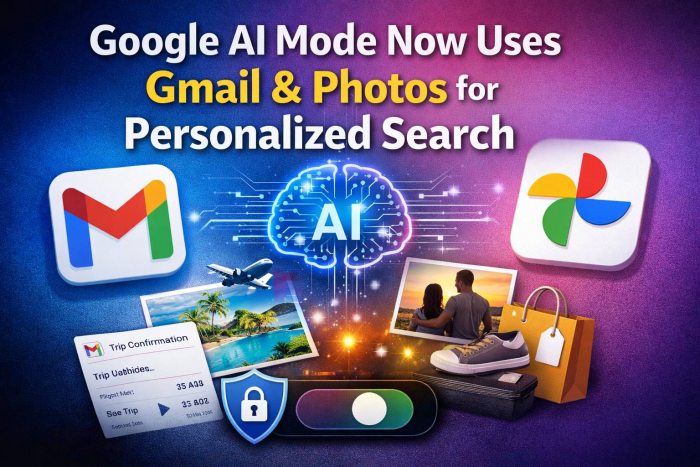
Google has introduced a major update to its AI Mode in Search, allowing the artificial intelligence tool to reference personal data from users’ Gmail and Google Photos accounts to deliver tailored responses and recommendations. The capability, known as Personal Intelligence, is being rolled out to eligible users in the United States as an opt-in feature.
The company said the enhanced AI Mode can now draw on information stored in a user’s Gmail inbox and Google Photos library when generating answers to search queries. By tapping into reservations, travel confirmations, photos, and other personal data with user consent the tool aims to make responses more relevant and context-aware.
Personal Intelligence functions by connecting AI Mode to selected Google services such as Gmail and Photos after users choose to enable the feature. Once enabled, the system can reference details from these apps to provide customized answers rather than relying solely on general web results.
For example, if a user asks about attractions or dining options for an upcoming trip, AI Mode could use a hotel booking in Gmail and past travel photos to suggest personalised recommendations. Similarly, shopping suggestions can consider brand preferences inferred from receipts or images in a user’s photo library.
Google said these kinds of tailored responses are intended to save users time and effort by eliminating the need to repeatedly explain their plans or preferences to the AI.
The Personal Intelligence feature is off by default and requires users to explicitly agree before their Gmail and Photos data can be accessed by AI Mode. Google emphasises that this is a user-controlled setting, and permissions can be adjusted or revoked at any time.
In terms of data handling, Google has stated that the AI does not directly train on users’ Gmail or Photos content. Instead, personal information is referenced to help answer specific queries, and model training remains focused on anonymised prompts and responses.
The Personal Intelligence feature in Google’s AI Mode is being introduced gradually and is not yet universally available to all users. The initial rollout is limited in scope, targeting a specific group of users based on subscription, geography, and account type.
At launch, the feature is being rolled out under Google Labs as an experimental capability. It is currently available only to Google AI Pro and Google AI Ultra subscribers in the United States who use English as their language setting. Eligible users will either receive an invitation prompt in AI Mode or can enable the feature manually through Search personalization settings by connecting Gmail and Google Photos.
Personal Intelligence is currently restricted to personal Google accounts and is not supported for Workspace business, enterprise, or education accounts. This restriction aligns with Google’s intention to focus the initial deployment on individual users rather than organizational or managed accounts, where different data and privacy policies apply. (The Times of India)
The rollout is taking place in phases, meaning that even within the U.S. and among eligible subscribers, some users may see the feature appear later as Google expands access over the coming days or weeks. Users outside the U.S. or on free accounts may not see Personal Intelligence yet. Google has indicated plans to broaden availability to more regions and potentially to free-tier users over time, although no firm timeline has been provided.
Because the rollout is incremental, some users with AI Pro or Ultra subscriptions have reported that the feature has not yet appeared on their accounts, underscoring the phased nature of the release. (Reddit)
Google’s move to connect AI Mode with personal services such as Gmail and Photos comes at a time when major technology companies are racing to redefine how people interact with search engines and digital assistants. The industry is shifting away from keyword-based results toward AI systems that can understand user intent, context, and behavior across multiple platforms.
Rival companies including OpenAI, Microsoft, Apple, and Amazon are all developing AI tools that aim to function as everyday personal assistants. Microsoft has already integrated AI features into Outlook, Windows, and Office apps, while OpenAI continues to expand ChatGPT with memory and personalization features. Apple is also expected to introduce deeper AI-powered personalization across iOS, iPadOS, and macOS.
Analysts say Google’s advantage lies in its vast ecosystem of consumer services. With access to Gmail, Photos, Search, Maps, YouTube, and Calendar, Google is uniquely positioned to build AI systems that understand users’ routines, preferences, and history in a way that competitors cannot easily replicate. The new Personal Intelligence feature reflects Google’s strategy to make its AI not just informative, but deeply contextual.
At the same time, the update has generated mixed reactions. Privacy advocates have raised concerns that even opt-in systems may encourage users to share more personal data than they fully realize. They warn that deeper integration between AI and private information could increase the risk of misuse or data exposure if safeguards fail.
On the other hand, technology analysts and early testers have described the feature as one of Google’s most significant steps toward a “truly personal” AI assistant. Many view it as a natural evolution of search, where systems no longer simply retrieve information but actively help users make decisions based on their own digital history.
As competition intensifies, industry experts believe similar personalization features will soon become standard across AI platforms. Google’s latest update signals that the future of search and digital assistance will likely be built around personal context rather than generic information.
As AI assistants become more capable and more connected to users’ digital lives, features like Personal Intelligence could redefine how people interact with search engines and AI tools. Google’s latest update marks a significant step toward more context-aware, personalized interactions with the caveat that users must consciously choose how much of their data they are comfortable sharing.
Be the first to post comment!