For enterprise IT leaders, managing remote infrastructure expenses isn’t just about saving money – it’s about making smarter, data-driven decisions. As workloads scale across multiple platforms, understanding and controlling expenses becomes critical. The best cloud cost optimization strategies for large enterprises go beyond cutting resources – they align performance, governance, and innovation.
Why Cloud Cost Optimization Matters in 2025
Enterprises today face increasing pressure to balance performance with efficiency. With multi-remote infrastructure environments, unmonitored resources, and fluctuating workloads, overspending is easy to miss. Adopting cloud cost optimization best practices ensures long-term control without sacrificing agility or security. It’s not just about trimming the fat – it’s about engineering lean, high-performing infrastructure that grows with your business.
Proven Cost Optimization Strategies for Enterprises
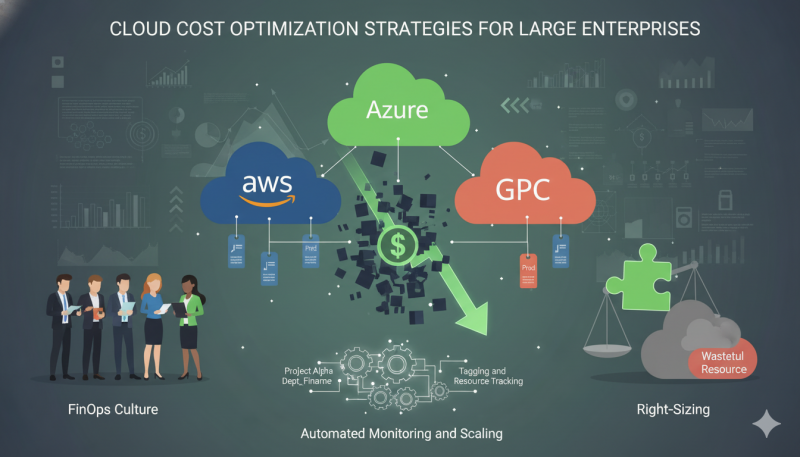
1. Implement Automated Monitoring and AlertsOne of the most effective Amazon cloud cost optimization techniques is real-time monitoring. Automating alerts for unused or over-provisioned instances helps IT teams act before expenses spiral out of control.
2. Use Reserved and Spot Instances WiselyAWS and other providers offer pricing models like Reserved Instances and Spot Instances that can reduce compute costs by up to 70%. Smart usage planning is key to building Amazon cloud cost optimization strategies for large businesses.
3. Adopt Tagging and Resource TrackingTagging all resources with clear ownership and environment identifiers allows teams to track spending more precisely. This forms the foundation of sustainable cloud cost management optimization strategies.
4. Embrace FinOps Culture Across TeamsRemote infrastructure finance isn’t just IT’s problem – it’s everyone’s. Successful enterprises implement FinOps, aligning developers, operations, and finance around transparent budget visibility and shared KPIs.
5. Optimize Data Storage TiersA core cloud cost optimization strategy involves right-sizing storage. Cold data should move to low-expense archival tiers like Amazon S3 Glacier or Azure Blob Cool.
6. Automate Infrastructure ScalingIntegrating automation into DevOps workflows ensures resources dynamically scale based on demand. Partnering with a trusted provider for DevOps automation service allows continuous scaling and expense balancing without downtime.
7. Streamline Cloud Migration PlanningEnterprises migrating to the remote infrastructure should apply proactive cost optimization strategies for cloud migration for enterprise. This means assessing workloads before migration, identifying redundancies, and setting expense baselines early.
8. Leverage Managed and End-to-End DevOps SupportWorking with a full-service partner offering end-to-end DevOps services at ARTJOKER company helps enterprises unify automation, CI/CD, and monitoring – the three pillars of long-term efficiency.
Best Practices for Amazon Cloud Expense Optimization
- Enable Auto-Scaling: Match resource allocation to usage in real time.
- Monitor Idle Instances: Schedule shutdowns for non-production hours.
- Consolidate Billing: Centralize multi-account expenses to track trends.
- Use Expense Explorer: Visualize where your money is going – and why.
- Right-Size Instances: Scale up or down based on utilization data, not assumptions.
Real-World Case Studies and Why They Matter
To see how the best cloud cost optimization strategies translate into measurable results, it’s worth looking at how industry leaders have tackled financial efficiency at scale. These examples show that expense control is not about limitation – it’s about strategic reinvestment in innovation.
1. MyCredit – AI-Driven Customer Support Scaling
One of the largest fintech lenders introduced an AI chatbot and VoiceBot to handle over 100,000 monthly customer requests without expanding staff. Result: 100% QA coverage, lower operational costs, and faster resolution times.
Why it matters: AI-powered automation enables financial platforms to scale support efficiently while maintaining compliance and customer trust.
2. CallChecker – Predictive QA for Call Centers
A major contact center in Mexico deployed an AI call scoring system that evaluates thousands of calls daily with 95%+ accuracy and 40% lower infrastructure costs.
Why it matters: Predictive analytics transforms manual review into data-driven quality assurance, making performance measurable and consistent.
3. Lonvest – Cloud Cost Optimization with AWS Automation
A European investment platform reduced AWS expenses by introducing automated infrastructure management and usage-based scaling. Result: Significant cost savings, improved reliability, and faster resource provisioning.
Why it matters: Cloud cost governance and automation ensure scalability without unnecessary spend — a critical edge for fast-growing fintechs.
4. CryptoPlatform – DevOps Automation for Blockchain Scalability
A blockchain platform adopted Infrastructure-as-Code and serverless deployment, achieving 50× faster releases and a 320% performance boost.
Why it matters: DevOps automation builds resilience and scalability into digital ecosystems — a must for secure, high-growth fintech and blockchain products.
These cases prove that efficiency is not about cutting corners – it’s about engineering flexibility, transparency, and resilience into every layer of infrastructure.
Final Thoughts
Expense reduction has evolved from a tactical goal into a core strategic advantage for modern enterprises. Organizations that proactively manage their infrastructure spending gain more than just lower bills – they unlock the flexibility to reinvest in innovation, product development, and customer experience. Strong monitoring, automation, and governance together form the foundation of sustainable expense management. By combining data-driven insights with operational discipline, enterprises can eliminate inefficiencies while ensuring that every dollar spent contributes to measurable business outcomes.
Post Comment
Be the first to post comment!