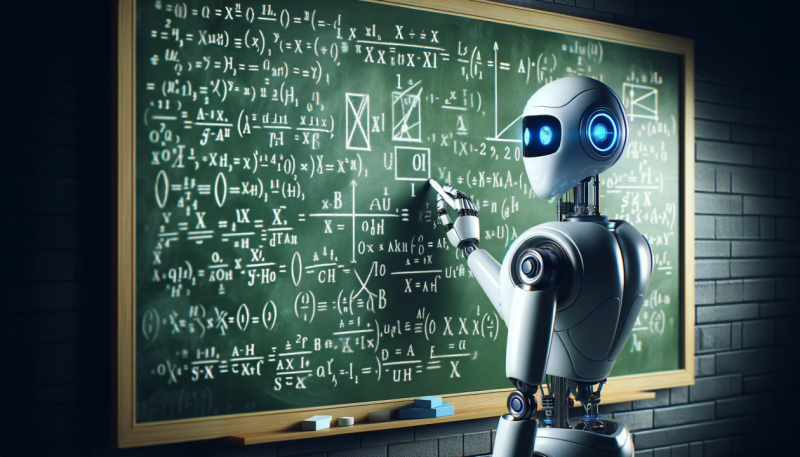
As AI speeds forward, we keep circling back to a single, oddly captivating mystery. Can AI solve Olympiad-level math? For a lot of learners, these questions mark the peak of their math coursework. They need imagination, offbeat ideas, and solid insight. If you need a straightforward challenge for AI, these fit the bill. To gauge AI’s progress, scientists feed it challenging problems. These tasks expose the way machines think, test their grasp of elaborate proofs, and show the true reach of their capabilities.
https://www.linkedin.com/pulse/how-ai-revolutionising-mathematical-problem-solving-daudi-turya-78dee
Why Olympiad Problems Matter
Olympiad problems are notorious for being tricky. A single question may require geometry, algebra, number theory, or a mix of all three. Solvers must analyze mathematical structures, understand hidden patterns, and often come up with clever ideas that aren't written in textbooks.
Because of this, these tasks are ideal for testing AI-assisted math problem-solving. The good news is that the math solver for Chrome can solve problems of virtually any level. All you need to launch the math AI extension is a photo of the problem. But it's better not just to hear about it; it's better to actually try the math solver for Chrome.
Statistics show how quickly progress has been made:
- In 2020, most general-purpose models solved less than 10 percent of International Mathematical Olympiad (IMO)–style tasks.
- By 2024, specialized math AIs reached around 30–40 percent accuracy on curated benchmarks.
- Some automated theorem-proving tools, when combined with large models, solved over 50 percent of intermediate-level proof problems.
These numbers are not perfect, but they are rising every year.
How AI Approaches Advanced Problems
You’ll notice that current systems use evidence, steering clear of simple guesswork. They mix a few tricks together at the same time. Their first move is to cut the work down to manageable parts. Next they try to get past reasoning gaps, so they review their work, sketch out a few different approaches, and pick the option that appears most solid.
You’ll find that many verification tools grasp dense proofs, as long as the reasoning is organized. By using Lean or Coq, AI writes step by step logic that the computer can automatically verify. If an AI solves a task inside one of these systems, we can state with confidence that the solution is correct.
It gives AI a way to gauge its logical strengths. When a model generates a proof that a formal verifier accepts, you can see it doing more than word salad—it is engaging in genuine mathematical reasoning.
You’ll find the method impressive, yet it’s easily broken. Changing the problem’s phrasing slightly often confuses the model. Adding extra difficulty to the geometry sometimes forces it to stray from the intended route. Facing such challenges reveals that AI’s mathematical reasoning falls short of the natural insight humans bring to the subject. Rather than memorizing, it picks up patterns and works to apply them more broadly.
Where AI Still Struggles
Despite the strides made, AI continues to wrestle with several real‑world challenges.
1. Deep Creativity
An Olympiad question often calls for a twist that nobody expects. In practice, AI tends to lean on tried‑and‑true techniques, echoing solution styles it has already learned. When a novel trick is needed, they sometimes can't find it.
2. Long Proofs
Many problems demand multi-step reasoning. AI sometimes forgets steps it already took, spits out conflicting answers, or overlooks the conditions given in the problem.
3. Symbolic Precision
Machines sometimes confuse expressions or make small algebra errors. We can repair such glitches quickly, yet a machine may turn a simple typo into an entire project.
4. Incomplete Training Data
Even the best resources lack a large database of Olympiad solutions. This makes learning slower.
These constraints also make it tougher for AI to sharpen its problem solving accuracy, yet scientists are testing fresh training techniques to cut down the flaws.
What Progress Means for Learning
AI isn’t a substitute for human creativity, yet classrooms already benefit from its help for both pupils and teachers. When used properly, AI-based tools can:
- Support competitive math training by generating step-by-step hints without giving away full answers.
- Enrich instructional resources through demonstration of diverse problem solving strategies, incorporating techniques that may be unfamiliar to students.
- When you simplify the jargon, even the hardest subjects start to make sense.
- Students can dive into tough math exercises, feeling safe and in control.
In one 2024 study, students who trained with AI-generated practice problems improved their competition results by roughly 12 percent on average. This shows that AI is not only a solver but also a helpful guide.
How AI Expands Mathematical Research
Beyond education, advanced AI systems can help mathematicians evaluate logical capability, test conjectures, and even propose new ideas. Some researchers use AI to explore massive search spaces that are impossible for humans to scan manually. For example, automated proving tools assisted in breakthroughs in knot theory and group theory, not by solving everything alone, but by suggesting ideas humans later confirmed.
This hints at a future where humans and machines work together. AI may expand mathematical research by helping with tasks that require checking thousands of cases or analyzing large structures, while humans focus on creativity and theory building.
Are We Close to Full Olympiad-Level Skill?
Not yet. But we are closer than ever.
Current models can solve many medium-level problems and a small percentage of the hardest ones. They can recognize useful patterns, apply known theorems, and sometimes surprise researchers with clever solutions. However, full mastery — the ability to solve almost any Olympiad task — remains out of reach.
Still, every year brings stronger models, better proof checkers, and more accurate reasoning systems. These advancements make it possible to measure AI progress precisely and see where improvements are happening.
What It All Means
Whether AI will one day match top Olympiad students is uncertain, but the effort brings many benefits. It shows us how computers think, fuels research into smarter algorithms, and creates software that actually boosts students’ abilities.
While the project may sound high tech, its real intention stays simple: it supports the curiosity that only people can bring, rather than swapping out their intellect. The aim is to craft helpers that work with us, so more folks can enjoy the thrill of equations, make sense of layered topics, and see the hidden art in demanding problems.
AI might not yet crack Olympiad level math, yet it keeps getting nearer. And the progress we gain along the way may turn out to be even more valuable than the final result.
Post Comment
Be the first to post comment!