Table of Content
I ran both tools on the same brief. One article topic, same target keyword, no other instructions. GravityWrite returned an 850-word draft in under a minute. Writesonic took closer to seven minutes but came back with a 3,000-word piece that had already pulled from live competitor content, structured the headings around search intent, and suggested internal linking opportunities. Both were usable. Neither was the same tool.
That single test tells you more about this comparison than any feature list. The question is not which one is better. It is which one matches how you actually work.
The Fundamental Difference No Feature Comparison Captures
Writesonic has quietly repositioned itself. It is no longer primarily a content generator. As of 2026, it describes itself as an AI search visibility and content platform, one that tracks your brand mentions across ChatGPT, Perplexity, Google AI Overviews, and ten other AI platforms, then helps you close the gaps. The article writer is part of that larger content intelligence system, not the whole product.
GravityWrite does not try to be a platform. It is a writing tool with over 200 content templates across 30 languages and 25 tones, trusted by over two million users since launching in 2023. You show up, pick a template, and get content. The experience is deliberately simple and the pricing is deliberately low.
That divergence in product philosophy shapes everything from how each tool handles a long-form blog to what happens when you hit a usage limit.
How Each Tool Actually Generates Content
When you use Writesonic's AI Article Writer, the process works like this: you enter a topic, the system scans 100+ live web sources and top-ranking competitor articles, generates a structured outline, writes the full piece with keyword integration already baked in, adds internal linking suggestions, and can publish directly to WordPress. A 3,000-word article typically takes five to ten minutes. The depth comes from the research layer, not just the language model.
GravityWrite skips the research layer almost entirely and routes that time into speed. Its default output runs around 850 words and takes roughly one minute from prompt to draft. You get complete content fast, shaped by whichever of its 200+ templates you select. The trade-off is that it does not pull from live sources, which means factual accuracy depends entirely on what the model already knows rather than what is currently ranking.
This difference becomes most visible in factual niches. For a rapidly changing topic like AI tool pricing or a recent product launch, Writesonic's live research layer produces more accurate copy. For evergreen content like "10 tips for email subject lines" or a standard social post, GravityWrite's speed advantage matters more than Writesonic's research depth.
Where Each Tool Is Genuinely Stronger
Writesonic's clear advantages:

Writesonic's SEO infrastructure is genuinely bundled rather than bolted on. Keyword research pulls live data from Google Keyword Planner, Ahrefs, and Semrush natively inside the writing interface. The content optimizer scores your draft against competing pages and suggests improvements. Topic cluster generation maps out a full content calendar around a single keyword. Google Search Console integration tracks how published articles actually perform.
The AI search visibility tracking is what puts Writesonic in a different category from pure writing tools. It monitors your brand citations across AI platforms and helps you identify which content gaps are causing competitors to appear in AI-generated answers instead of you. No other tool in this comparison offers anything close to this.
Writesonic also handles tone consistency more reliably across longer outputs. Pieces above 2,000 words maintain a stable register and structure from beginning to end, which matters for SEO blogs that require sustained argument and authority throughout.
GravityWrite's clear advantages:
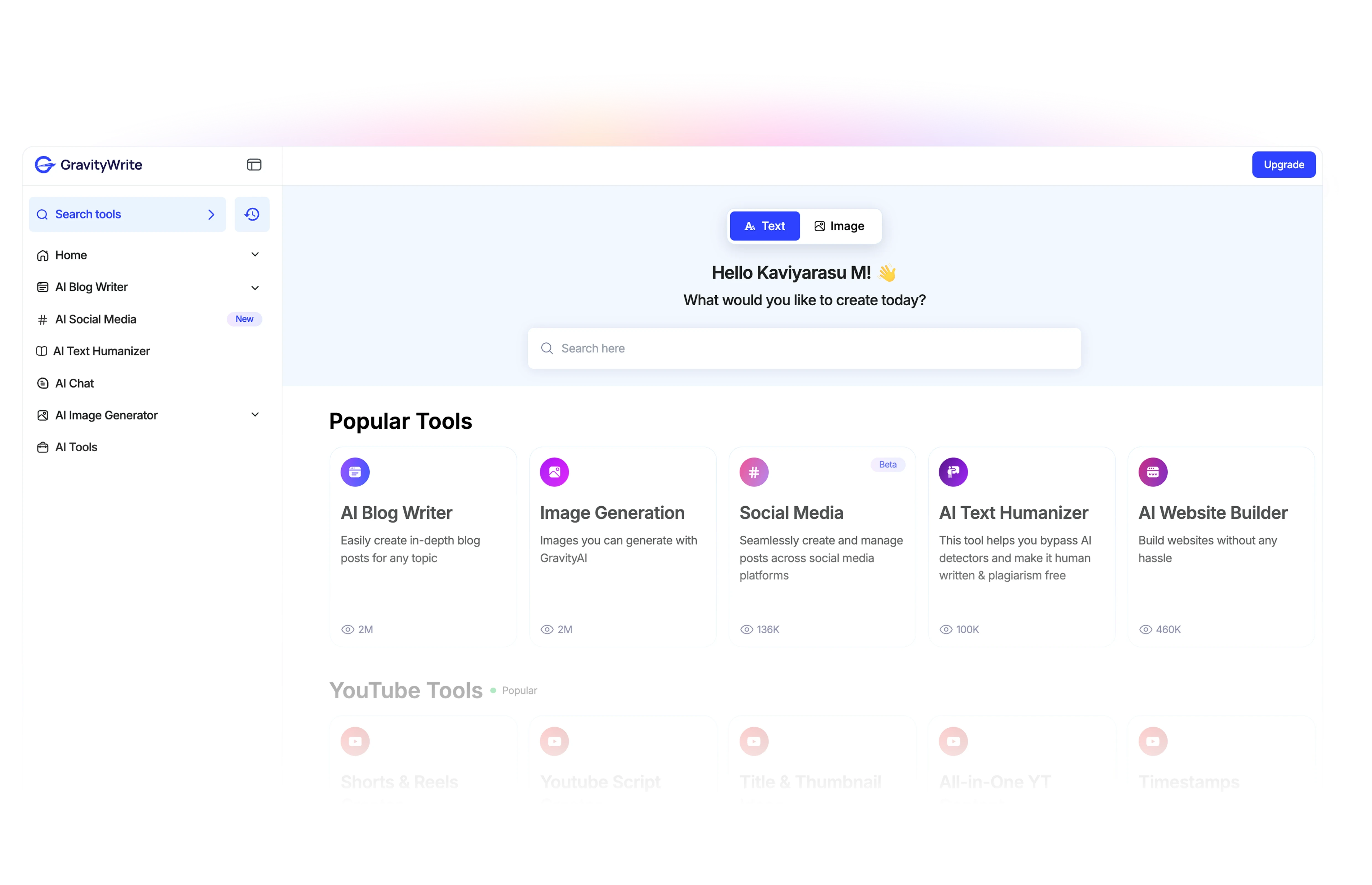
GravityWrite's pricing structure is its most immediate advantage. The free plan gives 1,000 words per month. The Plus plan at $8 per month provides 100,000 words and 500 image credits. The Pro plan at $49 per month unlocks 300,000 words and 2,500 credits. At the Plus tier, no serious competitor comes close to that volume at that price point.
The template library covers content types that Writesonic treats as secondary: YouTube scripts, ad copy variations, email sequences, product descriptions, social captions, and resume writing. For creators and small business owners who need a wide variety of short and medium-form content quickly without a large monthly commitment, the breadth at the $8 entry point is hard to argue against.freerdps+1
The interface is also notably faster to navigate for new users. GravityWrite's layout requires no learning curve. You pick a template, fill in a few fields, and generate. Writesonic's deeper toolset creates a proportionally steeper onboarding experience, especially for users who only want the article writer and not the full SEO suite.trustpilot+2
Head-to-Head: Specific Metrics
| Category | Writesonic | GravityWrite |
| Content quality (long-form) | 9.0/10 | 8.5/10 |
| Generation speed | 8.6/10 | 9.3/10 |
| SEO tooling depth | 9.4/10 | 7.8/10 |
| Ease of use | 8.7/10 | 9.2/10 |
| Template variety | 8.5/10 | 9.1/10 |
| Scalability for teams | 9.3/10 | 8.3/10 |
| Entry-level value | 7.8/10 | 9.5/10 |
| Overall score | 8.9/10 | 8.7/10 |
Pricing: The Gap Is Real and It Matters
| Plan | Writesonic | GravityWrite |
| Free | 25 one-time credits | 1,000 words/month |
| Entry paid | $16/month (50 credits) | $8/month (100,000 words) |
| Mid tier | $79/month (Standard, 30 articles) | $49/month (300,000 words) |
| Advanced SEO features | $249/month and above | Not available |
| Enterprise | Custom pricing | Not publicly listed |
The credit system on Writesonic's lower tiers draws consistent frustration. Users on the Individual plan at $16 per month receive 50 credits, and premium model usage burns through those quickly. Several reviewers note that meaningful access to Writesonic's SEO and AI search visibility features only begins at the $249 per month Professional plan, which is a significant step up from the entry price.juma+2
GravityWrite's volume at $8 per month is the headline number that keeps coming up across reviews. An agency principal evaluating the Pro tier at $49 per month noted it reduced their per-client content production cost from $400 to $80.
What Real Users Are Actually Saying
Writesonic holds a 4.7 out of 5 rating on both G2 and Trustpilot. Users consistently praise the speed of long-form generation and the SEO integrations, specifically how the tool consolidates keyword research, content scoring, and article writing inside a single workspace.
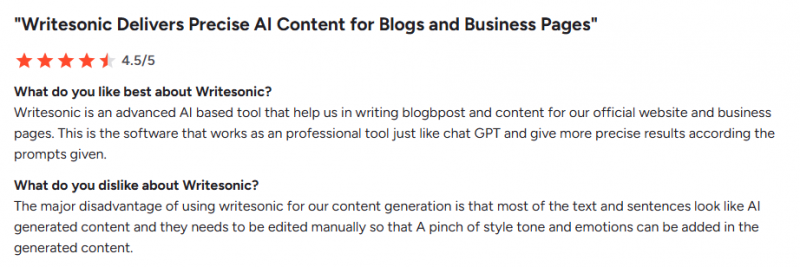
A Trustpilot reviewer described it as having "revolutionized every step of blog content creation" by handling everything from the initial idea to the final structure.
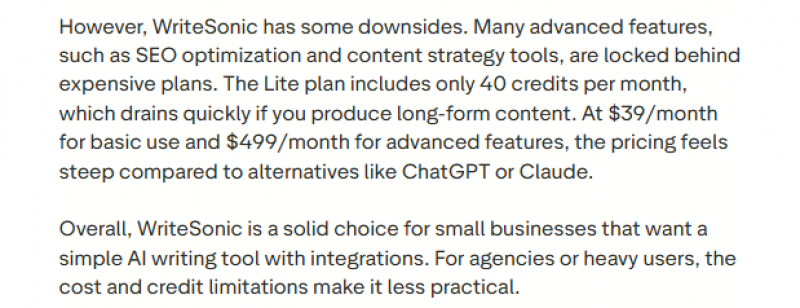
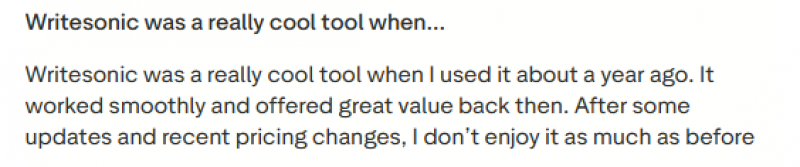
The friction points are equally consistent. The credit limitations on lower plans frustrate users who expected unlimited usage for a flat fee. The learning curve for non-SEO users is real. Several reviewers describe spending time understanding the tool's full feature set before getting reliable results, and some report that at lower credit tiers, Writesonic's output can feel inconsistent in factual accuracy, requiring a careful editing pass before publishing.
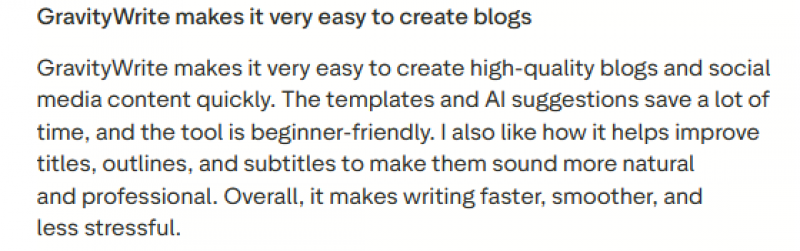
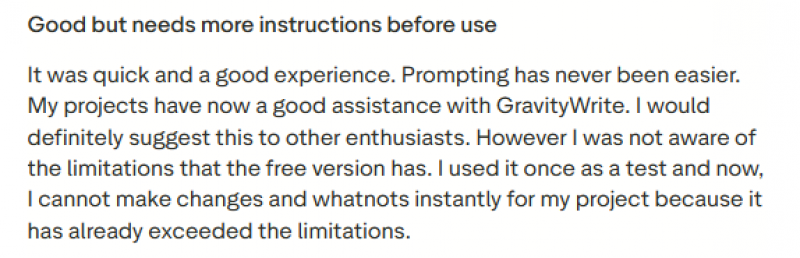
GravityWrite collects many reviews on Trustpilot and G2, with recurring themes of clean interface, fast generation, and high template variety. Users specifically praise that the output feels less robotic than comparable tools at similar price points, and multilingual support receives positive mentions from non-English content creators.
The main limitation surfaced in GravityWrite reviews is template repetition. Users who lean on the same few templates frequently start noticing similar sentence constructions and structural patterns appearing across different pieces. Manual editing at that point is essential, and for long-form SEO content requiring research-backed accuracy, several reviewers noted GravityWrite falls short compared to tools that pull from live sources.
Who Should Use Which Tool
Writesonic makes the most sense for:
- SEO professionals and content marketing teams who need live-research-backed articles at scale
- Businesses tracking AI search visibility and wanting to close citation gaps in ChatGPT, Perplexity, and Google AI Overviews
- Teams running long-form content programs where keyword integration, topic clusters, and Google Search Console data need to live in one workflow
- Users comfortable paying a premium for a tool that reduces the number of separate SEO subscriptions they need
GravityWrite makes the most sense for:
- Individual bloggers, freelancers, and small business owners who need high-volume, fast content at the lowest possible cost
- Social media managers and ad copywriters who cycle through many short-form content types daily
- Non-technical users who want a clean, low-friction tool they can open and use immediately without reading documentation
- Teams producing multilingual content across a variety of formats that do not require deep SEO research integration
The Honest Summary
If you are an SEO professional or a content marketing team running a serious publishing operation in 2026, Writesonic's research depth, content scoring, and AI search visibility tracking justify its higher price for the right plan tier. The tool has grown beyond writing into something closer to a content intelligence platform, and that is genuinely useful if SEO performance is your primary metric.
If you need words on a page quickly, across many formats, at a price that does not require budget approval, GravityWrite delivers more volume per dollar than almost anything else in the category. Its limitations in research accuracy and template variety at scale are real, but for the right user at the right price point, they are easy to work around with a light editing pass.
The sharpest way to think about it: Writesonic is the investment you make when content is a serious growth channel. GravityWrite is the tool you use when content needs to keep moving and the budget is tight.
Post Comment
Be the first to post comment!