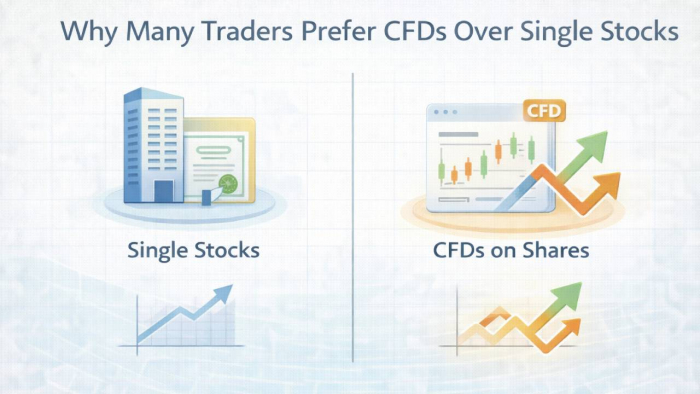
Trading individual stocks can be rewarding, but it often comes with limitations that active traders find restrictive. Contracts for Difference (CFDs) on shares offer an alternative that provides more flexibility, lower barriers and broader opportunities. Many traders prefer CFDs because they allow speculation on price direction without owning the underlying stock, with added benefits like leverage and short-selling. In current market conditions, where volatility and sector rotation create frequent opportunities, CFDs help traders capture moves more efficiently. Platforms that support trade share CFDs make this accessible. This article explains why CFDs are often preferred over single stocks and how they fit different trading styles.
No Ownership, No Hassle
CFDs let you trade share price movements without buying the actual stock. You don't need to deal with stock certificates, custody fees or dividend handling. Settlement is in cash, so there's no transfer or delivery process.
This removes many traditional barriers. No need for large capital to buy whole shares, especially expensive ones like Amazon or Tesla. No stamp duty or custody costs that apply to physical stock ownership in some regions.
For active traders, this simplicity means more focus on price action and less on administrative details. It's a cleaner way to speculate on direction.
Leverage and Capital Efficiency
Leverage is one of the biggest reasons traders choose CFDs. A small margin controls a larger position, turning modest capital into significant exposure. At 5x leverage, $1,000 controls $5,000 worth of shares, so a 2% move yields 10% on your margin instead of 2%.
This capital efficiency allows diversification. Instead of tying up funds in one or two expensive stocks, traders can spread across multiple sectors or regions with the same capital.
Lower entry barriers suit smaller accounts. Many platforms allow starting with $100-500, making CFDs accessible for beginners who can't afford full stock positions.
Short-Selling and Flexibility
CFDs make short-selling straightforward. You can profit from falling prices without borrowing shares or paying borrow fees. This is especially valuable in bear markets or when specific stocks are overvalued.
No ownership also means no dividend adjustments or corporate actions to worry about. You simply close the position when ready.
This flexibility suits active strategies. Traders can go long or short instantly, hedge portfolios or capture both sides of a move.
The table below compares key differences:
| Feature | Single Stocks | CFDs on Shares | Benefit for Active Traders |
| Ownership | Yes | No | No custody or dividend hassle |
| Leverage | Usually 1x | 5x-20x | Amplified returns on small capital |
| Short-Selling | Difficult/expensive | Easy and cheap | Profit in downtrends |
| Capital Required | Full share price | Margin only | Lower entry barrier |
| Trading Hours | Exchange hours | Often extended | More opportunities |
Hedging and Portfolio Management
CFDs allow easy hedging. If you hold a long portfolio of tech stocks, short CFDs on a tech index or specific names to protect against sector downturns.
This is harder with single stocks, where short-selling is costly or restricted. CFDs make hedging simple and cost-effective.
Diversification is easier. Trade multiple sectors or regions with the same account and capital, reducing single-stock risk.
Risks to Keep in Mind
Leverage magnifies losses. A 5% drop at 10x leverage loses 50% of margin. 80% of retail traders lose money due to overexposure.
Spreads and overnight fees add up. High-frequency trading increases costs.
Market gaps and slippage can occur during news events. Use stop-loss orders and avoid excessive leverage.
Conclusion
CFDs on shares are preferred by many traders because they remove ownership hassles, provide leverage, enable easy short-selling and offer hedging flexibility. In volatile markets, these features help capture broad sector moves and manage risk effectively. Start with low leverage, risk 1-2% per trade, and use tight stops. CFDs aren't for everyone, but for active traders who understand the risks, they provide tools that single stocks can't match. In today's fast-moving markets, CFDs turn broad trends into actionable opportunities.
Post Comment
Be the first to post comment!