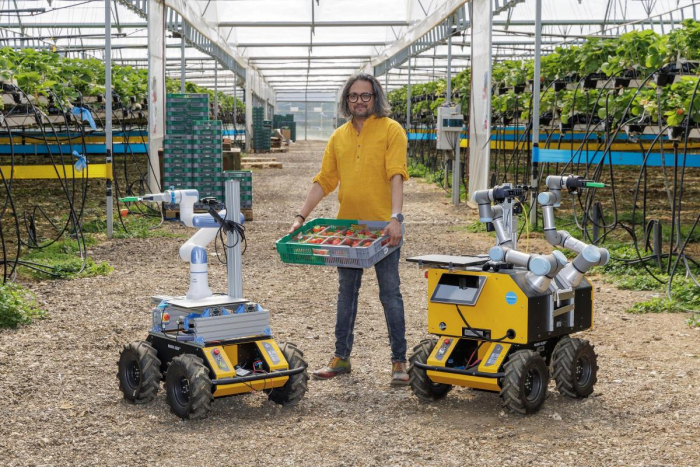
A research team in the UK has developed a fruit-picking robot that could reshape how farms handle labor shortages and rising operational costs. The system, created at University of Essex, has now received a major national engineering award, highlighting growing recognition for automation in agriculture.
The project reflects a broader shift toward robotics and AI-driven systems in farming, where traditional labor-intensive processes are becoming increasingly difficult to sustain.
Fruit picking has long been one of the most physically demanding and labor-dependent parts of agriculture. Seasonal workers are required in large numbers, and shortages have become more common due to rising costs, immigration changes, and workforce availability.
The Essex team’s robot is designed to address exactly this gap.
Using computer vision and robotic arms, the system can:
Unlike earlier automation attempts that struggled with delicate crops, this robot focuses on precision handling. Soft fruits, in particular, require careful pressure control, which has historically been difficult for machines to replicate.
The system’s ability to combine visual recognition with controlled movement is what makes it commercially relevant rather than experimental.
At its core, the robot combines two critical systems:
Vision layer: Cameras and AI models detect fruit, determine ripeness, and map its position in real time
Robotic layer: A mechanical arm adjusts its movement dynamically to pick the fruit without bruising it
This combination allows the robot to operate in environments that are unpredictable, such as outdoor farms where lighting, plant density, and fruit positioning vary constantly.
The challenge is not just identifying fruit, but doing so reliably across thousands of picking cycles without error.
That is where recent improvements in AI vision models have made a difference. Systems can now distinguish subtle differences in color, size, and orientation, enabling more accurate harvesting decisions.
The recognition given to the Essex project is not just about technical achievement. It reflects the system’s real-world applicability.
Key factors behind the award include:
In agriculture, innovations are often judged not just by performance but by scalability. A system that works in controlled environments but fails in the field has limited value.
The Essex robot stands out because it is designed with deployment in mind, not just research validation.
The development comes at a time when automation is becoming less optional and more necessary across global agriculture.
Farmers are facing a combination of pressures:
| Challenge | Impact on Farming |
|---|---|
| Labor shortages | Reduced harvest capacity |
| Rising wages | Higher operational costs |
| Climate variability | Unpredictable crop cycles |
| Food waste | Loss of revenue and resources |
Automation addresses several of these issues simultaneously.
Robotic systems can operate for longer hours, reduce reliance on seasonal labor, and maintain consistent performance. Over time, this can stabilize production in an industry that has historically been vulnerable to disruption.
Despite the promise of automation, the transition is not immediate or complete.
Robots like the Essex system are likely to:
This means farms will continue to rely on hybrid models where technology augments human labor rather than eliminates it.
The recognition of this robot signals a shift in how agricultural innovation is being prioritized in the UK.
Instead of focusing solely on yield improvements or chemical inputs, there is increasing emphasis on:
For universities and research institutions, this also highlights the role of applied engineering in solving industry problems. Projects like this move beyond academic prototypes and into systems that can realistically be deployed on farms.
The fruit-picking robot developed at the University of Essex represents a grounded approach to agricultural innovation. It does not attempt to reinvent farming entirely but focuses on one of its most persistent challenges.
By combining AI vision with robotic precision, the system offers a workable solution to labor shortages while improving efficiency and reducing waste. As automation continues to expand across agriculture, projects like this are likely to define the next phase. Not experimental technologies, but tools designed to integrate into existing workflows and deliver measurable results.
The award is a signal that this transition is already underway.
Be the first to post comment!