Table of Content
Flight deals for under $100. TikTokers flashing jaw-dropping fares. Instagram posts screaming “This won’t last long!” The brand behind much of this buzz? Triips.
Triips is marketed as a subscription-based cheap flight club. Pay a yearly fee, get access to hidden or short-lived flight deals, and save big — that’s the pitch. But after digging into real reviews, Reddit threads, and independent trust ratings, the story is far less straightforward.
This review breaks down the origins, promises, red flags, marketing tactics, and safer alternatives, so you can decide if Triips deserves your trust.
The Story Behind Triips
Triips wasn’t always Triips. Before the rebrand, it was known as Fair Fare Club. Rebranding isn’t automatically bad — many businesses update their names as they grow. But in the flight deal industry, constant rebrands can signal attempts to shake off bad press.
On Reddit, travelers warned that the new name doesn’t erase old complaints. Some users suggested the shift was less about “fresh identity” and more about escaping a reputation problem.
Inside the Triips Subscription Model
Unlike Google Flights or Skyscanner, Triips isn’t free. Instead, it runs on a membership model:
- $99 per year (billed annually).
- Equivalent to $8.25 per month.
- Comes with a 7-day free trial.
- Advertises a “Save $500 or your money back” guarantee .
- Focused only on departures from the U.S. and Canada .
The guarantee sounds bold, but refund policies often involve fine print that can make claims difficult. Unless you can document every search and booking, proving savings shortfalls may be a headache.
What Makes Triips Different From Regular Flight Search Engines
Traditional flight tools like Google Flights or Skyscanner let you search globally in real time. You set dates, airlines, and filters, and the data comes straight from airlines and online travel agencies.
Triips works differently:
- Deals are curated and delivered to paying members.
- Access is limited behind a paywall.
- Coverage is narrower (U.S./Canada departures only).
This model appeals to people who don’t want to spend hours hunting flights — but it also limits transparency.
Triips in the Words of Travelers
On Trustpilot, Triips holds a 4-star average rating. Many subscribers claim big wins:
“I saved $600 on my first booking. More than paid for the subscription.”
But on Reddit, skepticism dominates. Users complain of:
- Screenshots that don’t match real airline prices.
- Deals disappearing at checkout.
A sense that Triips overhypes error fares that were never bookable in the first place.
This split — enthusiastic Trustpilot praise vs. critical Reddit threads — makes it hard to pin Triips as fully legit or fully scammy.
Red Flags Hidden in Plain Sight
After reviewing user feedback, third-party reports, and independent site checks, several recurring concerns stand out. Individually, none of these points conclusively prove wrongdoing. However, taken together, they suggest that prospective members should approach Triips Flight Club with careful due diligence rather than blind trust.
One of the most frequently cited red flags is the promotion of extremely low international fares, sometimes advertised at under $100 round-trip. In the airline industry, such prices are exceptionally rare. When they do occur, they are usually “error fares”, pricing mistakes caused by technical glitches or short-lived fare anomalies. These deals often disappear within minutes and are not consistently bookable by the average consumer. The repeated marketing of ultra-cheap long-haul flights can create unrealistic expectations, especially for users who assume these prices are regularly attainable rather than occasional anomalies.
Another point that has drawn attention is the platform’s rebranding history. Triips reportedly operated under the name “Fair Fare Club” before transitioning to its current branding. Rebranding itself is not unusual in the digital subscription space. However, when a service changes its name after receiving mixed or negative reviews under a previous identity, it can raise concerns among cautious consumers. Transparency around why a rebrand occurred and what structural changes accompanied it would help reduce skepticism.
Trust score evaluations from website reputation tools also contribute to the mixed perception. ScamAdviser and similar automated assessment platforms typically analyze domain age, traffic patterns, hosting information, and other signals to generate a trust score. In the case of Triips.com, reports have indicated an average or moderate trust rating rather than a high-confidence one. An “average” trust score does not mean a platform is fraudulent, but it does mean it has not earned strong automated credibility signals compared to long-established brands.
User complaints form the most substantial body of concern. A recurring theme across review platforms involves billing and cancellation frustrations. Some subscribers claim they were charged after trial periods or found cancellation processes unclear. Others report difficulty receiving refunds after deciding the service did not meet expectations. There are also comments questioning the authenticity of promotional screenshots showing discounted fares, with some users stating they could not replicate the same prices through standard booking channels.
It’s important to emphasize that none of these red flags, taken in isolation, definitively prove that Triips is a scam. Many legitimate subscription services face billing complaints or negative reviews. However, when unrealistic marketing claims, rebranding history, average trust-rating indicators, and recurring customer dissatisfaction appear together, they form a pattern that encourages caution.
For potential subscribers, the most prudent approach is to independently verify deals before booking, carefully review refund and cancellation policies, monitor billing dates closely, and avoid relying solely on promotional screenshots as proof of savings. In subscription-based flight alert services, skepticism and verification are not paranoia — they are smart consumer habits.
The Real Risks of Using Triips
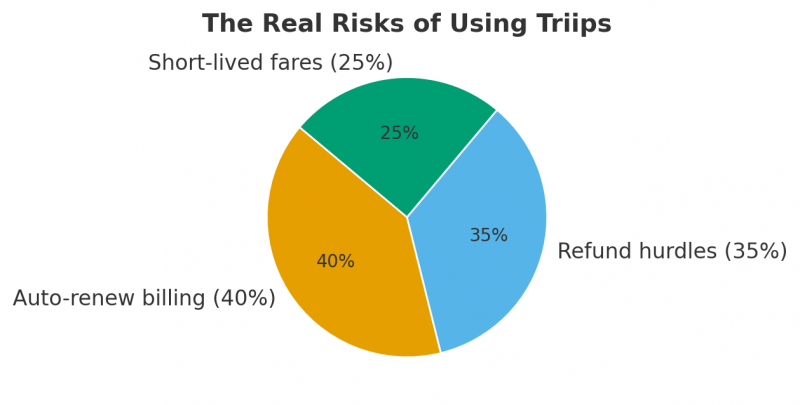
Even if Triips finds you a good deal, here are risks to keep in mind:
- Billing traps: forget to cancel the 7-day trial, and you’re charged $99 automatically.
- Refund obstacles: the “save $500 guarantee” may require burdensome proof.
- Short-lived fares: many disappear before you can actually book them.
These risks are common in subscription-based flight clubs — but Triips’ combination of bold claims and rebranding makes them sharper.
Lessons Learned From Flight Deal Clubs Like Triips
Triips highlights both the appeal and the pitfalls of paid flight clubs.
- They can uncover genuine mistake fares.
- They sometimes save travelers hundreds.
- But without transparency, they risk being unreliable.
Lesson: Always treat flight clubs as one tool, not your only tool.
Safer Alternatives That Deliver Consistently
Below is a structured comparison of flight deal platforms that generally have a more established reputation and transparent track record compared to newer subscription models.
| Platform | Type of Service | Why It’s Considered Safer | Pricing Model | Best For |
|---|---|---|---|---|
| Google Flights | Real-time flight search engine | Direct integration with airline and OTA pricing, no subscription required, highly transparent fare calendar | Free | Travelers who want full control and flexible date comparison |
| Skyscanner | Global flight comparison platform | Long-standing brand, aggregates multiple airlines and travel agencies, strong consumer trust | Free | International travelers comparing multiple departure airports |
| Going (formerly Scott’s Cheap Flights) | Curated flight deal subscription | Human-verified deals, strong reputation in media, transparent subscription tiers | Free tier + Paid plans | Flexible travelers looking for mistake fares and international deals |
| Dollar Flight Club | Flight deal alert subscription | Established subscription model, clearer pricing structure, wider media coverage | Free tier + Paid plans | Budget-conscious travelers open to destination inspiration |
Why These Platforms Feel More Reliable
The primary difference between these alternatives and riskier subscription services lies in transparency and verification. Google Flights and Skyscanner allow users to see live, bookable prices directly from airlines or trusted booking platforms. There’s no mystery pricing, what you see is what you book.
Subscription-based services like Going and Dollar Flight Club operate differently. They curate discounted or mistake fares and send alerts to members. However, these platforms generally have a longer operational history, clearer cancellation policies, and broader media recognition. That visibility reduces the uncertainty often associated with newer or less-documented services.
For travelers who want maximum transparency and minimal billing complexity, real-time search engines like Google Flights remain the safest starting point. For those comfortable with subscription alerts, but who want stronger credibility signals, Going and Dollar Flight Club typically present a lower perceived risk profile.
Is Triips Right for You? (Decision Checklist)
Triips may be worth testing only if:
- You fly several times a year.
- You’re based in the U.S. or Canada.
- You’re disciplined enough to cancel the trial if it doesn’t deliver.
- You double-check every deal on Google Flights or the airline’s own site.
If you’re an occasional traveler or hate subscription traps, skip Triips.
Final Word on Triips
So, is Triips legit? The honest answer sits somewhere in the middle.
There are real users who report saving significant amounts on flights, particularly when they were flexible with dates and destinations. For them, the membership paid off. But there’s also a noticeable volume of feedback describing unbookable deals, confusing billing experiences, and slow customer support responses. That inconsistency is what makes the platform feel unpredictable rather than dependable.
My personal take? Triips does not appear to be an outright scam, but it also doesn’t inspire the level of confidence you’d expect from a fully established flight deal brand. If you’re curious, start with caution. Use the free trial, read the cancellation terms carefully, and always cross-check any deal with Google Flights or airline websites before booking.
In the world of airfare savings, skepticism isn’t negativity, it’s smart travel behavior.
Quick FAQs on Triips
What does Triips actually do?
It curates and sends flight deals to paying members, mainly from U.S./Canada.
Can Triips save me money?
Yes, but deals may not always be reproducible.
How much does Triips cost?
$99 annually, with a 7-day free trial.
Is Triips legit or a scam?
It’s a mixed case, not clearly a scam, but too many complaints to ignore.
Post Comment
Share your thoughts about this article.
Be the first to post a comment!