Table of Content
When I first logged into Topview AI, I didn’t approach it like a marketer looking for shortcuts. I approached it like someone who has tested too many AI video tools that promise “viral content” and deliver templated mediocrity. My goal was simple: Can this tool realistically reduce marketing effort without creating new problems downstream?
Over several days, I tested Topview AI using:
- A live product URL
- Static product images
- An avatar created from a real photo
- Multiple regeneration cycles across different plans
What follows is not a feature list. It’s a breakdown of what actually happened.
My First Impression: Fast Setup, but You’re Boxed In Early
Signing up was frictionless. The dashboard loads quickly, and within minutes you’re prompted to either paste a product URL or upload assets. That’s where Topview’s personality becomes clear almost immediately.
This is not a creative playground.
It’s a guided system with guardrails everywhere.
At first, that feels efficient. Later, it can feel restrictive.
I noticed that most workflows are optimized for short-form promotional output, not experimentation. If you like adjusting camera angles, pacing, or dialogue nuance—you’ll feel constrained.
Testing the URL-to-Video Workflow: Where It Saves Time (and Where It Loses Control)
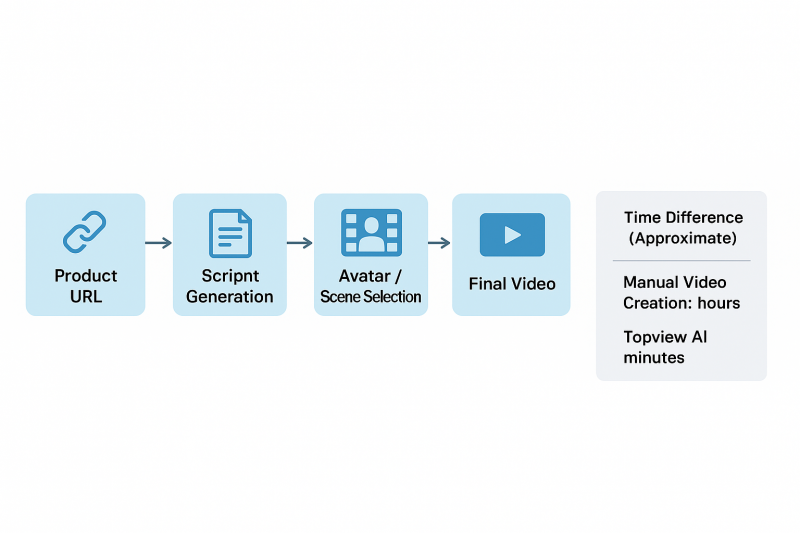
I started with the URL-based video generation, which Topview heavily promotes. I used a clean e-commerce product page with:
- Clear imagery
- Simple value proposition
- No complex variants
The system extracted product context surprisingly well. The generated script was usable but generic—think “attention-grabbing but safe.” It didn’t hallucinate features, which is a positive, but it also didn’t add insight.
What impressed me:
- Speed (video drafts in minutes)
- Visual coherence
- Reasonable product framing
What didn’t:
- Script repetition across regenerations
- Minimal tone control
- Marketing language that sounds “AI-polished”
If you’re running performance ads, this is workable. If you’re building a brand voice, you’ll need edits.
Creating an Avatar: Technically Solid, Emotionally Flat
I tested the avatar system using a high-resolution portrait. The setup process is straightforward, and the resulting avatar is visually consistent across outputs—which is something many competitors still struggle with.
However, realism has layers.
Facial features were accurate.
Movements were smooth.
But emotional range? Limited.
The avatar performs actions, not expressions. This is fine for demonstrations or announcements, but it won’t replace a human creator anytime soon.
I also became very aware of ethical responsibility here. The avatar can convincingly “wear” or “use” products, which means disclosure matters. Used carelessly, this could cross into misleading territory.
UGC-Style Videos: This Is Where Expectations Must Be Managed
Topview’s UGC-style output is one of its most talked-about features. I tested it expecting TikTok-like authenticity.
The reality:
- It looks like UGC
- It does not feel like UGC
- And that distinction matters.
These videos are best described as UGC-inspired, not user-generated in spirit. They work well as test creatives, placeholders, or rapid iterations—but not as final, high-trust content.
That said, for teams without access to creators, this is still valuable. You just need to treat it as a starting point, not a finished campaign.
Product AnyShoot: Useful, But Only for Certain Categories
AnyShoot allowed me to place products into scenes without reshooting. For simple objects—accessories, packaged goods—it performed adequately.
But realism breaks quickly when:
- The product has reflective surfaces
- Fabric movement is expected
- Lighting consistency matters
This is not a photography replacement. It’s a visual prototyping tool. When used with that mindset, it’s helpful. When used as a final asset generator, it falls short.
Credit Consumption: The Silent Constraint
One of the most important things I discovered wasn’t obvious at first: credits drain faster than expected.
Avatar videos, longer durations, and multiple regenerations stack up quickly. If you’re experimenting heavily, you’ll feel pressure to “settle” on outputs sooner than you might like.
This doesn’t make the pricing unfair—but it does mean:
- You should plan sessions
- Avoid blind regenerations
- Treat credits like production budget
Several negative user reviews I later checked echoed this exact frustration, which aligned with my experience.
Performance vs Creativity: A Trade-Off You Can’t Ignore
Topview AI clearly prioritizes speed and predictability over creative depth.
That’s not a flaw—it’s a design choice.
In practical terms:
- It’s excellent for scaling known formats
- It’s weak for discovering new ones
If your workflow already knows what kind of ad works, Topview helps you produce more of it. If you’re still figuring that out, it won’t guide you.
Privacy and Data Considerations I Took Seriously
Uploading face data and product materials forced me to read the privacy policy carefully. The platform does allow opt-out from training usage, which is good, but users need to be aware that:
- Inputs may be processed for model improvement
- Avatar data is inherently sensitive
- Deletion requires proactive requests
This isn’t unique to Topview—but it’s not something users should gloss over.
Where Topview AI Fits and Where It Doesn’t
After real use, my conclusion is clear:
Topview AI is best used as:
- A production accelerator
- A creative testing layer
- A cost-saving substitute for early-stage ads
It should not be used as:
- A brand voice generator
- A high-trust testimonial replacement
- A fully autonomous marketing system
Teams that understand this distinction will extract value. Those chasing “hands-off virality” will be disappointed.
My Final Take: Useful Tool, Honest Limits
I don’t regret testing Topview AI. It saved time. It produced usable assets. It also reminded me that AI still reflects the structure you impose on it.
Used thoughtfully, it’s a solid addition to a modern marketing stack. Used blindly, it creates content that looks busy but says little.
The tool isn’t the problem.
Expectations usually are.
Post Comment
Be the first to post comment!