As artificial intelligence becomes deeply embedded in creative industries, a new movement is emerging with a surprising goal: proving when something was not made by AI.
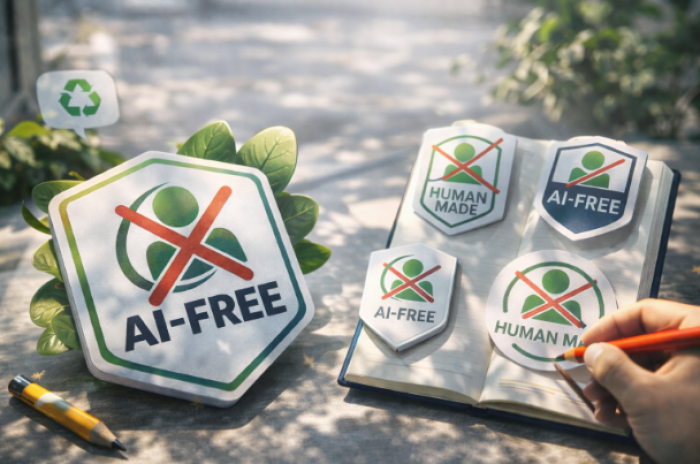
Designers, industry groups, and standards organizations are now proposing competing “AI-free” or “human-made” logos that could appear on products, artwork, and digital content. The goal is to create a universally recognizable symbol that tells consumers a piece of work was produced entirely by human creators.
Supporters believe such a label could help artists protect their work and allow audiences to easily distinguish between human creativity and machine-generated content.
The push for an AI-free symbol reflects growing public concern about the rapid expansion of artificial intelligence in creative fields.
AI tools are now widely used to generate:
In many cases, audiences cannot easily tell whether something was created by a human or produced by AI. Advocates argue that a clear labeling system would give consumers greater transparency about how content is made.
Some groups envision a symbol that could become as widely recognized as the recycling logo, signaling authenticity and human craftsmanship across industries.
Multiple organizations and designers are currently experimenting with different concepts for AI-free labeling. These proposals range from simple icons to certification-style marks that brands could display on products, websites, and creative work.
However, no single design has yet gained global recognition. The effort remains fragmented, with several initiatives trying to establish their own standard.
For the idea to succeed, one symbol would need to achieve widespread adoption among creators, companies, and consumers.
Advocates believe a trusted AI-free label could provide several benefits.
First, it would allow consumers to quickly identify human-made work, particularly in industries where originality and craftsmanship matter.
Second, it could provide economic support for artists who feel their work is being overshadowed or replicated by generative AI systems.
Finally, a standardized label could encourage transparency, helping companies communicate how their content and products are created.
For some creators, the label would function almost like a digital authenticity badge in an era increasingly dominated by automation.
Despite the enthusiasm around the idea, critics argue that implementing a reliable AI-free logo could be extremely difficult.
The main concern is verification.
Creative workflows are becoming increasingly hybrid, with artists often using AI tools at certain stages of production while still performing most of the work themselves. Determining whether something is truly “AI-free” may be harder than it sounds.
Without strict standards and enforcement, critics worry the label could quickly turn into a marketing claim rather than a verifiable certification.
Another challenge is the pace of AI adoption. As artificial intelligence tools become integrated into everyday creative software, separating human-only production from AI-assisted work may become increasingly complicated.
The rise of AI-free labeling highlights a broader cultural reaction to the rapid spread of generative AI.
While investors and technology companies continue to pour billions into AI development, artists, designers, and consumers are simultaneously looking for ways to preserve human identity in creative work.
The idea of a universal AI-free logo represents one possible response: a simple visual signal that celebrates human creativity in a world increasingly shaped by machines.
Whether such a symbol can become globally recognized remains uncertain. But the growing interest around the concept shows that the debate over AI’s role in creative industries is only just beginning.
Be the first to post comment!