The mist rising over the ancient archaeological ruins of Liangzhu in Hangzhou no longer signals just a tribute to China’s 5,000-year-old civilization; today, it mirrors the digital steam rising from one of the most concentrated robotics clusters on the planet. As 2026 opens, a profound shift is occurring in the global technology landscape. The focus of the artificial intelligence revolution has moved definitively from the digital confines of large language models to the tangible world of physical movement. Hangzhou, a city once defined by the e-commerce empire of Alibaba, has successfully pivoted to become the "Deep Silicon Valley" of embodied AI, creating a synergy between sophisticated Western silicon and rapid Eastern industrial scaling.
At the heart of this transformation is the Liangzhu district, where a new generation of startups is bridging the gap between virtual intelligence and physical labor. While the previous decade was defined by AI that could write and code, this era belongs to AI that can walk, grasp, and manufacture. Companies such as Unitree, already globally recognized for their high-performance quadruped and humanoid robots, are no longer outliers; they are the anchors of a massive ecosystem that includes simulation pioneers like Manycore and hardware innovators that are slashing the cost of robotic actuators to levels previously thought impossible.
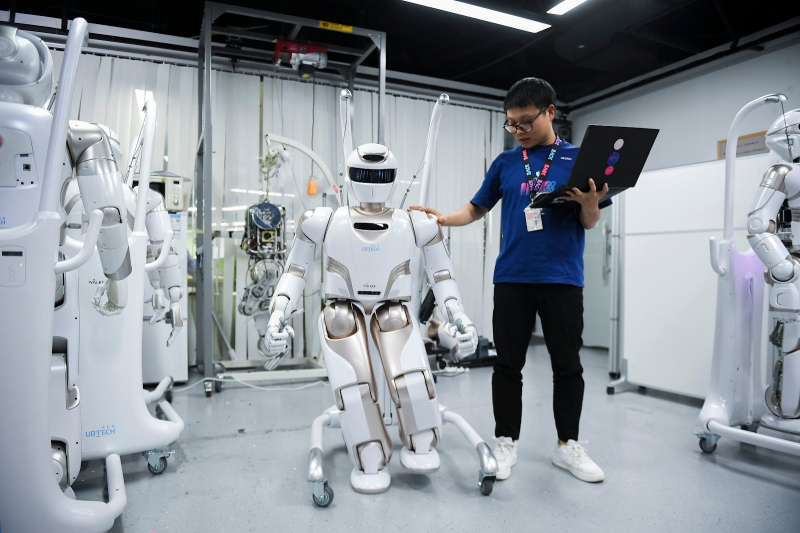
This surge is being fueled by an unprecedented integration of global technologies. Even as geopolitical tensions fluctuate, the technical reliance on Nvidia’s high-compute architecture remains a cornerstone of this movement. By leveraging Nvidia’s Omniverse for physics-based simulations, Hangzhou’s startups are training their robots in digital twins virtual replicas of factories and homes where machines learn from millions of trial-and-error iterations in seconds before ever stepping onto a physical floor. This "simulation-to-reality" pipeline has allowed Chinese firms to iterate at a pace that is currently outstripping their counterparts in traditional tech hubs.
The significance of the Liangzhu cluster lies in its "full-stack" nature. Within a ten-mile radius, a startup can design a neural network, simulate its physical stress points using Manycore’s advanced geometry engines, and source the high-torque motors required for a humanoid’s knee joint. This proximity has compressed the development cycle of sophisticated robotics from years to months. Industry analysts note that what is happening in Hangzhou is the physicalization of the AI boom, where the intelligence born in the cloud is finally being given a body capable of navigating the complexities of human environments.
As venture capital flows into these "embodied AI" ventures, the narrative of the tech industry is being rewritten. The competition is no longer just about who has the best chatbot, but about who can deploy the most reliable, affordable, and versatile physical agents. With the backing of a robust supply chain and a relentless focus on commercialization, Hangzhou’s Liangzhu district is positioning itself as the epicenter of this new industrial revolution, proving that the future of AI will not just be heard or read, but seen moving through the physical world.
Post Comment
Be the first to post comment!