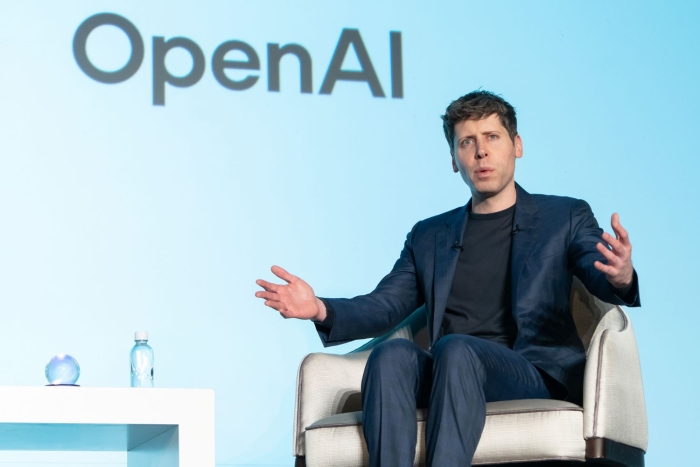
OpenAI chief executive Sam Altman has renewed his push to position ChatGPT as a digital assistant for parents, suggesting that families could use artificial intelligence to organize schedules and create personalized audio content for the daily school run.
The proposal quickly triggered criticism online, raising a broader question about whether AI should help families communicate or replace conversations that parents could have directly with their children.
In a social media post published on Friday, July 31, 2026, Altman described a family-focused use case for ChatGPT Work, a new OpenAI product.
He suggested that parents could connect their family calendars to the platform and provide information about their children’s interests. ChatGPT could then generate a personalized podcast every morning for the journey to school.
The AI-produced program could discuss events such as one child’s soccer game later that day, another child’s upcoming birthday and selected news stories.
The concept combines at least 3 types of personal information: calendar data, children’s interests and family events. It also reflects OpenAI’s broader effort to make ChatGPT part of users’ daily routines rather than a tool opened only for individual questions.
The strongest response came from Alex Hirsch, creator of the animated television series “Gravity Falls.”
Hirsch questioned why parents would use an AI-generated podcast instead of simply talking to their children.
His response attracted significantly more engagement than Altman’s original proposal.
By Saturday morning, Altman’s post had received approximately 300 reposts and 9,600 likes. Hirsch’s reply had collected around 9,000 reposts and 122,000 likes.
That means Hirsch’s response generated about 30 times as many reposts and nearly 12.7 times as many likes as Altman’s original message.
The engagement gap suggests that many social media users viewed the idea as an unnecessary use of AI in a situation where direct family interaction was already possible.
The school-run podcast proposal is not Altman’s first public endorsement of ChatGPT as a parenting tool.
During an appearance on “The Tonight Show Starring Jimmy Fallon,” Altman said he found it difficult to imagine raising a newborn without ChatGPT. He also acknowledged that parents had successfully raised children without AI assistance for generations.
His comments highlighted the growing use of chatbots for practical parenting questions, including sleep schedules, feeding routines, developmental milestones and household organization.
However, AI-generated parenting guidance can vary in accuracy and should not be treated as a substitute for professional medical advice, emergency services or direct consultation with qualified specialists.
OpenAI appears to be developing more products and safeguards for family use.
The company recently advertised a product management position seeking experience with trust-sensitive consumer products for parents and families. Such a role could involve designing parental controls, age-appropriate experiences and systems that help families understand how their information is used.
OpenAI has also introduced safety tools intended to give parents greater oversight of younger users.
The company’s family strategy reflects a significant commercial opportunity. A household that uses AI for scheduling, education, entertainment and communication could interact with the technology several times each day.
At the same time, family-focused AI products face stricter expectations because they may process sensitive information involving children, health, education and personal relationships.
OpenAI’s effort to promote ChatGPT to families comes as the company faces legal and public scrutiny over how conversational AI responds during sensitive interactions.
Multiple lawsuits brought by parents and families have alleged that ChatGPT contributed to harmful situations involving delusions or suicide. OpenAI has said that it continues to improve how its models respond to users experiencing emotional distress or other sensitive circumstances.
These cases create a difficult contrast for the company. OpenAI is encouraging parents to integrate ChatGPT more deeply into family life while also working to demonstrate that its products can be used safely by vulnerable people.
The challenge extends beyond individual responses. Family-focused AI systems must also address privacy, data retention, parental consent, age verification and the possibility that users may become overly dependent on automated advice.
Altman is not the only technology executive who has presented AI as an alternative to traditional audio or conversation during a morning commute.
Microsoft chief executive Satya Nadella previously said he had stopped listening to some of his favorite podcasts while driving. Instead, he used an AI chatbot to discuss information from those programs.
Both examples point to a broader technology industry vision in which AI does not merely recommend content. It reorganizes, summarizes and delivers that content in a personalized format.
For parents, this could produce useful reminders and educational material. It could also reduce spontaneous conversations and create situations where an algorithm decides which family events deserve attention.
The reaction to Altman’s proposal was not primarily about whether ChatGPT could generate a personalized podcast. Modern AI systems can already combine calendar information, written instructions and selected topics into structured audio scripts.
The disagreement centered on whether the technology should be used for that purpose.
Supporters may see the idea as a practical tool for busy households managing several schedules. Critics may view it as another attempt to automate an ordinary human interaction.
The viral response demonstrates that greater technical capability does not automatically produce public acceptance. As AI companies expand into family life, they will need to show not only that their products work, but also that they improve experiences without replacing relationships people still value.
Share your thoughts about this article.
Be the first to post a comment!