Real-money gaming is an unforgiving category of software. A live table is a video stream and a payments pipeline sharing one screen, running over whatever network the player happens to be standing in, and that whole workload now executes in an ordinary browser tab. The technologies that made this possible are the same ones underneath banking apps, trading platforms and live commerce, which makes the category worth studying. One caveat applies throughout: this story is usually told with marketing numbers, and the more useful version uses measured ones.
No-install delivery raised the stakes for the web stack
Distribution changed first. The modern pattern is browser-first, with HTML5 games running in the tab and service workers standing between the application and the network. Mozilla's developer documentation describes service workers as proxy servers sitting between web applications, the browser and the network, intercepting requests and serving cached assets, which is how a returning visitor skips most of a site's load time.
The shift that long ago turned no-install VoIP calling into a browser tab reached real-money play later, because the stakes were higher. Take the notorious Betway brand, today their online casino opens in a stock mobile browser with no installation step, the native app kept as an option. What the browser route gives up is control. An installed binary knows its runtime; a tab inherits whatever handset, browser build and radio conditions arrive with the session, so caching and payload discipline have to absorb that variance rather than assume it away.
The latency budget is real, but check the numbers
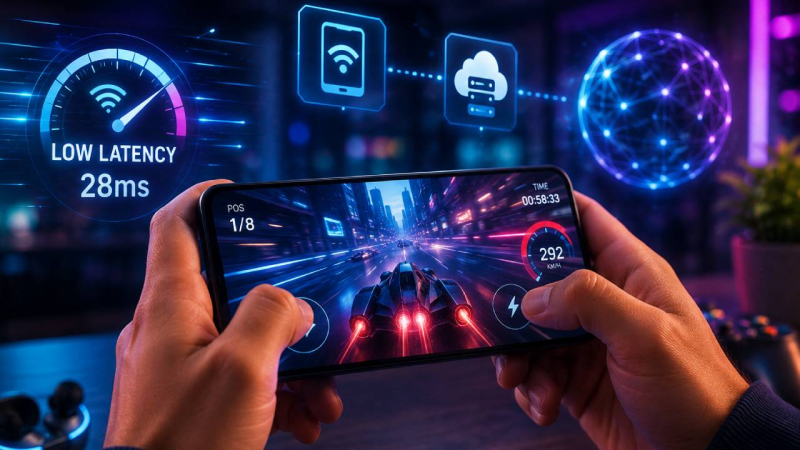
Interactive gaming is latency-bound: a live dealer stream has to stay synchronized with a betting window, and a bet or cash-out has to register when pressed, not shortly after. The infrastructure answer stacks content delivery networks, which hold static assets at edge locations near the user, on top of persistent connections that keep session state flowing without repeated requests, with 5G shortening the radio leg of the journey. For a live table, the practical requirement is that the video, the betting window and the wallet all agree about what time it is.
That last layer deserves honest numbers, because marketing has muddied it. The ITU's 5G specification sets user-plane latency requirements of 4 milliseconds, and 1 millisecond for ultra-reliable use cases, under idealized single-user conditions. Measured reality is different: Ofcom's 2025 UK testing put average 5G response times between 15 and 21 milliseconds. That is a genuine generational improvement, and it is not single digits. Engineering teams design for the network users actually get, which is why edge placement and connection reuse still matter on 5G instead of being made redundant by it.
Security became a performance feature
Encryption once cost noticeable connection time; the current protocol generation gives some of it back. TLS 1.3, specified in RFC 8446, redesigned the handshake so a full negotiation completes in one round trip, and its zero round-trip resumption mode lets a returning client send application data with the first flight of packets, trading a measured amount of security margin for connection speed. For a platform where every session begins with a secure handshake and money moves inside it, protocol efficiency compounds across millions of connections. The fraud and integrity monitoring layered behind it runs server-side, invisible to the player unless it fires.
Where this leaves the industry
A category with live video, live state and real money settled on the open web stack, and the stack held. Each technology described above is now a proven baseline for interactive mobile software generally, not a gaming-industry curiosity. Teams building against that baseline should start where this article did: with the measured numbers, not the advertised ones.
Post Comment
Share your thoughts about this article.
Be the first to post a comment!