We all have those few apps on our phones that we open every single day. Maybe it is for checking the weather, ordering coffee, or just killing five minutes while waiting in line. Those apps have mastered the art of "stickiness." They have made themselves an essential part of our daily routine. As a business owner, getting that kind of prime real estate on your customer's home screen is the ultimate win. It changes the relationship from a one-time transaction to an ongoing conversation.
For a long time, building a dedicated mobile app felt like a luxury reserved for massive brands with bottomless budgets. But that has changed completely. You no longer need a room full of developers to build something great. You just need a good idea and the right starting point.
In this guide, we are going to look at how you can use mobile apps to keep your customers glued to your brand. We will explore how to make your app sticky, how to increase the value of every customer, and most importantly, how to get started easily using templates.
TL;DR
● Mobile apps create "stickiness" by becoming essential tools for daily activities, increasing customer retention and loyalty.
● Using app templates significantly reduces development effort, allowing businesses to launch apps in days rather than months.
● Key features for stickiness include personalization, effective push notifications, and engaging loyalty programs that enhance user engagement.
● Data-driven decision-making is crucial; analyzing user behavior helps in optimizing the app experience and boosting Customer Lifetime Value (LTV).
The Fast Track: Why Templates Are Your Best Friend
Let’s be real for a second. The biggest thing stopping most businesses from launching an app is the fear that it is too hard. We tend to think of app development as this giant, expensive mountain to climb. You might picture months of coding, endless testing, and a price tag that makes your eyes water.
This is where app templates change the game completely.
Think of a template like a pre-built house. The foundation is poured, the walls are up, and the roof is on. You do not have to worry about structural engineering or plumbing. Your job is the fun part: picking the paint colors, choosing the furniture, and making it feel like home.
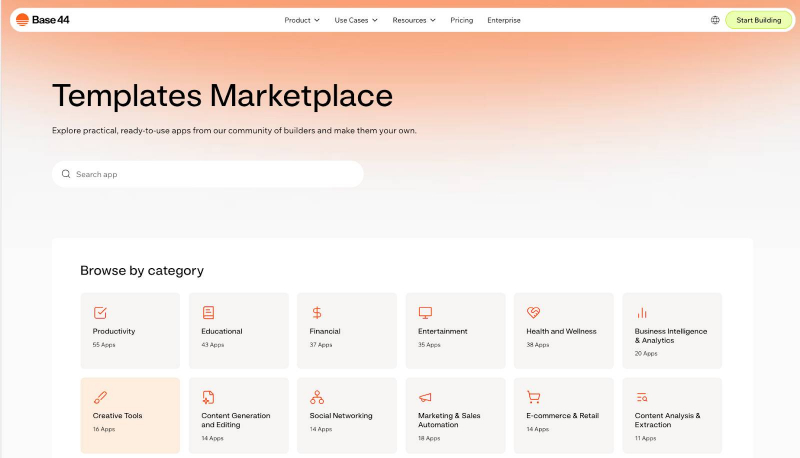
Base44, a leading app builder, offers straightforward app templates with a professional framework ready to use. Each template comes with essential features and built-in tool integrations. Need a productivity or financial layout? They have it. Looking for a booking system? That’s covered too.
By using a template, you skip the hardest 80% of the work. You can focus your energy on branding, content, and products. This accessibility means you can get your app into the hands of your customers in days, not months. It removes the risk and lowers the barrier to entry, so you can start building those deeper relationships right away.
What is "Stickiness" and Why Do You Need It?
Stickiness is exactly what it sounds like. It is the quality that makes users want to stick around. A sticky app is one that offers enough value, entertainment, or utility that a user opens it repeatedly.
When your app is sticky, you are not constantly fighting for attention. You are already part of the user's habits. This is vital because acquiring a new customer is always more expensive than keeping an existing one. Stickiness is the engine that drives retention.
So how do you create it? It comes down to three main pillars: personalization, connection, and incentives.
The Power of Personalization
We all like to feel special. We like it when our local barista knows our order, and we like it when our favorite apps know what we want to see. A mobile app gives you data that a website simply cannot. You know where your user is, what they have bought in the past, and how often they visit.
You can use this info to tailor the experience. If you run a clothing store, your app can show users items that match their style based on past purchases. If you run a fitness business, you can suggest workouts based on their previous activity.
This kind of personal touch makes the user feel understood. It transforms your app from a generic catalog into a personal assistant. When users feel like an app was made just for them, they are much less likely to delete it.
The Gentle Nudge of Push Notifications
Email is great, but it can get buried. Social media is powerful, but algorithms can hide your posts. Push notifications are the only marketing channel that taps your customer on the shoulder and says, "Hey, look at this."
But there is a fine line between being helpful and being annoying. Sticky apps use notifications strategically.
● Transactional: "Your order has shipped!" Everyone loves these.
● Time-Sensitive: "Flash sale ends in one hour." This creates urgency.
● Personal: "You left something in your cart." This reminds them of what they already wanted.
When used correctly, push notifications bring users back into the app when they might have otherwise forgotten. They keep your brand top-of-mind without requiring the user to actively search for you.
Loyalty Programs and Gamification
Nothing builds a habit like a reward. Integrating a loyalty program directly into your app is one of the smartest moves you can make. Forget about physical punch cards that get lost in wallets. A digital loyalty program is always with your customer.
You can gamify the experience to make it even more engaging. Show a progress bar filling up as they get closer to a free reward. Offer bonus points for opening the app daily or sharing a product with a friend. These little dopamine hits make using your app feel fun and rewarding. It gives customers a tangible reason to choose you over a competitor every single time.
Boosting Customer Lifetime Value (LTV)
Stickiness leads to retention, and retention leads to a higher Customer Lifetime Value (LTV). LTV is the total amount of money a customer is expected to spend with your business during their relationship with you.
Mobile apps are incredible tools for boosting this number. Here is how they help you maximize the value of every user.
Reducing Friction Increases Sales
The harder it is to buy something, the less likely someone is to do it. On a mobile website, a user might have to sign in, enter their shipping info, and find their credit card. It is a hassle.
An app solves this. Once a user is logged in, their info is saved. They can often buy with a single tap using Apple Pay or Google Pay. When you make purchasing this easy, you remove the " I'll do it later" excuse. Impulse buys go up, and repeat purchases become a breeze.
Upselling and Cross-Selling Opportunities
Because you know what your customers like, you can make smarter recommendations. If someone is buying a camera in your app, you can immediately suggest a compatible lens or a memory card at checkout.
You can also create bundles or exclusive app-only offers. For example, offering free shipping on app orders over a certain amount encourages users to add just one more item to their cart. These small increases in average order value add up significantly over the lifetime of a customer.
Building Brand Affinity
LTV isn't just about money; it is about love. Customers who love a brand stay longer and tell their friends. An app gives you a dedicated space to tell your brand story without the noise of the open internet.
You can share behind-the-scenes content, host community forums, or offer early access to new drops. This makes your most loyal customers feel like insiders. When people feel emotionally connected to a brand, they become advocates. They do the marketing for you, bringing in new customers with high LTV potential.
Designing for Delight
You can have the best products in the world, but if your app is frustrating to use, nobody will stick around. Design plays a massive role in stickiness. This is another area where templates shine, as they usually come with user-friendly design best practices built in.
Keep It Simple
The best interfaces are invisible. The user should not have to think about how to navigate your app. Buttons should look like buttons. The menu should be where they expect it to be.
Avoid clutter. Mobile screens are small, so you need to be ruthless with your editing. Only show what is necessary. Use plenty of white space to let the content breathe. A clean, simple design feels professional and trustworthy.
Engaging Content is King
An app shouldn't just be a store; it should be a resource. Give people a reason to open the app even when they aren't planning to buy something right this second.
● Blogs and Articles: Share tips related to your industry.
● Videos: Post tutorials or product demos.
● Lookbooks: Inspire users with beautiful imagery.
New content marketing keeps your app feeling fresh. If a user opens your app and sees the same banner they saw three months ago, they’ll assume nothing is happening. Regular updates give them a reason to check back in.
Speed Matters
We are an impatient bunch. If an app takes five seconds to load, we are gone. Performance is a design feature. Your app needs to be snappy and responsive.
This includes how quickly images load and how smooth the transitions are between pages. A laggy app feels cheap and unreliable. Fortunately, modern app builders optimize for performance automatically, ensuring your app runs smoothly on all devices.
Using Data to Improve
The beauty of a digital platform is that everything is measurable. You do not have to guess what your customers like; they tell you with their actions.
Most app builders come with built-in analytics. You should be looking at this data regularly.
● Active Users: How many people open the app daily or monthly?
● Retention Rate: How many people install the app and are still using it 30 days later?
● Conversion Rate: How many people who view a product actually buy it?
Turn this data into your secret weapon for finding weak spots. If people are abandoning carts at checkout, your shipping costs might be too high or the process too long. If your articles aren't getting hits, you can experiment with new layouts or better topics to boost blog traffic. Focus on what your users are telling you so you can give them exactly what they want.
Continuous improvement is the secret to long-term success. Test different push notification times. Try new banner images. Experiment with different offers. The more you learn about your audience, the better you can serve them.
Your App, Your Future
Building a mobile app is one of the most powerful steps you can take to secure the future of your business. It allows you to own your audience, build deeper connections, and drive consistent revenue.
It is no longer a question of "if" you can build one, but "when." With templates removing the technical hurdles, the path is clear. You have the vision, and now you have the tools.
Start by looking at what your customers need. Find a template that matches your goals. Customize it to reflect your unique brand personality. Then, focus on creating an experience that is so helpful, so rewarding, and so easy to use that your customers can't help but stick around.
FAQ
What is customer stickiness and why is it important for businesses?
Customer stickiness refers to the ability of an app to keep users engaged and coming back. A sticky app provides enough value, entertainment, or utility that users incorporate it into their daily routines. This is crucial for businesses because retaining existing customers is often cheaper than acquiring new ones. Stickiness leads to higher customer retention rates, facilitating a deeper relationship and enhancing customer loyalty.
How do mobile apps increase customer lifetime value (LTV)?
Mobile apps boost customer lifetime value (LTV) by enhancing customer retention and engagement. By simplifying the purchasing process, offering personalized recommendations, and integrating loyalty programs, apps make it easier for customers to buy and encourage repeat transactions. Additionally, by fostering emotional connections through brand storytelling within the app, businesses can turn customers into advocates, further increasing their lifetime value.
What role do app templates play in developing mobile applications?
App templates significantly streamline the app development process. They provide a pre-built framework that includes essential features, reducing the technical challenges and costs associated with app creation. By using templates, businesses can launch their apps in a matter of days rather than months. This accessibility encourages more businesses to develop apps, allowing them to focus on branding and content rather than the technical complexities of development.
How can personalization enhance the stickiness of a mobile app?
Personalization enhances app stickiness by tailoring the user experience based on individual preferences and behaviors. For instance, an app can suggest products that align with a user's past purchases or offer content that reflects their interests. This personal touch makes users feel valued and understood, which increases the likelihood that they will continue using the app instead of deleting it. When users perceive the app as a customized experience, their engagement and loyalty grow.
What are some effective strategies for using push notifications in mobile apps?
Effective push notifications should be strategic and relevant to users to avoid annoyance. Types of useful notifications include transactional messages (e.g., order updates), time-sensitive alerts (e.g., sales), and personalized reminders (e.g., abandoned carts). By using push notifications wisely, businesses can re-engage users and bring them back to the app, ensuring that the app remains top-of-mind for customers and driving ongoing interaction.
Post Comment
Be the first to post comment!