Table of Content
- What Is Wonderplan AI and Why Is It Gaining Attention?
- How Wonderplan AI Generates Travel Plans
- Accuracy Breakdown: Where Wonderplan AI Performs Reliably
- Safety Analysis: Is Wonderplan AI Safe to Use?
- Legitimacy Check: Is Wonderplan AI a Real and Credible Platform?
- How to Use Wonderplan AI Responsibly: A Step-by-Step Guide
- Final Evaluation: Can Wonderplan AI Be Trusted?
AI travel planners are no longer experimental tools; they are actively shaping how people research, organize, and prepare for trips. Among these tools, Wonderplan AI often appears in searches as a free AI travel planner. That description alone invites both interest and caution.
This guide takes a deeper, structured look at Wonderplan AI, not just how it works, but how trustworthy it is, what its claims really mean, where accuracy holds up, and where users must slow down and verify details.
What Is Wonderplan AI and Why Is It Gaining Attention?
Wonderplan AI is a web-based travel planning platform that uses artificial intelligence to generate itineraries based on user input such as destination, duration, budget level, and interests.

Its growing visibility comes from two factors:
- It removes the initial friction of trip planning
- It remains free to use, without obvious paywalls
This combination makes it appealing to casual travelers, first-time planners, and groups looking for structure without commitment.
However, popularity alone does not equal reliability, which is why understanding its role is essential before trusting its output. That naturally leads to a closer look at what Wonderplan AI actually promises.
What Wonderplan AI Claims, and What It Carefully Avoids Claiming
One of the reasons Wonderplan AI avoids major controversy is that its claims are relatively restrained.
It does not claim to:
- Provide real-time prices
- Guarantee availability
- Replace booking platforms
- Act as an official travel authority
Instead, the platform implicitly positions itself as:
- A planning assistant
- An itinerary generator
- A research shortcut
This distinction matters because many misunderstandings arise when users assume AI tools provide factual certainty rather than probabilistic suggestions. To evaluate this properly, we need to understand how the AI behind Wonderplan actually works.
How Wonderplan AI Generates Travel Plans
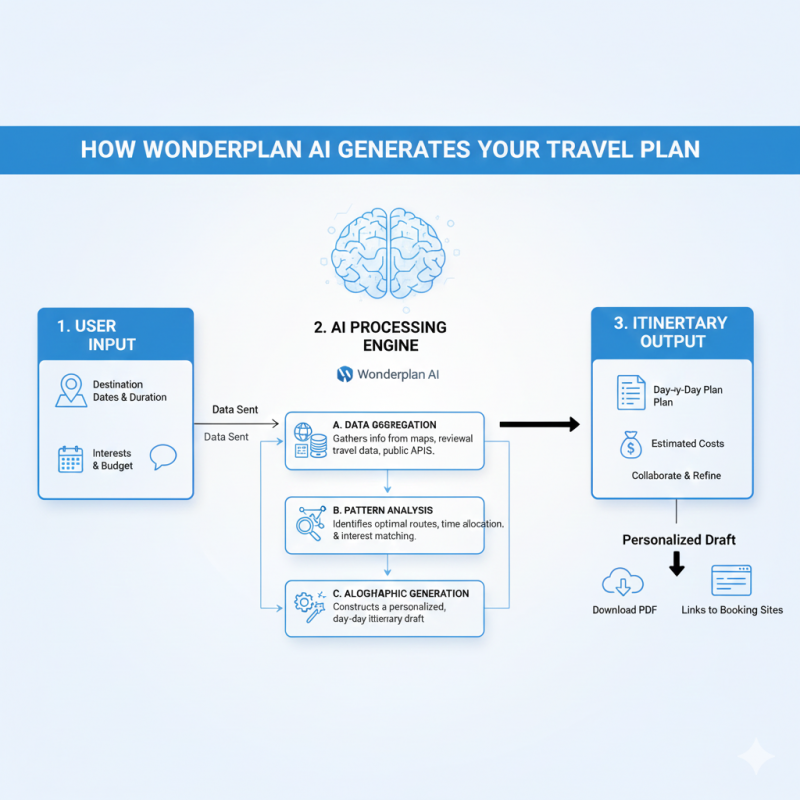
Wonderplan AI relies on a combination of:
- Aggregated travel datasets
- Common tourist patterns
- Popular points of interest
- Budget-based heuristics
- Historical averages rather than live feeds
The AI does not:
- Access airline reservation systems
- Pull real-time hotel inventory
- Monitor live closures or events
Instead, it predicts what typically makes sense for a trip of a certain type.
This design explains both its strengths and its limitations, which become clearer when we evaluate accuracy more closely.
Accuracy Breakdown: Where Wonderplan AI Performs Reliably
From repeated use and analysis, Wonderplan AI shows consistent reliability in several structural areas.
Itinerary Structure Accuracy
- Trip length usually aligns well with daily planning
- Days are rarely overloaded beyond reasonable expectations
- Activities are sequenced logically at a high level
Interest and Budget Matching
- Budget tiers influence accommodation and activity types
- Interest selections (culture, food, leisure) visibly change outputs
- Relaxed vs fast-paced trips feel meaningfully different
These strengths explain why many users find the tool useful early in the planning process. However, structural accuracy does not guarantee situational accuracy, which is where limitations appear.
Accuracy Gaps: Where Human Verification Is Essential
Wonderplan AI does not actively verify time-sensitive or situational details. Users should always manually confirm:
- Opening and closing hours
- Seasonal access restrictions
- Reservation or ticket requirements
- Transit time feasibility
- Local holidays or strikes
The AI often provides plausible suggestions—but plausibility is not certainty.
This is not deceptive behavior, but it does mean the tool must be treated as advisory rather than authoritative, which ties directly into safety considerations.
Safety Analysis: Is Wonderplan AI Safe to Use?
From a technical and consumer-safety standpoint, Wonderplan AI presents low risk.
Positive Safety Indicators
- No payment processing
- No forced sign-up
- No suspicious urgency tactics
- No internal handling of bookings or finances
Practical Safety Risks
The main risks are decision-based, not technical:
- Over-trusting AI recommendations
- Skipping manual checks
- Assuming estimates equal confirmed plans
In short, Wonderplan AI is not unsafe, but it can be misused if treated as a final authority. That brings us to the question of truthfulness and marketing integrity.
Truthfulness of Wonderplan AI’s Claims
Wonderplan AI markets itself around three core ideas:
- Free access
- AI-powered planning
- Personalized itineraries
All three claims are accurate as of early 2025.
What it does not claim, but users sometimes infer, is guaranteed correctness. This distinction is critical and should be kept in mind when evaluating the tool’s legitimacy.
Legitimacy Check: Is Wonderplan AI a Real and Credible Platform?
Several indicators suggest Wonderplan AI is a legitimate service rather than a deceptive or low-effort product:
- Functional platform with consistent behavior
- Transparent redirection to third-party booking services
- Presence on multiple tech and review platforms
- Absence of scam-like monetization tactics
That said, it is still:
- A relatively young platform
- Light on long-term user data
- Not independently audited
This places it in the category of legitimate but still maturing, which is common for AI-first tools.
User Reviews, Ratings, and the Problem of Limited Data
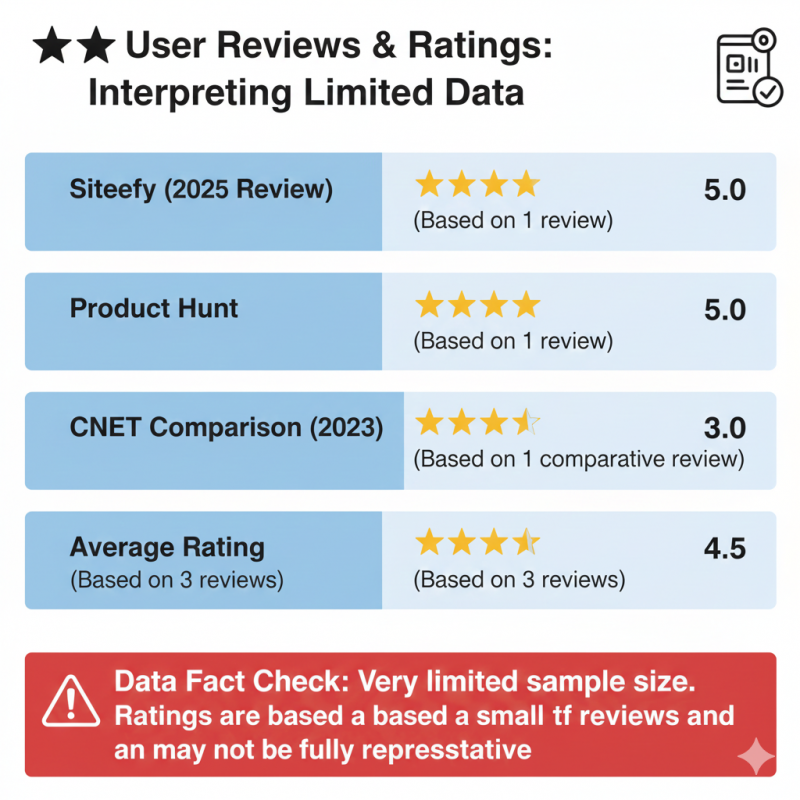
Wonderplan AI often shows high ratings on platforms where it is reviewed. However, those ratings typically come from very small sample sizes.
This creates two realities:
- Early users appear satisfied
- Statistical confidence remains low
Responsible interpretation means treating ratings as early signals, not definitive proof of quality. This nuance is important for trust and ties into how the tool should be used in practice.
How to Use Wonderplan AI Responsibly: A Step-by-Step Guide
To get value from Wonderplan AI without risk, a structured approach helps.
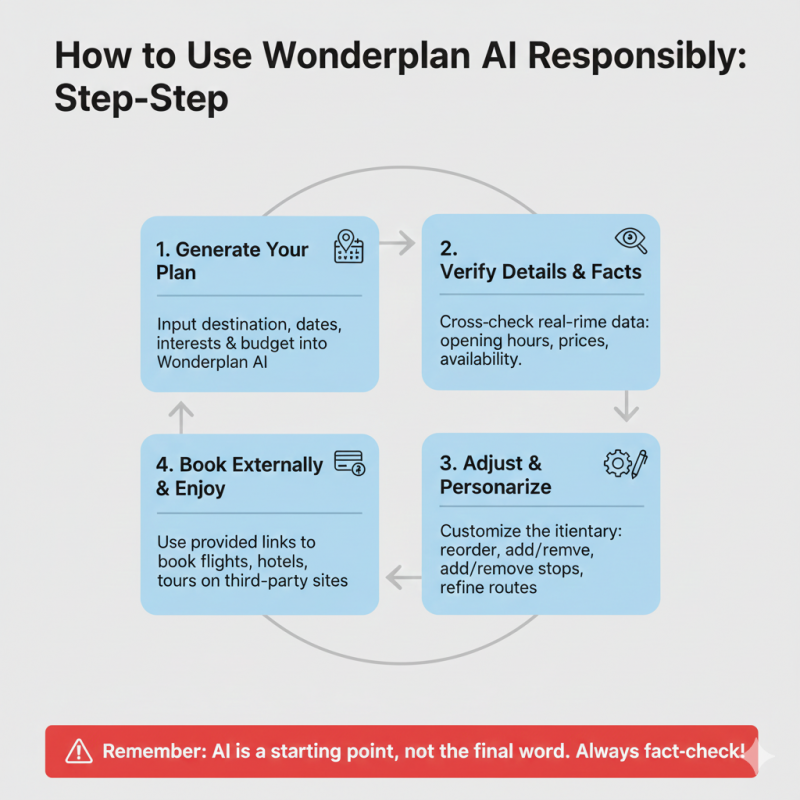
Recommended Workflow
- Generate an initial itinerary
- Review pacing and geography
- Cross-check routes using maps
- Verify hours and reservations
- Confirm prices on official platforms
- Adjust based on personal comfort
Used this way, Wonderplan AI acts as a planning accelerator, not a decision-maker.
AI Planning vs Human Judgment: Drawing the Right Boundary
AI tools excel at:
- Organizing information
- Reducing cognitive overload
- Offering starting structures
Humans remain better at:
- Contextual judgment
- Risk assessment
- Real-time decision-making
Wonderplan AI works best when this boundary is respected—something many frustrations disappear once expectations are aligned.
Final Evaluation: Can Wonderplan AI Be Trusted?
Wonderplan AI is:
- Legitimate
- Structurally accurate
- Transparent in intent
- Safe to use
It is not:
- Real-time
- Guaranteed
- A replacement for verification
Its biggest weakness is not misinformation, but the illusion of completeness that AI tools can create. With awareness and basic checks, it becomes a helpful companion rather than a risky shortcut.
Frequently Asked Questions (FAQ)
Is Wonderplan AI completely free?
As of early 2025, Wonderplan AI does not charge users or require subscription upgrades.
Does Wonderplan AI provide live prices?
No. All prices are estimates and must be verified on booking platforms.
Can Wonderplan AI book hotels or flights?
No. It redirects users to third-party services for bookings.
Is Wonderplan AI safe to use?
Yes, from a technical standpoint. Users should still verify travel details manually.
Is Wonderplan AI accurate?
It is accurate in structure and intent, but not guaranteed for real-time details.
Final Takeaway
Wonderplan AI is best understood as a planning guide, not a promise. When used with verification and realistic expectations, it can significantly reduce planning effort without introducing meaningful risk.
The key is not whether Wonderplan AI is perfect, but whether users understand what it is designed to do.
And when that understanding is clear, the tool does exactly what it claims, no more, no less.
Post Comment
Be the first to post comment!