How Optical Character Recognition, Edge Computing, and Real-Time Data Encoding are Redefining the User Experience
The online gaming landscape has undergone a radical architectural shift over the past decade. While the industry was built on the back of Random Number Generators (RNG) and 2D graphics, the last few years have seen a massive migration toward "Live Dealer" technology. This sector does not merely replicate the casino experience; it digitizes physical reality in real-time, relying on a complex stack of high-definition streaming, optical recognition software, and low-latency data transmission.
For the tech-savvy user, understanding the difference between a standard digital slot and a live broadcast table requires looking "under the hood" at the mechanics that govern gameplay, fairness, and user interface (UI) integration.
From Algorithms to Physical Outcomes
To understand the innovation of live studios, one must first distinguish them from the standard online gaming engine. Traditional online casino games—slots, digital blackjack, or roulette—operate on RNG (Random Number Generator) software.
In an RNG scenario, the outcome of a "spin" or a "deal" is determined the millisecond the player presses the button. The visual animation of reels spinning or cards flipping is merely a graphical interface designed to entertain; the mathematical result is instantaneous. These games rely heavily on RTP (Return to Player) percentages and Volatility metrics hard-coded into the software. For example, a slot with high volatility might pay out less frequently but in larger amounts, governed entirely by the algorithm's variance.
Live Dealer technology flips this model. The outcome is not determined by a processor seed but by physical physics—the velocity of a roulette ball or the shuffle of a deck. However, the challenge lies in translating these physical actions into digital data that the user's device can understand and settle bets against.
The Brain of the Operation: The Game Control Unit (GCU)
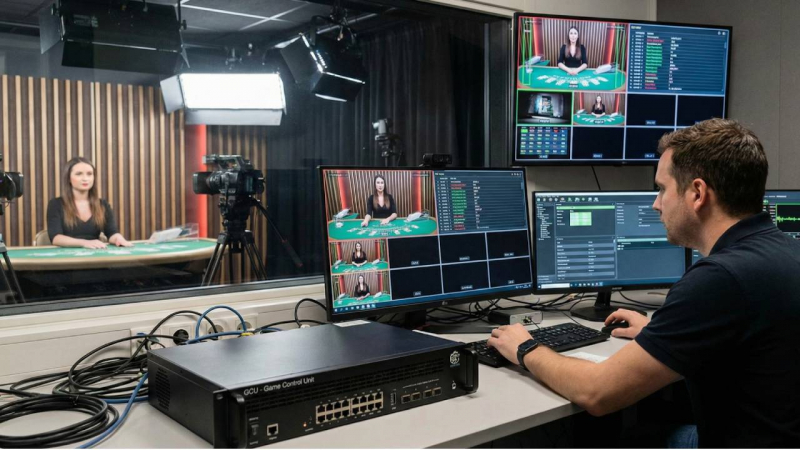
The most critical component in any live studio is the Game Control Unit (GCU). Every table in a studio, whether it is located in Riga, Malta, or New Jersey, is equipped with a GCU. It is a hardware device, roughly the size of a shoebox, that encodes the video data and game data.
The GCU is responsible for assisting the dealer in running the game. It acts as the bridge between the analog world (the cards/wheel) and the digital world (the player's screen). Without the GCU, the system is just a video broadcast; with the GCU, it becomes an interactive interface where clicks on a screen translate to wagers on a physical table.
Optical Character Recognition (OCR)
How does the computer know which card was dealt? This is achieved through Optical Character Recognition (OCR) technology.
In a game of Blackjack or Baccarat, every card in the shoe contains a micro-code or is scanned by sensitive cameras embedded in the table or the dealing shoe (often called a "smart shoe"). As the card is drawn, the OCR software instantly scans the suit and rank.
1. Image Capture: The camera records the card face.
2. Digitization: The software converts the image into a data string (e.g., "Queen of Hearts").
3. UI Overlay: This data is instantly sent to the player’s video feed, appearing as a digital graphic overlay on top of the live video.
4. Settlement: The system logic checks the card against the player's bet and game rules to determine a win or loss—all in milliseconds.
This technology allows for features like "Bet Behind" (where unlimited players can bet on the outcome of a single seat’s hand) because the system knows the state of the game mathematically, even though the input is physical.
Latency and Bandwidth Challenges
For a seamless experience, live casino mechanics require incredibly low latency. Unlike a Netflix stream, which can buffer, a live game requires real-time interaction. If a player hits "Stand," that signal must reach the studio, appear on the dealer's monitor, and be acted upon immediately.
Top-tier providers utilize content delivery networks (CDNs) optimized for high-frequency data to minimize "lag." However, the quality of the experience often varies depending on the specific software provider and the location of their studio server relative to the user.
The technical variance between providers is significant. Some focus on 4K multi-camera angles which require significant bandwidth, while others prioritize speed and mobile compatibility. Because the market is fragmented with dozens of providers (Evolution, Playtech, Pragmatic Play, etc.), the user experience can differ wildly regarding stream clarity and interface responsiveness.
Navigating these technical specifications can be complex for the average user. Independent analysis is often required to distinguish between high-performance streams and legacy setups. Specialized resources like https://www.livecasinocomparer.com/ focus on auditing these distinct environments, providing data on studio locations, software capabilities, and the specific rulesets applied by different providers, helping users identify which platforms offer the most stable technical performance.
Hybrid Mechanics: The Rise of Game Shows
Recently, the industry has moved beyond traditional tables into "Game Shows." These represent a hybrid of RNG and Live mechanics.
Take, for example, games that utilize a physical money wheel but include a "Bonus Round." The main game relies on the physical spin (gravity and friction), but the bonus round often transitions into a 3D environment powered by RNG.
Here, the mechanics of Augmented Reality (AR) come into play. Studios use green screens and motion tracking to place a real human presenter inside a generated 3D world. The "Monopoly" or "Crazy Time" style games use this extensively. The technical challenge here is synchronization: the rendering engine must sync perfectly with the camera movements to maintain the illusion that the host is interacting with virtual objects.
Volatility and RTP in Live vs. Digital
From a mathematical perspective, understanding the shift from digital to live requires a look at House Edge and RTP.
● Digital Slots: These often feature RTPs ranging from 92% to 97%. The mechanics are complex, utilizing features like Megaways (where paylines change dynamically every spin) or Cascading Reels. These games generally have higher volatility.
● Live Table Games: These are bound by the mathematical probability of the game itself. European Roulette, for instance, has a fixed House Edge of 2.7% (an RTP of 97.3%). Blackjack, played with optimal strategy, can have an RTP as high as 99.5%.
However, the "cost" of the higher RTP in live games is the speed of play. A digital RNG hand of blackjack takes 3 seconds. A live dealer hand takes 45 seconds to a minute. Therefore, while the theoretical return is higher, the "action per hour" is significantly lower in a live environment.
The Role of Regulatory Tech
A common misconception is that live games are easier to rig than RNG games. In reality, the surveillance technology in these studios rivals that of high-security banks.
Every hand dealt and every spin of the wheel is monitored not just by the OCR software, but by separate oversight teams.
● Smart Shoes: These track every card leaving the deck. If a card is missing or the order of the shuffle was compromised, the system locks down before the hand is even played.
● Wheel Sensors: Modern roulette wheels are equipped with sensors that detect "bias." They track the velocity of the rotor and the ball, as well as the drop zones. If the system detects that the wheel is tilting or that outcomes are deviating statistically from the norm (indicating a mechanical flaw), the table is flagged for maintenance automatically.
Conclusion: A Tech-First Future
The future of this niche lies in the further integration of immersive tech. We are already seeing the early stages of VR (Virtual Reality) lobbies where players can "walk" through a studio. Furthermore, 5G connectivity is eliminating the latency bottlenecks that previously restricted mobile play, allowing for 4K streaming on handheld devices.
For the user, the key to engaging with this technology is understanding that it is not magic, but a sophisticated blend of optical engineering, data encoding, and probability mathematics. Whether one prefers the algorithmic variance of a Megaways slot or the physical predictability of a live roulette wheel, recognizing the mechanics behind the screen ensures a more informed and grounded perspective on the industry.
Post Comment
Be the first to post comment!