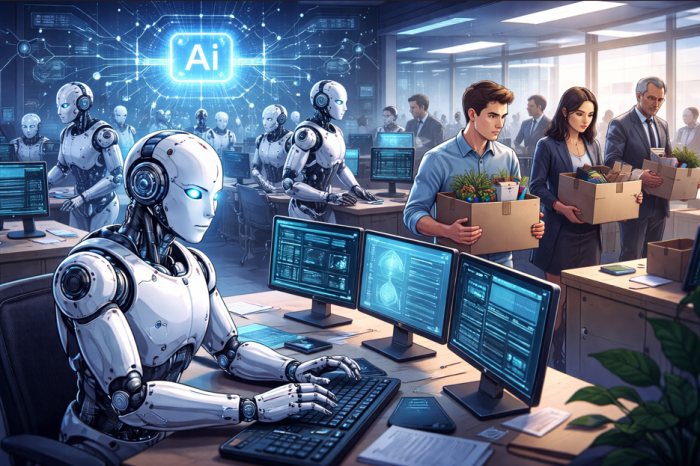
Former HDFC Bank CEO Aditya Puri has pushed back against growing anxiety around artificial intelligence and employment, saying current fears about mass job losses are being overstated.
Speaking in a recent discussion alongside N. R. Narayana Murthy, the veteran banker argued that while AI will certainly reshape work, predictions of widespread white-collar collapse are unrealistic and driven by hype.
Puri described the current AI narrative as “too much hype,” both in terms of how quickly the technology will mature and how many roles it will ultimately eliminate.
He acknowledged that some jobs will inevitably change or disappear. However, he emphasized that history shows technological shifts also create entirely new categories of work and business opportunities.
According to Puri, forecasts claiming that a majority of existing jobs could vanish do not reflect how economic transitions typically unfold. His core message was blunt: humans will remain central to the workforce.
One of Puri’s key arguments is that the rise of agentic AI systems will be evolutionary rather than instantly disruptive.
He expects advanced AI tools to function primarily as collaborators that enhance human productivity rather than fully autonomous replacements. Any large-scale structural shift in employment, he suggested, is more likely to play out over the next one to two decades rather than within the next few years.
This longer timeline, he implied, gives businesses and workers time to adapt.
In financial services, Puri pointed to several areas where AI is already making measurable inroads.
He highlighted marketing optimization, credit assessment, fraud detection, and process automation as functions that are gradually being reshaped by AI tools. Many banks have begun deploying early use cases in these domains, though the transformation remains incremental.
Importantly, Puri framed AI not as a threat to banking jobs but as a productivity engine that can support growth when implemented responsibly.
Beyond the technology itself, Puri stressed that institutions must remain grounded in core business principles.
He argued that success in the AI era will still depend heavily on factors such as:
In his view, AI is a powerful tool but not a substitute for sound business fundamentals.
In the same conversation, Infosys co-founder N. R. Narayana Murthy reinforced the importance of professional discipline and continuous learning.
Both leaders agreed that workers who proactively learn to use AI as an assistive technology will be best positioned to benefit from the shift. Rather than fearing automation, they suggested professionals should focus on adaptation and skill development.
Puri’s comments offer a clear counterweight to more alarmist AI narratives. His position is not that disruption will be absent, but that it will be gradual, uneven, and ultimately accompanied by new job creation.
The message from two of India’s most prominent business leaders is consistent: AI will reshape work, demand upskilling, and improve productivity. But the idea of humans rapidly disappearing from the workplace remains, in their view, greatly exaggerated.
Be the first to post comment!