The 15 million modern vehicles that arrive on the market each year are effectively rolling data centers, recording millions of data points every second. When a crash occurs, this digital trail provides an objective narrative of the events leading up to impact. Forensic crash analysis no longer relies solely on tire skid measurements or witness statements.
Today, vehicle telematics, onboard computers, and sensor networks capture exact speeds, braking patterns, steering inputs, and seatbelt usage. This technological shift changes how liability is determined, replacing guesswork with verifiable digital evidence.
What Your Car Remembers About a Crash
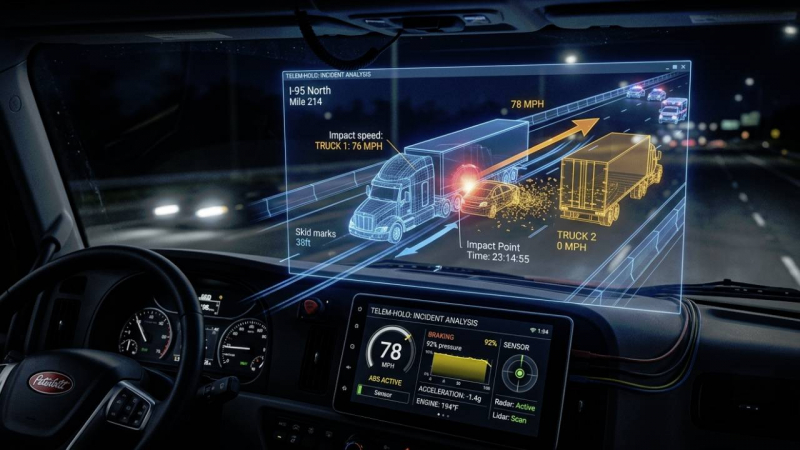
Every modern passenger vehicle comes equipped with an Event Data Recorder, often called the automotive black box. In the seconds surrounding a collision, this device freezes and stores crucial pre-crash telemetry.
Engineers examine this data to reveal throttle position, engine RPM, steering angle, and whether the brakes were applied. Federal safety standards mandate EDR capture requirements to ensure crash investigators have access to uniform kinematic metrics. Advanced driver-assistance systems add another layer of insight by recording lane departures, automatic emergency braking triggers, and blind-spot alerts.
Outside the internal computer, mobile apps and connected infotainment hubs track precise GPS routes and Bluetooth connection activity. These records reveal if a driver was interacting with a smartphone at the moment of impact. Taken together, these data streams recreate the physical reality of a wreck with microscopic precision.
How Commercial Fleets Generate Massive Digital Footprints
Commercial freight vehicles carry significantly more technology than standard passenger cars. Semis and heavy trucks utilize advanced Engine Control Modules alongside integrated fleet management software to track continuous driver behavior.
When a massive rig collides with a smaller passenger car, the resulting data footprint can be massive, and extracting and interpreting this data requires specialized technical knowledge and regional expertise in the laws of the state where the collision occurred. If an accident takes place in OK, injured parties often work with truck accident lawyers in Oklahoma City to secure court orders that prevent transportation companies from overwriting vital Electronic Logging Device records. Finding similarly seasoned specialists wherever you’re based is wise.
- Commercial vehicles monitor operational compliance and safety metrics through several specialized systems.
- Electronic Logging Devices that record exact driving hours and duty status to prevent driver fatigue
- Forward-facing and cab-mounted AI dash cameras that capture dual-perspective video feeds during sudden maneuvers
- Telematics units that track real-time speed, hard braking, rapid acceleration, and engine diagnostic fault codes
Accessing this information early is essential because commercial telemetry data can be erased or overwritten during routine fleet maintenance cycles.
Decoding Digital Evidence in Crash Claims
Raw data alone does not settle a dispute. Telematics files require extraction through proprietary hardware and interpretation by certified accident reconstruction specialists.
There are thousands of commercial vehicle crashes every day across national highway networks. When these collisions happen, digital evidence often serves as the deciding factor in resolving conflicting insurance accounts. Reconstruction experts plug into the vehicle's diagnostic port, pull the hex code, and map the physics of the crash frame by frame.
This process matches physical damage against internal computer timestamps. If a commercial driver claims they hit the brakes a hundred feet before impact, but the ECM log shows zero brake pressure, the telemetry exposes the truth. Data eliminates the subjective arguments that used to stall resolution, and it’s just one example of digital information’s impact on how complex processes are handled, with another being the influence it holds over business decision-making.
The Future of Highway Safety and Data Analysis
As autonomous features expand, vehicle data will become even more granular. Continuous cloud connectivity means future crash analysis will happen almost instantaneously, streaming real-time diagnostics directly to emergency responders and safety regulators.
Navigating the aftermath of a major crash means looking beyond visible body damage to examine the underlying code. Drivers who understand the data captured by modern vehicles are far better equipped to protect their rights when a serious incident occurs on the road. For ongoing insights into how technology is changing various aspects of the modern world, stick around on our site.
Post Comment
Share your thoughts about this article.
Be the first to post a comment!