Table of Content
- Why this comparison matters
- Quick verdict
- Two very different companies
- Voice quality
- Where ElevenLabs wins
- Where Murf AI wins
- Voice library and controls
- Voice cloning
- Studio and workflow
- API and developer tools
- Pricing and value
- What users are saying
- Dubbing and multilingual use
- Security and enterprise fit
- Which one should you choose?
- Final verdict
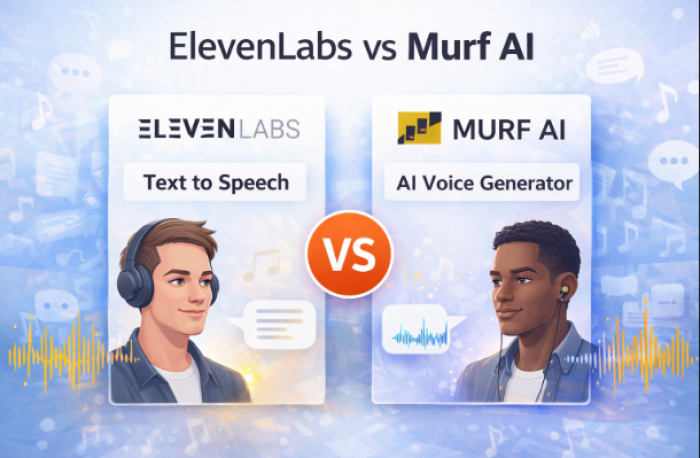
ElevenLabs and Murf AI are both excellent AI voice generators, but they are built for very different users. ElevenLabs is the stronger choice if you care most about voice realism, cloning, and developer power, while Murf AI is the better fit if you want a structured production workflow for business, eLearning, and presentations.
That difference matters because picking the wrong tool is expensive in more ways than one. It does not just waste money on a subscription you do not fully use. It also costs time when you have to fight a platform that was never really designed for your workflow.
Why this comparison matters
The AI voice market has matured fast, but most tools still fall into one of two camps. Some are obsessed with voice quality and frontier features. Others are built to help teams produce content efficiently inside real business workflows.
ElevenLabs and Murf AI sit on opposite sides of that split. One feels like an audio AI platform pushing the category forward. The other feels like a polished production system made for teams that need voice-overs to just work.
Quick verdict
| Category | Winner | Why |
| Voice realism | ElevenLabs | More human, expressive, and emotionally natural |
| Voice cloning | ElevenLabs | More accessible and affordable |
| Business workflow | Murf AI | Better for production teams and structured content |
| Developer API | ElevenLabs | Broader and more advanced ecosystem |
| eLearning and presentations | Murf AI | Strong integrations and timeline-based workflow |
| Pricing entry point | ElevenLabs | Lower-cost starting plan |
| Compliance and enterprise fit | Murf AI | Stronger procurement-friendly compliance stack |
Two very different companies
ElevenLabs and Murf AI did not grow up with the same goals. That matters because their products reflect those original ambitions.
ElevenLabs was founded to solve the problem of bad dubbing and weak voice localization. The company has since grown into a major audio AI platform with massive funding, rapid product expansion, and a strong focus on advanced voice generation.

Murf AI took a quieter, more practical route. It was built with business teams in mind from the beginning, and that shows in the way it handles presentations, narration, and production workflows. It is less about pushing voice AI boundaries and more about making voiceovers easy to create at scale.
Voice quality
If you care about one thing above all else, ElevenLabs still leads: the voices sound more human.
Its newer model produces speech that feels expressive, natural, and emotionally alive. It handles emphasis, tone shifts, and more subtle delivery patterns in a way that is still hard for most competitors to match. For Western English-language content, the difference is especially noticeable.
Murf AI does not sound bad at all. In fact, for business narration, training content, and explainers, it sounds clean, polished, and dependable. But it usually feels more controlled than deeply expressive. That is not a flaw if you want clarity and consistency. It just means the platform is aimed at a slightly different use case.
Where ElevenLabs wins
- More natural voice realism.
- Better emotional range.
- Stronger for storytelling and character work.
- Better fit for English-language content that needs personality.
Where Murf AI wins
- Clean and broadcast-ready delivery.
- Strong consistency across large batches of content.
- Better fit for structured narration and internal business content.
- More predictable for teams producing at scale.
Voice library and controls
ElevenLabs gives you a very large voice library and a lot of creative control. You can fine-tune stability, similarity, and style, and you can even generate a voice from a plain-text description. That makes it especially appealing if you want experimentation and variety.
Murf AI takes the opposite approach. It has fewer voices, but the voices are curated and the control layer is more production-focused. Features like “Say It My Way,” word-level emphasis, and variability make it useful for people who want precise control over delivery rather than endless choice.
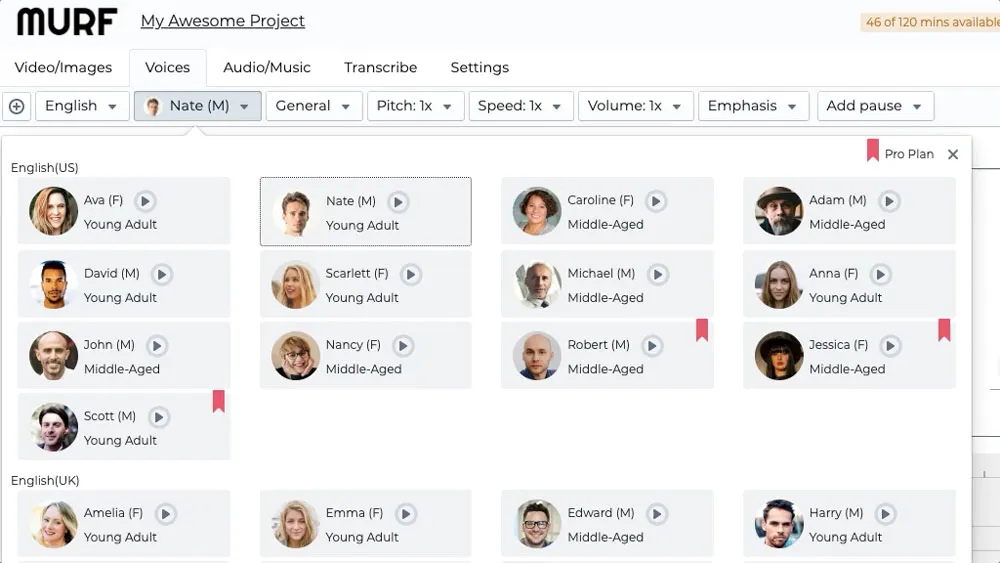
That means ElevenLabs is better for creators who want range, while Murf is better for teams that want a reliable repeatable output.
Voice cloning
This is one of the biggest differences between the two platforms.
ElevenLabs makes voice cloning available at a much lower price point, which is a huge advantage for individual creators, podcasters, personal brands, and developers. You do not need an enterprise contract to experiment with cloning, and that makes the feature much more practical for everyday use.
Murf AI keeps cloning behind its enterprise tier. That immediately limits its usefulness for solo users and smaller teams. Even if the underlying technology is strong, the access model makes it far less flexible than ElevenLabs.
If voice cloning is central to your workflow, ElevenLabs is the clear winner.
Studio and workflow

Murf AI feels more like a complete production workspace. Its timeline editor lets you combine voice, video, images, and background music in one place, which makes it very attractive for training videos, product explainers, and presentation-based content.
Its integrations are also a big deal. Canva, Google Slides, PowerPoint, Articulate 360, and Adobe Captivate all fit naturally into the Murf workflow. For business teams, that means less jumping between tools and less time spent rebuilding content.

ElevenLabs takes a different path. It is strong for long-form narration, audiobooks, and voice-first content, but it does not try to be a full video production environment. That makes it more specialized, but also more powerful in the areas it focuses on.
Best workflow fit
- ElevenLabs for voice-first creators, narrators, and developers.
- Murf AI for teams producing presentations, training, and corporate content.
API and developer tools
ElevenLabs has the stronger developer ecosystem by a wide margin. Its API covers text-to-speech, speech-to-text, voice cloning, dubbing, sound effects, music generation, voice design, voice isolation, and real-time conversational agents.
That makes it far more than a simple voiceover tool. It is closer to a full voice infrastructure platform, which is why developers building AI products tend to gravitate toward it.
Murf AI’s Falcon API is impressive in a different way. It focuses on speed, latency, and production reliability, and it may be a better fit for some high-volume enterprise use cases. But if you want breadth, flexibility, and a deeper product ecosystem, ElevenLabs is ahead.
Pricing and value
Here’s the clear pricing breakdown you were missing, in blog‑ready form.
ElevenLabs pricing
ElevenLabs is character-based and has a genuinely usable free tier.photonpay+1
| Plan | Price / month | Characters / month | Commercial use | Best for |
| Free | $0 | 10,000 | No | Testing the platform |
| Starter | $5 | 30,000 | Yes | Hobbyists, simple projects |
| Creator | $22 | 100,000 | Yes | YouTube creators, podcasters |
| Pro | $99 | 500,000 | Yes | Agencies, audio teams |
| Scale | $330 | 2,000,000 | Yes | Growing businesses, heavy API use |
| Business | $1,320 | 11,000,000 | Yes | Large orgs, low-latency + advanced features |
| Enterprise | Custom | Custom | Yes | Custom SLAs, SSO, dedicated infra |
- Real entry point at $5/month with cloning and commercial use.magichour+1
- Free plan is enough to properly test voices and basic workflows (about ~10 minutes of speech).
- Pro/Scale are the “agency” tiers where character limits and API throughput become the main value.photonpay+1
Murf AI pricing
Murf is time-based (hours of generated audio) and more “production tier” oriented.softwaresuggest+1
| Plan | Price / month (monthly billing) | Approx. voice generation | Key details |
| Free | $0 | 10 minutes lifetime | Testing only; no real downloads |
| Creator | $19 | ~24 hours / year (annual) | Commercial rights, 100 projects |
| Business | $66 | 96 hours / year (annual) or ~20 hours / month on monthly plan | Teams, Google Slides, collaboration |
| Enterprise | Custom | Custom | API, custom voices, SSO, SLAs |
(Older references still list Creator at $29 and Business at $99, but current 2026 analyses put Creator at $19 and Business at $66 on annual billing.)
- Murf starts higher than ElevenLabs, but gives you hours, not characters, which can be better for long eLearning content.
- Business is the real “sweet spot” for teams: ~8 hours/month on annual or 20 hours/month on monthly, plus integrations and collaboration.
- Voice cloning sits behind Enterprise, unlike ElevenLabs where cloning is available from Starter upward.magichour+1
Pricing logic
- ElevenLabs is better for lower-cost access and cloning.
- Murf AI is better when your team needs lots of generated audio inside a business workflow.
The other important difference is the free plan. ElevenLabs gives you something that is actually useful for testing. Murf’s free plan is much more limited and feels more like a demo than a working tier.
What users are saying
User feedback follows the same pattern as the product differences.
People praise ElevenLabs for how real the voices sound. They also love the cloning options and the wider platform capabilities. But pricing and credit exhaustion are common complaints, especially for users who generate a lot of content.


Murf AI gets strong feedback for ease of use, polished delivery, and workflow convenience. Reviewers especially like it when they are creating training videos, corporate presentations, or multilingual business content. Its main complaint is access to advanced features like cloning, which are locked behind enterprise pricing.


Dubbing and multilingual use
ElevenLabs has the broader dubbing reach. It supports more languages and focuses on preserving the emotional quality of the original voice.
Murf AI takes a slightly more controlled approach. Its dubbing workflow includes human linguistic review, which can be a real advantage for business or compliance-sensitive content. That makes Murf attractive for organizations that value accuracy and review processes over raw creative flexibility.
If you need maximum language breadth, ElevenLabs is stronger. If you need quality assurance in a business pipeline, Murf has a real edge.
Security and enterprise fit
Murf AI is the more enterprise-friendly option from a compliance standpoint. It has a stronger public posture around security and is easier to position in procurement-heavy environments.
ElevenLabs also has serious security and compliance measures, but it has had more public scrutiny because of how powerful and accessible its cloning tools are. That does not make it a bad choice. It just means enterprise buyers may need to evaluate risk more carefully.
For regulated industries, Murf often looks easier to approve.
Which one should you choose?
| Use case | Better choice | Why |
| Realistic voiceovers | ElevenLabs | More natural and expressive |
| Voice cloning | ElevenLabs | Easier and more affordable |
| Audiobooks and narrative content | ElevenLabs | Better voice realism and flexibility |
| eLearning videos | Murf AI | Better workflow and integrations |
| Corporate presentations | Murf AI | Smooth production pipeline |
| Developer voice apps | ElevenLabs | Much stronger API ecosystem |
| Multilingual business content | Murf AI | Strong control and review process |
| High-volume enterprise workflows | Murf AI | Better business fit and compliance profile |
Final verdict
ElevenLabs is the better AI voice generator if you want the best voice quality, the most accessible cloning, and the strongest developer ecosystem. It is the platform for creators and builders who care about how human the output sounds.
Murf AI is the better choice if your focus is workflow, consistency, and business production. It is especially useful for teams creating training content, presentations, and other structured voice-led media.
So the real answer is simple: choose ElevenLabs for realism and power, and choose Murf AI for business workflow and production efficiency. The best tool depends on whether you are building a voice experience or shipping content.
Post Comment
Be the first to post comment!