Mapping software has changed how organizations manage territories, plan routes, and use location data. For years, many teams relied on systems that required specialized training, separate software installations, or dedicated GIS professionals to handle even routine tasks. That approach worked when geographic analysis stayed within technical departments, but now sales managers, field operations teams, and logistics coordinators need direct access to mapping tools. The gap between technical complexity and practical business needs has grown, creating demand for platforms that deliver full capabilities without requiring users to become mapping specialists first.
Two platforms occupy different positions in this market. Maptive focuses on rapid implementation and automated workflows that allow business users to create maps immediately. ArcGIS Online serves organizations that need comprehensive geographic information systems with deep analytical features and integration across the Esri ecosystem. Both platforms operate in the cloud, both handle large datasets, and both provide mapping capabilities for distributed teams. The choice between them comes down to how organizations balance technical depth against speed of deployment and ease of use.
Speed from Upload to Map
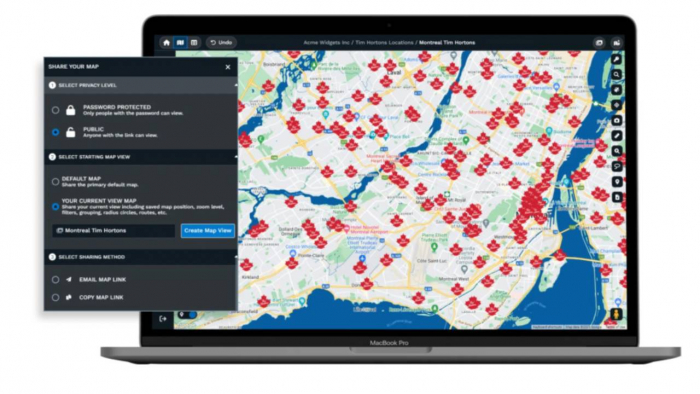
Maptive iQ, which began rolling out to existing customers in March 2025, automates the entire mapping process from data upload to visualization. Users upload Excel or CSV spreadsheets, the software recognizes address columns automatically, geocodes them, and creates interactive maps immediately. This automation eliminates manual workflows that slow down mapping projects.
The system requires no learning curve. First-time users build complex territory maps with custom markers, overlays, and multiple views within minutes. Maptive earned the number one ranking in Best Online Mapping Software according to January 2025 industry reviews. Multiple business technology publications named it Most User-Friendly Location Intelligence Platform in mid-2025. Mapping software surveys published in July 2025 confirm these rankings, with Maptive scoring highest for ease of use and business value delivered.
Processing Power and Data Capacity
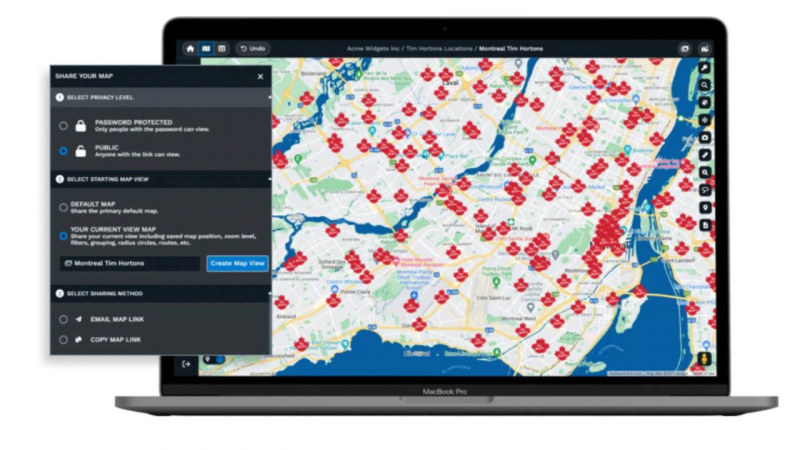
Maptive processes more than 50,000 rows in under 30 seconds without causing browser lockups. The platform maintains consistent speed even when handling maps with over 100,000 locations, plotting entire address databases at a rate of 10 per second. A database of 10,000 customer locations becomes a fully interactive map in approximately 16 minutes.
The technical architecture behind this performance runs three to five times faster than ArcGIS and Mapline when loading complex layers or large CSV files. The platform maintained zero documented major system outages or workflow interruptions in 2025. Support for large data sets has been expanded where up to 100,000 records can be displayed per map, covering needs from enterprise sales to national delivery networks.
White Glove Support That Handles the Work
The customer support model that Maptive provides represents a significant differentiator. White-glove onboarding for larger teams covers setup, training, and workflow consultation. Support adapts to team size and technical level, ensuring everyone gets productive quickly.
Maptive's support goes past basic troubleshooting. The service includes setting up maps, importing and cleaning business data, and making sure the end map is exactly right for the team's use case. Many organizations, including those with limited technical staff, rely on this support to get maps working for immediate needs. Users do not need to spend hours or days fixing files or creating their own map layers because Maptive support staff do these jobs directly.
Support tickets get answered within hours, not days. Live chat connects you directly to mapping experts who know the platform inside out. Real people solve problems in a single conversation. Support is handled by real mapping experts, not bots, no AI, and no scripts. Real mapping professionals understand business needs and can help set up maps, clean data, or build custom maps from scratch. This service is available for all clients with no hidden fees or wait queues.
Route Planning That Cuts Costs
Route optimization features provide substantial business value. Maptive handles 70 stops per route compared to the approximate 50 stops that competitors manage. This capacity allows delivery companies and field service organizations to maximize daily visits while minimizing travel time. The system recalculates routes instantly when adding or removing stops, maintaining optimal efficiency throughout the day. With Maptive's route planning software, you can find the most efficient route between as many as 25 locations and up to 73 stops.
The platform provides real drive-time route optimization that factors actual traffic conditions rather than straight-line distances. Drive-time calculations use 300% more calculation points than earlier software. Users can now plan drive times up to 4 hours with better accuracy. Tests by logistics teams show routing errors drop by about 22% while fuel costs in pilot studies fell as much as 15%.
A field service company saw an 18% drop in fuel costs and a 22% increase in completed service calls after adopting Maptive iQ. A logistics firm processed thousands of routes in seconds, reducing holiday shipping delays by over 40%. Field service providers are cutting fuel costs and boosting the number of service calls thanks to better route planning. Logistics teams report fewer delivery delays even at peak times, linked to improved service area calculations and more reliable travel time mapping.
Territory Tools That Save Hours
Maptive iQ merges the tools used to work with territory boundaries and create regions. The new combined tools let users draw and modify territories with polygons using data from states, counties, or custom sets. Users can add or remove areas with fewer steps. Sales managers can realign their teams or correct boundaries without recoding or starting over.
An entire realignment that once took a full workday now takes a few minutes. After setting new zones, Maptive iQ instantly notifies managers of any changes to assignments or customer groups. This rapid feedback helps test proposed territory splits. The platform provides visual customization tools, direct territory drawing functions, drag-and-drop map editing, undo/redo functionality, and immediate zoom/view saving.
Real-Time CRM Integration
CRM systems now connect to Maptive iQ in real time. Salesforce users can sync data automatically without manual uploads. Work is underway to support other options such as Zoho. As records update in the CRM system, Maptive iQ maps update at the same time. Sales teams and managers see current customer assignments and sales performance by region and can push adjustments across platforms automatically. This limits time spent on duplicate data entry and reduces errors linked to out-of-date maps.
Beta users with Salesforce report that map and data updates synchronize with a lag of under 90 seconds. Other systems like Zoho are planned for support soon. Maptive supports integrations with the most common CRM software including Salesforce, Zoho, Keap, Pipedrive, and HubSpot. If your current CRM is not listed, simply contact Maptive to have the integration set up.
Automated Analysis and Suggestions
Maptive iQ focuses on reducing manual work and speeding up analysis. Automated suggestions and analysis on the screen offer immediate feedback on territory and market changes. The platform includes bulk geocoding, demographic heatmaps, and route optimization for delivery and field teams. Drive time polygons now use more calculation points when measuring service areas, allowing the tool to map areas of up to 4 hours from a location with strong accuracy in multi-hour distances.
The system provides automated territory generation algorithms and demographic overlays for market analysis and expansion planning. Key features include competitive territory management tools that support flexible region management and reduce manual work, even for maps with thousands of records.
Cloud Access and Deployment
Maptive runs entirely through web browsers, eliminating software installation or maintenance tasks. Users access the platform from desktops, tablets, or mobile devices with identical functionality across all platforms. Updates roll out automatically, ensuring all users work with the latest features and bug fixes.
This cloud-based architecture simplifies deployment for distributed teams. New employees gain access immediately without waiting for IT support or software configuration. The platform's web accessibility means field teams can update maps from customer sites and executives can review territory plans during travel.
ArcGIS Online as a Comparison Point
ArcGIS Online serves as Esri's cloud-based GIS solution designed primarily for organizations requiring comprehensive geographic information system capabilities. The platform provides feature layers, data management tools, and collaboration features built on enterprise-grade infrastructure. ArcGIS Online incorporates security standards including FedRAMP authorization for government and enterprise use cases.
Organizations using ArcGIS typically employ the solution for complex spatial analysis projects across urban planning, environmental management, and large-scale government operations. The platform offers extensive learning resources and documentation to support implementation. The technical depth and feature breadth mean organizations often require specialized training and dedicated GIS professionals to maximize platform capabilities. ArcGIS Online operates within the broader Esri ecosystem, providing integration with other Esri products for organizations building comprehensive geographic information infrastructures.
Enterprise Adoption and Proven Results
The largest companies including Fortune 500 names have adopted Maptive for their mapping and planning. Internal testing has proven value for large distributed teams with complex data. Feedback from these firms has helped Maptive refine key features. Support demands from these companies led Maptive to expand white glove support and real-time system improvements that are now available to every customer.
On peer review sites, Maptive earns high satisfaction scores. G2 reviews for Maptive are strong with an average score above 4.5 out of 5. Most reviews mention ease of use, broad map coverage, and fast setup. Reviewers from retail, healthcare, and finance report time savings across territory management, branch planning, and sales routing.
Clients appreciate visualizing data when constructing sales territories, finding the product user-friendly and robust. Another customer reported that Maptive made organizing company territories easy, removing guesswork and making time more effective and efficient. These testimonials represent patterns across industries where users consistently praise Maptive's ability to transform raw data into actionable insights quickly.
Pricing and Trial Access
Maptive's pricing model is flexible. The entry-level $250 plan covers 6 weeks and supports deep feature access. The Pro plan handles large data files and grants unlimited user seats, which is uncommon at this price point. Organizations interested in testing Maptive's capabilities can access a 10-day free trial without providing credit card information. This trial includes all platform features, allowing thorough evaluation before purchase decisions.
Expanding Capabilities
Maptive iQ adds more accurate geographic calculations, boundary merging tools, and integration of point cloud processing for 3D mapping. This expansion increases appeal to construction, urban planning, agriculture, and property management sectors. Enterprise users also have wider options for automated map work. The public API set for wider release soon lets large users automate address lookups and territory assignments at a volume of over 1,000,000 addresses per month.
Market Position and Growth
The location intelligence market size reached approximately $25,000,000,000 in 2025. Multiple research firms project compound annual growth rates between 13% and 17% through 2030. North America dominates with over 32% revenue share driven by strong technology infrastructure and early adoption by Fortune 500 companies. This growth reflects increasing enterprise adoption of spatial analytics for workforce management, asset management, sales optimization, and customer targeting. The global location intelligence sector is growing at a compound annual rate of nearly 17%, driven by the need for faster data-driven choices and the increase in location data from connected devices.
Practical Implementation Wins
The difference between platforms shows most clearly in implementation speed and user independence. Maptive eliminates the gap between data and decision. Teams upload files and see results within minutes. Support staff handle technical barriers before they slow down projects. The platform scales from small business needs to Fortune 500 requirements without requiring users to become mapping specialists.
ArcGIS Online provides depth for organizations that need comprehensive GIS capabilities and can invest in specialized staff and training. Maptive provides speed for organizations that need results now and prefer systems that work immediately. Both platforms serve real needs. The choice depends on how quickly you need maps working and how much technical expertise your team can dedicate to implementation and ongoing management. For most business applications where speed, ease of use, and practical support matter more than academic depth, Maptive delivers measurable results faster.
Post Comment
Be the first to post comment!